Extended Learning
A. Introduction
Congratulations — you have completed all the requirements for the Astronomy merit badge! You can now identify constellations, explain how telescopes work, understand the Moon’s phases and eclipses, and speak knowledgeably about our Sun, planets, and stars. But this is just the beginning. The universe is vast, and there is always more to discover. Here are some deeper dives and resources to fuel your continued exploration.
B. Deep Dive: Choosing Your First Telescope
Buying a telescope is one of the most exciting steps for a new astronomer, but the market is filled with options that can be overwhelming. Understanding a few key principles will help you make a smart choice and avoid common mistakes.
The most important specification is aperture — the diameter of the telescope’s main lens or mirror. Aperture determines how much light the telescope collects and how much detail it can show. A telescope with a 6-inch (150mm) aperture will show you far more than one with a 3-inch (76mm) aperture, regardless of the magnification advertised on the box. Beware of telescopes marketed with high magnification numbers (like “525x power!”) — this is a common sales tactic for low-quality telescopes. High magnification without sufficient aperture produces dim, blurry images.
For a first telescope, consider these three options:
Tabletop Dobsonian (4–6 inch) — An affordable reflector telescope on a simple swivel base. Dobsonians offer the most aperture per dollar and are incredibly easy to use — just push the tube to point where you want and look. They sit on a table or sturdy surface and require almost zero setup. A 6-inch tabletop Dobsonian ($200–$350) will show you lunar craters, Jupiter’s cloud bands and moons, Saturn’s rings, star clusters, bright nebulae, and even nearby galaxies.
Full-size Dobsonian (8–10 inch) — A larger reflector on a floor-standing rocker box. The 8-inch Dobsonian ($300–$500) is widely considered the single best telescope for serious beginners. Its large aperture reveals stunning detail on planets and hundreds of deep-sky objects. The trade-off is size and weight — an 8-inch Dob weighs about 40 pounds and needs a car to transport.
Computerized GoTo Telescope (4–5 inch) — A compound (Schmidt-Cassegrain or Maksutov) telescope on a motorized mount with a built-in database of thousands of objects. Press a button, and the telescope finds the object automatically. These are more expensive ($400–$800+) but incredibly convenient, especially if you have limited dark-sky access and want to spend your time observing rather than hunting.
Avoid department store telescopes with flimsy tripods and plastic eyepieces — they produce frustrating images and often end up collecting dust. Instead, buy from a reputable astronomy retailer or consider a quality used telescope from a local astronomy club.
C. Deep Dive: Navigating with the Stars
Long before GPS, sailors, explorers, and travelers found their way using the stars. Learning celestial navigation connects you to one of humanity’s oldest skills and gives you a backup navigation method that never runs out of batteries.
The most basic celestial navigation technique is finding north using Polaris. Because Polaris sits almost directly above Earth’s North Pole, its height above the horizon equals your latitude. A Scout standing at 40° north latitude will see Polaris 40° above the northern horizon. At the equator, Polaris sits right on the horizon. At the North Pole, it is directly overhead.
Beyond Polaris, you can use the celestial sphere concept. Imagine the sky as a giant dome with Earth at the center. The stars rise in the east and set in the west, just like the Sun. If you face south and watch a star, it will move from left (east) to right (west) across the sky. This east-west motion provides direction even when Polaris is hidden by clouds or terrain.
For more precise navigation, historical navigators used a sextant — an instrument that measures the angle between a celestial object and the horizon. By measuring the altitude of the Sun at local noon, or the altitude of known stars at a known time, a navigator could calculate both latitude and longitude. Sextant navigation was the primary method of ocean navigation from the 1700s until GPS became widespread in the 1990s.
If you earn both the Astronomy and Orienteering merit badges, you will have a powerful combination of celestial and terrestrial navigation skills — the kind of knowledge that builds true self-reliance in the outdoors.
D. Deep Dive: What Hubble and Webb Have Revealed
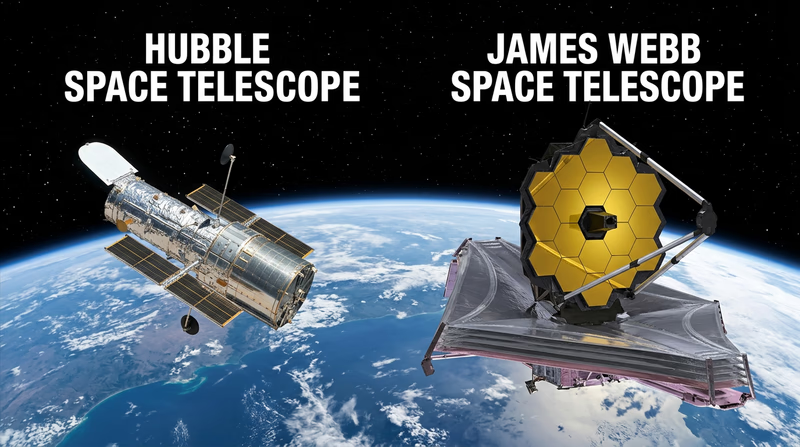
Two space telescopes have transformed our understanding of the universe more than any other instruments in history.
The Hubble Space Telescope, launched in 1990, orbits 340 miles above Earth. Free from atmospheric distortion, Hubble has produced some of the most iconic images in science: the Pillars of Creation in the Eagle Nebula, the Ultra Deep Field (revealing thousands of galaxies in a patch of sky the size of a grain of sand held at arm’s length), and detailed views of planets, nebulae, and galaxies across the observable universe. Hubble observes in visible, ultraviolet, and near-infrared light.
The James Webb Space Telescope (JWST), launched on Christmas Day 2021, is the most powerful space telescope ever built. It orbits nearly a million miles from Earth at a point called L2, where it is shielded from the Sun, Earth, and Moon’s heat. Webb’s 21-foot gold-coated mirror (over 6 times the collecting area of Hubble) observes primarily in infrared light, allowing it to peer through cosmic dust clouds that block visible light, study the atmospheres of planets orbiting other stars, and see galaxies that formed less than 300 million years after the Big Bang.
Together, Hubble and Webb have helped determine the age of the universe (13.8 billion years), confirmed the accelerating expansion of the universe, discovered thousands of exoplanets, and revealed the earliest galaxies ever seen. Their discoveries are freely available — you can browse and download full-resolution images at hubblesite.org and webbtelescope.org.
E. Real-World Experiences
Dark Sky Parks
Star Parties and Astronomy Festivals
NASA Visitor Centers
Major Observatories with Public Programs
Meteor Shower Watching
F. Organizations
The largest federation of amateur astronomy clubs in the United States, offering observing programs, awards, and a network of local clubs.
Works to protect the night sky from light pollution through education, advocacy, and dark-sky place designations.
Coordinates citizen science observations of variable stars, enabling amateurs to contribute to real astronomical research.
The world’s largest space advocacy organization, founded by Carl Sagan. Promotes space exploration, planetary science, and the search for life beyond Earth.
A nationwide coalition of astronomy clubs that bring the wonders of space to the public through events and educational programs.
One of the world’s oldest astronomy organizations, offering resources for both professional and amateur astronomers.