Req 1d — Safe Solar Observation
The Sun is the most spectacular object you can observe, but it is also the most dangerous. The Sun emits intense visible light, ultraviolet radiation, and infrared radiation — all of which can damage your eyes in a fraction of a second if you look at it without proper protection. This is the one area of astronomy where there is absolutely no room for shortcuts or mistakes.
The Golden Rule of Solar Observation
Never look at the Sun with your naked eyes, binoculars, or a telescope without a certified solar filter. This rule has no exceptions. Even during a partial solar eclipse, the remaining sliver of Sun is bright enough to cause permanent retinal damage. Regular sunglasses, stacked sunglasses, smoked glass, exposed film, and CDs are NOT safe solar filters — they let through invisible infrared and ultraviolet radiation that burns your retina.
Safe Methods for Solar Observation
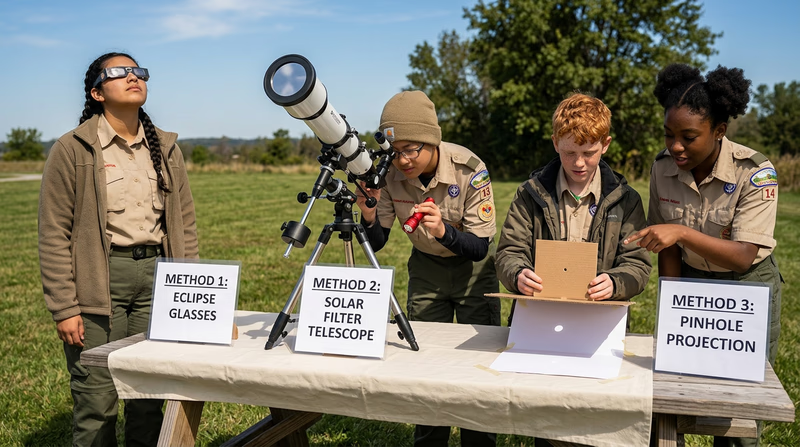
There are several proven, safe ways to observe the Sun. Each method has its advantages:
Eclipse Glasses (ISO 12312-2 Certified) — These special-purpose glasses block 99.997% of visible light and all harmful ultraviolet and infrared radiation. They allow you to look directly at the Sun and see sunspots, eclipses, and planetary transits. Make sure your glasses meet the ISO 12312-2 international safety standard — the certification should be printed on the glasses.
- Inspect glasses before each use. If they are scratched, wrinkled, or more than three years old, discard them.
- Put the glasses on before looking up, and look away before removing them.
- Do NOT use eclipse glasses with binoculars or a telescope — the concentrated light will melt through them.
Solar Telescope Filters — These are special filters that fit over the front of a telescope’s aperture (the big end). They reduce the Sun’s light before it enters the telescope, making it safe to view through the eyepiece. Only use filters specifically designed for your telescope — generic filters can crack from heat and fail without warning.
Solar Projection — This method does not require looking at the Sun at all. Point a telescope or one side of a pair of binoculars at the Sun (without looking through it!) and project the image onto a white card or screen held a foot or so behind the eyepiece. You will see a clear image of the Sun’s disk, including sunspots. This is the safest method and works great for groups because everyone can see the projected image at once.
Pinhole Projection — The simplest method of all. Poke a small hole in a piece of cardboard and hold it so sunlight passes through the hole onto a second piece of white paper. The hole acts like a tiny lens and projects a small image of the Sun. During a partial eclipse, you will see the Moon’s shadow taking a bite out of the Sun’s disk.
Observing Solar Eclipses
A solar eclipse happens when the Moon passes directly between Earth and the Sun, blocking some or all of the Sun’s light. There are three types:
Partial Eclipse — The Moon covers part of the Sun. You MUST use eclipse glasses or another safe solar filter for the entire duration. The exposed portion of the Sun is still dangerously bright.
Annular Eclipse — The Moon is too far from Earth to completely cover the Sun, leaving a bright ring (“annulus”) of sunlight visible. You must use eclipse glasses for the entire event — the ring is still the full intensity of the Sun.
Total Eclipse — The Moon completely covers the Sun’s disk. During the brief period of totality — and ONLY during totality — it is safe to look at the Sun with your naked eyes. You will see the Sun’s corona, a ghostly white halo of superheated gas that is normally invisible. The moment the Sun begins to reappear (called “third contact”), you must immediately put your eclipse glasses back on.
Objects Near the Sun
Planets like Mercury and Venus sometimes appear very close to the Sun in the sky, especially around dawn and dusk. When searching for these objects:
- Never sweep your binoculars or telescope toward the Sun while searching. The Sun could enter your field of view without warning.
- Wait until the Sun is fully below the horizon before scanning that region of the sky.
- Use a planetarium app to know exactly where Mercury or Venus will appear relative to the Sun.
You now have a solid understanding of all the safety fundamentals for astronomy. Next, let’s explore a different kind of threat to stargazing — light pollution.