Req 2 — Light Pollution
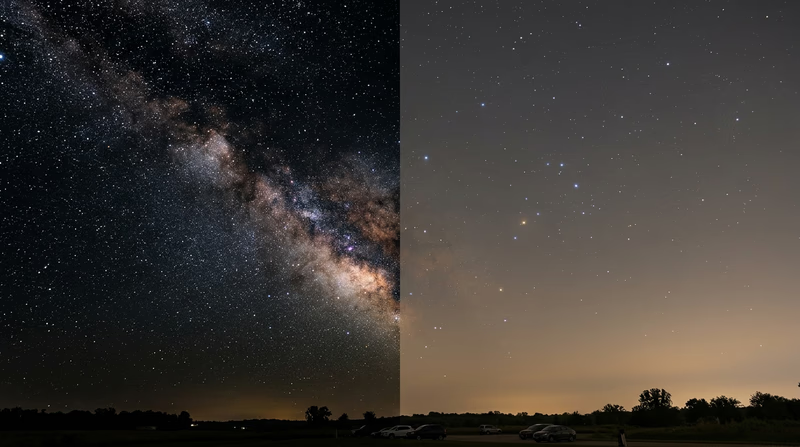
Have you ever looked up at the night sky from a city and wondered where all the stars went? On a truly dark night away from civilization, you can see thousands of stars, the Milky Way stretching across the sky, and faint fuzzy patches that are actually distant galaxies. But from most towns and cities, you might only see a few dozen bright stars. The culprit? Light pollution.
What Is Light Pollution?
Light pollution is excessive, misdirected, or unnecessary artificial light that brightens the night sky and makes it harder to see celestial objects. It comes from streetlights, parking lot lights, building lights, signs, and even the glow from your neighbor’s porch light. When all of this light scatters off particles and moisture in the atmosphere, it creates a dome of brightness over populated areas called skyglow.
There are four main types of light pollution:
- Skyglow — The orange or whitish dome of light visible over cities, sometimes from dozens of miles away. This is the biggest problem for astronomers.
- Glare — Excessive brightness from a light source that causes visual discomfort. An unshielded streetlight blasting light in every direction is a common example.
- Light trespass — Light falling where it is not needed or wanted, like a neighbor’s floodlight shining into your yard or bedroom.
- Clutter — Excessive groupings of lights, like a strip mall with dozens of uncoordinated bright signs, that create confusing and unnecessary brightness.
The Bortle Scale
Astronomers use the Bortle Dark-Sky Scale to rate how dark a location’s sky is, from 1 (the darkest skies on Earth) to 9 (the brightest city centers).
| Class | Description | What You Can See |
|---|---|---|
| 1 | Excellent dark site | The Milky Way casts visible shadows; zodiacal light is brilliant |
| 2 | Typical dark site | The Milky Way is highly structured and detailed |
| 3 | Rural sky | Some light pollution visible on the horizon |
| 4 | Rural/suburban transition | The Milky Way is visible but lacks detail |
| 5 | Suburban sky | The Milky Way is faint and washed out |
| 6 | Bright suburban sky | The Milky Way is only visible near the zenith (straight up) |
| 7 | Suburban/urban transition | The sky has a grayish-white background; Milky Way invisible |
| 8 | City sky | Only the Moon, planets, and a few bright stars visible |
| 9 | Inner-city sky | Only the Moon and planets visible |
How Light Pollution Affects Astronomy
Light pollution does not just hide stars — it makes serious astronomical work much harder:
- Reduces contrast. Faint objects like nebulae, galaxies, and dim stars are washed out by the bright background sky.
- Limits deep-sky observing. Many of the most interesting objects (the Andromeda Galaxy, the Orion Nebula, star clusters) become invisible from light-polluted areas.
- Affects professional observatories. Several major observatories that were built in remote locations decades ago now struggle with encroaching city lights. Some have had to relocate.
- Impacts scientific research. Astronomers studying faint objects need the darkest possible skies. Light pollution reduces the number of usable observing nights.
How Air Pollution Affects Astronomy
Air pollution — smoke, smog, dust, and industrial haze — also degrades the quality of what you can see in the sky.
- Scattering. Particles in the air scatter starlight, making stars appear dimmer and blurrier. This is the same reason sunsets are often more vivid (and redder) over polluted cities.
- Absorption. Some pollutants absorb certain wavelengths of light, changing the apparent color and brightness of celestial objects.
- Poor “seeing.” Astronomers use the word “seeing” to describe how steady and clear the atmosphere is. Air pollution, along with heat and moisture, creates turbulence that makes stars twinkle and telescope images shimmer. Ironically, twinkling stars may look pretty, but to an astronomer they signal poor observing conditions.
- Haze and reduced transparency. On hazy nights, even bright objects appear dimmed. The atmospheric “transparency” — how clearly you can see through the air — drops significantly with pollution.
What You Can Do About Light Pollution
The good news is that light pollution is the most reversible form of pollution. Unlike chemical spills or air pollution, you can fix it instantly by turning off or shielding a light. Here are ways you can help:
- Use shielded outdoor lights at home. Fully shielded fixtures point light downward where it is needed instead of up into the sky.
- Turn off unnecessary lights at night. If you do not need a light on, turn it off.
- Use warm-colored LEDs. Blue-white LEDs scatter more in the atmosphere and create worse skyglow than warm amber lights.
- Support dark-sky initiatives. The International Dark-Sky Association certifies “Dark Sky Parks” and “Dark Sky Communities” that commit to reducing light pollution.
- Educate others. Many people do not realize light pollution is a problem. Share what you have learned.
Now that you understand how light and air pollution affect the sky, let’s learn about the tools astronomers use to see beyond what the naked eye can detect.