Req 3a — Binoculars & Telescopes
Your eyes are amazing instruments — they can detect individual photons of light in ideal conditions. But even the best human eyes have limits. The pupil of your eye opens to about 7 millimeters in the dark, which means it can only collect a small amount of light. Binoculars and telescopes solve this problem by using much larger lenses or mirrors to gather far more light than your eye alone, revealing objects that are too faint, too small, or too distant to see unaided.
Why These Tools Matter
Astronomical optics do three key things:
Light Gathering — This is the most important function. A telescope with a 6-inch (150mm) mirror collects about 450 times more light than your unaided eye. That means objects that are completely invisible to you become clearly visible through the telescope. The bigger the aperture (the diameter of the main lens or mirror), the more light it gathers and the fainter the objects you can see.
Magnification — Telescopes and binoculars make distant objects appear larger and closer. You can see the rings of Saturn, the cloud bands of Jupiter, and craters on the Moon in stunning detail. However, magnification is actually less important than light gathering — a telescope that gathers lots of light at low magnification shows more than one that magnifies a lot but gathers little light.
Resolution — This is the ability to show fine detail and separate objects that are very close together. With good resolution, you can split a point of light that looks like one star into two separate stars, or see the gap in Saturn’s rings. Larger apertures provide better resolution.
Binoculars: Your First Astronomical Tool
Binoculars are described by two numbers, like 7x50 or 10x50:
- The first number is the magnification (7x means objects appear 7 times closer).
- The second number is the aperture in millimeters (50mm is the diameter of each front lens).
For astronomy, bigger aperture matters more than higher magnification. A pair of 7x50 binoculars is an excellent choice because:
- The 50mm lenses gather plenty of light for seeing star clusters, nebulae, and lunar features.
- The 7x magnification is low enough to hold steady by hand (higher magnification amplifies hand shake).
- They provide a wide field of view, making it easy to find objects and sweep across the Milky Way.
How to use binoculars for astronomy:
- Brace your elbows against your body or lean against a solid surface to steady the image.
- For even steadier views, rest the binoculars on a fence post, car roof, or mount them on a tripod with a binocular adapter.
- Start by aiming at the Moon — it is easy to find and the detail will amaze you.
- Slowly scan along the Milky Way to see how it breaks into millions of individual stars.
Telescopes: Reaching Deeper
Telescopes gather far more light than binoculars and can magnify objects much more. A basic telescope with a 4–8 inch aperture will show you:
- Hundreds of craters and mountain ranges on the Moon
- The rings of Saturn and the gap between them (Cassini Division)
- Jupiter’s cloud bands and its four largest moons
- Star clusters with dozens to hundreds of individual stars
- Nebulae — glowing clouds of gas where stars are born
- Galaxies millions of light-years away
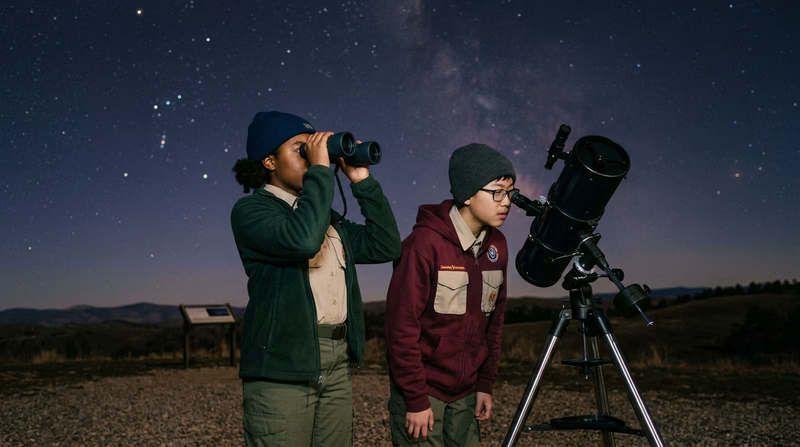
How to use a telescope:
- Set up on level ground. A wobbly telescope is frustrating to use.
- Start with the lowest magnification eyepiece (the one with the highest number, like 25mm). Low magnification gives you a wider field of view, making it easier to find objects.
- Use the finder scope to aim at your target. The finder scope is the small scope mounted on top of the main telescope. Line up the crosshairs on your target, and it should appear in the main eyepiece.
- Focus carefully. Turn the focus knob slowly until the image is sharp. Stars should look like points of light, not fuzzy blobs.
- Increase magnification gradually. Once you have found your target, switch to higher-magnification eyepieces (lower numbers, like 10mm) for a closer view.
- Let the telescope adjust to outdoor temperature. If you bring a telescope from a warm house into cold air, the optics need 15–30 minutes to reach the same temperature as the air. Until then, the image will shimmer and blur.
Next, let’s explore the different types of telescopes and how they work.