Req 3b — Types of Telescopes
Not all telescopes are created equal. Different designs use different methods to collect and focus light, and each type has strengths and trade-offs. Understanding the main types will help you talk knowledgeably about telescopes with your counselor and make smart choices if you ever buy one.
Optical Telescopes
All optical telescopes collect visible light — the same light your eyes can see — and focus it to create a magnified image. There are three main designs:
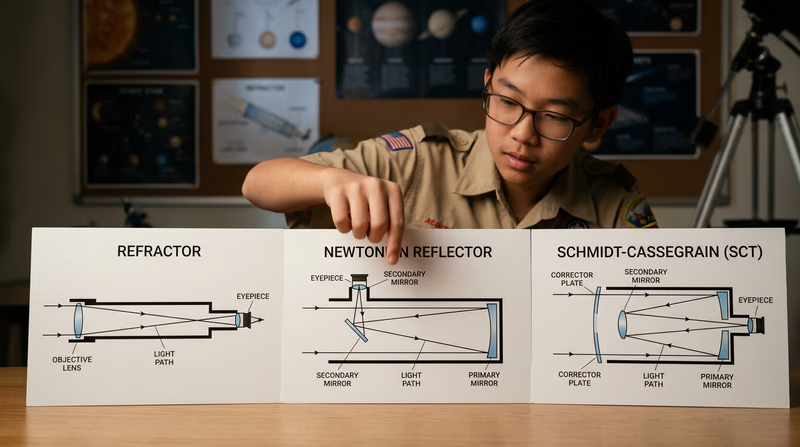
Refractor Telescope — Uses a large glass lens at the front of a tube to bend (refract) incoming light and focus it at the eyepiece at the back. This is the classic telescope shape that most people picture.
- Strengths: Sharp, high-contrast images. Great for the Moon, planets, and double stars. Low maintenance — the sealed tube keeps dust out.
- Weaknesses: Good large lenses are expensive to make. Larger refractors become very long and heavy. They can suffer from “chromatic aberration” — faint color fringes around bright objects caused by different colors of light bending at slightly different angles.
- Best for: Planetary viewing, lunar observation, and beginners who want a low-maintenance scope.
Reflector Telescope (Newtonian) — Uses a curved mirror at the bottom of an open tube to reflect and focus light. A small secondary mirror near the top of the tube bounces the focused light to an eyepiece on the side.
- Strengths: Mirrors are cheaper to make than lenses at large sizes, so you get more aperture for your money. No chromatic aberration. Excellent for faint deep-sky objects.
- Weaknesses: The open tube lets in dust, requiring occasional mirror cleaning. The mirrors need periodic alignment (called “collimation”). The eyepiece position on the side of the tube can be awkward at some angles.
- Best for: Deep-sky observing (galaxies, nebulae, star clusters) and anyone who wants the most aperture on a budget.
Compound (Catadioptric) Telescope — Combines lenses and mirrors in a compact design. The two most common types are the Schmidt-Cassegrain and Maksutov-Cassegrain. Light enters through a thin corrector lens, bounces off a primary mirror at the back, then off a secondary mirror, and finally out through a hole in the primary mirror to the eyepiece at the back.
- Strengths: Very compact and portable for their aperture. Versatile — good for planets, deep-sky objects, and astrophotography. Often come with computerized “GoTo” mounts that find objects automatically.
- Weaknesses: More expensive than reflectors of the same aperture. The secondary mirror blocks some incoming light. Can take longer to cool down to ambient temperature.
- Best for: Observers who want portability and versatility, and those interested in astrophotography.
What They Have in Common
Despite their differences, all three optical telescope types share these features:
- They all collect and focus visible light to create a magnified image.
- They all use eyepieces that can be swapped to change magnification.
- They all need a sturdy mount to keep the image steady.
- The larger the aperture, the more light they gather and the more detail they reveal.
- They all perform best after adjusting to the outdoor temperature.
Beyond Visible Light
Visible light is only a tiny sliver of the electromagnetic spectrum. The universe emits energy across the entire spectrum — from radio waves to gamma rays. Telescopes designed to detect these invisible forms of light reveal aspects of the cosmos that optical telescopes cannot see at all.
Radio Telescopes — These use large dish antennas (some over 300 feet across) to detect radio waves from space. Radio waves pass through clouds and dust that block visible light, so radio telescopes can “see” into the hearts of galaxies and the dense clouds where stars are born. The famous Very Large Array (VLA) in New Mexico uses 27 dish antennas working together to create incredibly detailed radio images. In 2019, a worldwide network of radio telescopes produced the first-ever image of a black hole’s shadow.
Infrared Telescopes — Infrared light is the “heat radiation” just beyond red in the spectrum. Infrared telescopes detect heat from cool objects like dust clouds, newly forming stars, and distant galaxies whose light has been stretched into the infrared by the expansion of the universe. The James Webb Space Telescope (JWST) is the most powerful infrared telescope ever built, orbiting nearly a million miles from Earth to escape our planet’s own infrared glow.
X-ray and Gamma-Ray Telescopes — These detect the most energetic forms of light, emitted by extreme objects like neutron stars, black holes, and supernova explosions. Earth’s atmosphere blocks X-rays and gamma rays (which is good for us!), so these telescopes must operate in space. NASA’s Chandra X-ray Observatory orbits Earth and captures stunning X-ray images of exploding stars and galaxy clusters.
Ultraviolet Telescopes — UV light comes from very hot objects like young stars and active galaxies. Like X-rays, most UV light is absorbed by Earth’s atmosphere, so UV telescopes are usually space-based. The Hubble Space Telescope can observe in ultraviolet, visible, and near-infrared light, making it one of the most versatile observatories ever launched.
Telescopes: Crash Course Astronomy Crash Course video explaining how different types of telescopes work and what they reveal about the universe. Hubble Space Telescope Instruments NASA's guide to the instruments aboard the Hubble Space Telescope.Now let’s look at the instruments astronomers attach to their telescopes to unlock even more information from starlight.