Req 3c — Telescope Instruments
A telescope by itself is just a light-gathering tool. What makes it truly powerful is the instruments astronomers attach to it. These instruments analyze the light in ways that reveal far more than what you can see with your eye alone — the temperature of a star, the composition of a distant galaxy, or the speed at which an object is moving. Here are some of the most important instruments used in astronomy.
Eyepieces
The eyepiece is the most basic and most common telescope instrument. It magnifies the focused image created by the telescope’s main lens or mirror so your eye can see it in detail. Eyepieces are interchangeable — by swapping one eyepiece for another, you change the magnification of the telescope.
Eyepieces are identified by their focal length in millimeters. A longer focal length (like 25mm) gives lower magnification and a wider field of view — great for finding objects and viewing large areas of sky. A shorter focal length (like 10mm) gives higher magnification for detailed views of planets and the Moon.
Different eyepiece designs also offer different fields of view and eye relief (how far your eye can be from the lens and still see the full image). Common designs include Plössl, wide-angle, and ultra-wide-angle eyepieces, each offering trade-offs between cost, sharpness, and viewing comfort.
CCD Cameras and Imaging Sensors
A CCD (Charge-Coupled Device) camera replaces the eyepiece and records the light electronically, creating digital images of celestial objects. Modern CCD and CMOS sensors are far more sensitive than the human eye — they can collect light over minutes or even hours, building up images of objects too faint for any eye to see.
CCD cameras are essential for:
- Astrophotography — Capturing detailed images of galaxies, nebulae, and planets.
- Scientific measurement — Precisely measuring the brightness of stars (photometry), which reveals information about variable stars, eclipsing binaries, and exoplanet transits.
- Discovery — Many asteroids, comets, and supernovae are discovered by amateur astronomers using CCD cameras on their backyard telescopes.
Professional observatories use massive CCD arrays with hundreds of millions of pixels. The camera on the Vera C. Rubin Observatory in Chile will have a 3.2-billion-pixel sensor — the largest digital camera ever built.
Spectrographs
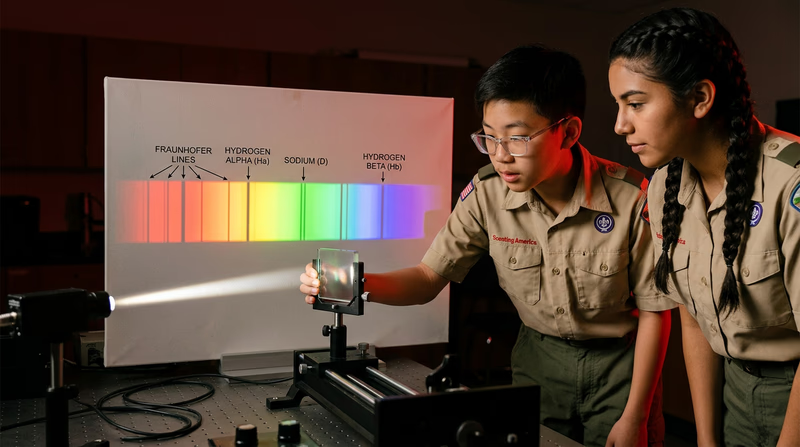
A spectrograph (or spectrometer) is one of the most powerful tools in all of astronomy. It splits incoming light into its individual wavelengths — essentially creating a rainbow from starlight. By studying this rainbow (called a spectrum), astronomers can determine an astonishing amount of information:
- Chemical composition — Every element produces a unique pattern of bright or dark lines in the spectrum, like a fingerprint. By matching these patterns, astronomers can identify exactly which elements are present in a star, nebula, or galaxy.
- Temperature — The overall shape and color of the spectrum reveals the surface temperature of a star.
- Motion — If an object is moving toward or away from us, its spectral lines shift slightly. Lines shift toward blue if the object approaches and toward red if it recedes. This is the Doppler effect, and it is how astronomers measure the speeds of stars, galaxies, and the expansion of the universe itself.
- Density and pressure — The width and shape of spectral lines tell astronomers about conditions in a star’s atmosphere.
Filters
Astronomical filters are precisely manufactured pieces of glass or film that block certain wavelengths of light while allowing others through. They serve different purposes:
- Light-pollution filters — Block the specific wavelengths produced by sodium and mercury streetlights, improving contrast from suburban locations.
- Narrowband filters — Pass only a very narrow range of wavelengths, such as the red light of hydrogen-alpha (Hα) emission. These make it possible to photograph faint nebulae even from light-polluted areas.
- Color filters — Enhance specific features on planets. A blue filter brings out cloud bands on Jupiter. A red filter improves contrast on Mars. A yellow filter sharpens detail on Saturn.
- Solar filters — Block nearly all the Sun’s light, making safe solar observation possible (as discussed in Requirement 1d).
Telescope Mounts
While not an instrument in the traditional sense, the mount is a critical part of any telescope system. There are two main types:
- Alt-azimuth (Alt-az) — Moves up-down (altitude) and left-right (azimuth). Simple and intuitive, but celestial objects drift out of view because the sky rotates at an angle.
- Equatorial — One axis is aligned with Earth’s rotation axis (pointed at the North Star). This lets you track objects across the sky by turning just one axis at a constant rate. Equatorial mounts are essential for long-exposure astrophotography.
Modern GoTo mounts include computers with databases of thousands of celestial objects. You select an object from the handset, and the telescope slews (moves) to point at it automatically. This is incredibly helpful for beginners and experienced observers alike.
What Astronomers Use to Explore the Universe Quick video overview of the key instruments astronomers use to study the cosmos.Now that you know what instruments go on a telescope, let’s learn how to take care of your equipment so it lasts for years.