Req 3d — Care & Storage
Telescopes and binoculars are precision optical instruments. Their lenses and mirrors are ground to incredibly exact shapes — sometimes accurate to within a fraction of a wavelength of light. Proper care protects that precision and ensures your equipment performs well for decades. The good news is that caring for optics is mostly about what you do NOT do.
The Golden Rules of Optics Care
1. Touch the glass as little as possible. Fingerprints leave oils that etch into optical coatings over time. If you accidentally touch a lens or mirror, clean it as soon as possible using proper methods.
2. Keep lens caps on. When you are not actively observing, put the dust caps back on all lenses and eyepieces. This is the single easiest thing you can do to protect your equipment.
3. Let dew dry naturally. After an observing session, dew will often form on your optics. Do NOT wipe wet optics — you will grind dust particles across the surface. Instead, bring the equipment indoors and let it dry on its own with the lens caps off for air circulation.
4. Never disassemble optics. Telescope mirrors and lens assemblies are aligned with extreme precision at the factory. Taking them apart will almost certainly ruin that alignment, and reassembly requires specialized equipment.
Cleaning Optics
Cleaning should be rare — only when debris actually interferes with your view. A few specks of dust on a lens or mirror have virtually no effect on image quality. Aggressive cleaning does more damage than dust ever will.
Optics Cleaning Steps
When cleaning is truly necessary, follow this order
- Blow off loose dust with a hand-squeeze air blower (not canned air, which can leave residue).
- Gently brush remaining particles with a soft camel-hair brush or lens pen brush.
- For stubborn smudges, apply a drop of optical cleaning fluid to a clean microfiber cloth or lens tissue.
- Wipe gently in one direction — never in circles, which can create swirl marks.
- Use a fresh section of the cloth or tissue for each wipe to avoid spreading contaminants.
Storage at Home
Where and how you store your equipment matters just as much as how you handle it.
Telescope Storage:
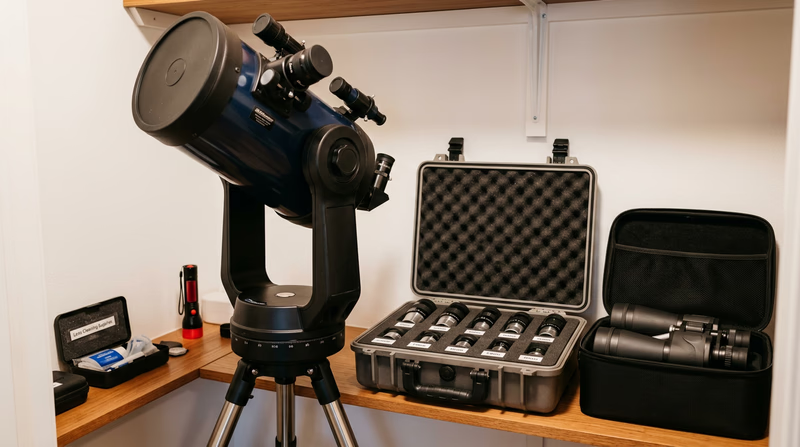
- Store upright or on its mount in a cool, dry area. Avoid attics (extreme heat), basements (dampness), and garages (dust and temperature swings).
- If the telescope came with a case, use it. Otherwise, cover the optical tube with a cloth or fitted cover.
- Store eyepieces in a padded case or pouch with their individual caps on.
- If you have a reflector telescope, store it with the mirror end down so dust settles away from the mirror surface.
- Loosen clamp screws on the mount slightly to relieve tension on the gears during long-term storage.
Binocular Storage:
- Keep binoculars in their case when not in use.
- Store with lens caps on both ends.
- Hang the strap in a way that does not put pressure on the barrels.
- Add a silica gel packet to the case to absorb moisture and prevent fungus growth on internal optics.
Care in the Field
The field — whether it is your backyard, a campsite, or a dark-sky park — presents its own challenges.
Field Care Checklist
Protect your equipment during observation sessions
- Set up on firm, level ground where the telescope will not tip over.
- Keep all equipment cases closed when not retrieving items — dew, dust, and insects get in fast.
- Place eyepieces on a clean towel or in a case, never directly on the ground.
- Use a dew shield (a tube extension) on refractors and compound telescopes to delay dew formation on the front lens.
- If dew forms, use a low-power dew heater strip or simply cap the optics and wait. Do not wipe.
- Keep red-light flashlights handy so you can see your equipment without tripping over it in the dark.
- Watch where you step — tripod legs are invisible in the dark and a collision can send your telescope crashing.
Transporting Equipment
Getting your telescope to a dark-sky site safely requires some thought:
- Use the original packaging or a purpose-built telescope case for car trips.
- Pad the telescope with blankets or foam in the trunk to prevent it from shifting during the drive.
- Remove eyepieces and store them separately — they can work loose and rattle around.
- Never leave a telescope in a hot car. Extreme heat can damage optical coatings and warp plastic components.
- Carry binoculars around your neck or in a padded case, never swinging loosely by the strap.
Excellent — you now have a solid foundation in telescope technology. Let’s head outside and put that knowledge to use by learning the night sky.