Req 4b — Bright Stars
Once you can find constellations, the next step is learning to identify individual stars by name. The brightest stars have been known by name for thousands of years — many of their names come from Arabic, Greek, and Latin. Learning to recognize these stars by sight builds your confidence navigating the sky and helps you find dimmer objects nearby.
Understanding Star Magnitude
Astronomers measure a star’s brightness using a system called apparent magnitude. The scale works backwards from what you might expect:
- Lower numbers = brighter. A magnitude 1 star is bright. A magnitude 6 star is about the faintest you can see with the naked eye.
- Negative numbers = very bright. Sirius, the brightest star in the night sky, has a magnitude of -1.46.
- Each magnitude step is about 2.5 times brighter. A magnitude 1 star is about 2.5 times brighter than a magnitude 2 star, and about 100 times brighter than a magnitude 6 star.
This system was invented by the ancient Greek astronomer Hipparchus around 130 BC. He ranked the brightest stars as “first magnitude” and the faintest visible stars as “sixth magnitude.” Modern astronomers refined the scale but kept his basic idea.
Stars of Magnitude 1 or Brighter
Here are some of the brightest stars in the sky. You need to identify at least five of these:
| Star | Magnitude | Constellation | Season | How to Find It |
|---|---|---|---|---|
| Sirius | -1.46 | Canis Major | Winter | Follow Orion’s Belt down and to the left |
| Arcturus | -0.05 | Boötes | Spring/Summer | Follow the arc of the Big Dipper’s handle (“arc to Arcturus”) |
| Vega | 0.03 | Lyra | Summer/Fall | Brilliant blue-white star nearly overhead in summer |
| Rigel | 0.13 | Orion | Winter | Blue-white star at Orion’s left knee |
| Procyon | 0.34 | Canis Minor | Winter | Forms a triangle with Sirius and Betelgeuse |
| Betelgeuse | ~0.42* | Orion | Winter | Reddish-orange star at Orion’s right shoulder |
| Altair | 0.77 | Aquila | Summer/Fall | Southern point of the Summer Triangle |
| Aldebaran | 0.87 | Taurus | Winter | Reddish-orange star in the V-shape of the bull’s face |
| Antares | 1.06 | Scorpius | Summer | Reddish star in the heart of the Scorpion |
| Spica | 1.04 | Virgo | Spring/Summer | “Arc to Arcturus, speed on to Spica” |
| Pollux | 1.14 | Gemini | Winter/Spring | Brighter of the two “twin” stars |
| Deneb | 1.25 | Cygnus | Summer/Fall | Northern point of the Summer Triangle |
| Regulus | 1.40 | Leo | Spring | Bottom of the “Sickle” pattern in Leo |
*Betelgeuse is a variable star — its brightness changes over time.
Star-Hopping Patterns
The easiest way to find stars is to use patterns that connect them:
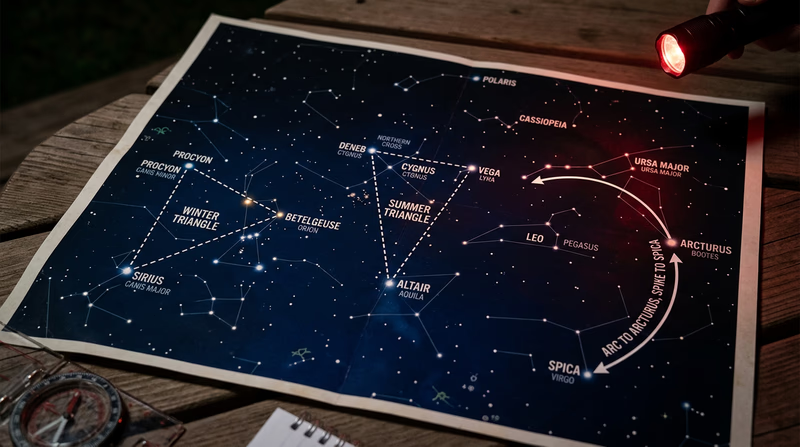
The Winter Triangle — Sirius, Betelgeuse, and Procyon form a large triangle dominating winter evenings. Start with Orion’s Belt, follow it down-left to Sirius, then look to the upper left for Procyon.
The Summer Triangle — Vega, Deneb, and Altair form an enormous triangle overhead on summer nights. Vega is the brightest and appears almost directly overhead. Deneb is to the northeast, and Altair is to the south.
Arc to Arcturus, Speed on to Spica — Follow the curved handle of the Big Dipper in an arc and you will reach the bright orange star Arcturus. Continue that arc in a straight line and you will reach Spica.
Telling Stars Apart
How do you tell one bright dot from another? Here are some clues:
Color — Stars are not all white. Betelgeuse and Aldebaran are distinctly orange-red. Rigel and Vega appear blue-white. Arcturus has a warm golden hue. Star color tells you about the star’s surface temperature — you will learn more about this in Requirement 7c.
Brightness — Compare nearby stars. Sirius is unmistakably the brightest star in the sky. In the Summer Triangle, Vega is noticeably brighter than Deneb.
Position relative to constellations — If you can identify the constellation, the star’s position within it confirms its identity. Regulus is always at the base of Leo’s Sickle. Antares is always in the heart of Scorpius.
Twinkling — Stars twinkle because their light passes through Earth’s turbulent atmosphere. Planets do not twinkle as much because they appear as tiny disks rather than points of light. If a bright “star” shines with a steady light, it might actually be a planet.
Star Magnitude Explained Video explanation of the magnitude system and how astronomers measure star brightness.Ready to put your observation skills into practice? Next, you will sketch the Big Dipper or Cassiopeia and see how the sky moves.