Req 4d — The Milky Way
On a truly dark night, far from city lights, a pale band of light stretches across the sky from horizon to horizon. It looks like a river of soft, glowing clouds — but it is not clouds at all. That glowing band is the Milky Way, and what you are seeing is the combined light of hundreds of billions of stars in our own galaxy, so far away and so densely packed that your eyes blend them into a continuous glow.
Our Galaxy from the Inside
The Milky Way is the galaxy we live in. A galaxy is a vast collection of stars, gas, dust, and dark matter held together by gravity. Our galaxy contains an estimated 100 to 400 billion stars, and our Sun is just one of them.
The Milky Way is a barred spiral galaxy — it has a central bar-shaped core surrounded by sweeping spiral arms that wrap around like a pinwheel. If you could see it from above, it would look like a giant cosmic hurricane made of stars. But we are inside it, roughly two-thirds of the way out from the center, embedded in one of the spiral arms. So instead of seeing a pinwheel, we see the galaxy edge-on — that is why it appears as a band of light stretching across the sky.
Think of it this way: imagine standing inside a huge, flat, round room packed with millions of candles. If you look toward the walls, you see an overwhelming glow of candlelight in every direction along the floor. If you look straight up at the ceiling, you see far fewer candles. That is exactly what happens with the Milky Way — when you look along the plane of the galaxy, you see the combined glow of billions of distant stars. When you look above or below the plane, you see fewer stars and more empty space.
What You See in the Milky Way
Through binoculars, the smooth glow of the Milky Way breaks apart into countless individual stars. You will also notice:
Dark Lanes and Rifts — The Milky Way is not a uniform band of light. It is split and mottled by dark patches and lanes. These are not gaps between stars — they are enormous clouds of interstellar dust that block the light of the stars behind them. The most prominent is the Great Rift, a dark lane that splits the Milky Way from Cygnus to Sagittarius.
Star Clouds — In some areas, especially toward Sagittarius and Scutum, the Milky Way is noticeably brighter. These are star clouds — regions where you are looking through especially dense concentrations of stars in the spiral arms.
The Galactic Center — The brightest, widest part of the Milky Way lies in the direction of the constellation Sagittarius. This is because you are looking toward the center of the galaxy, where stars are packed most densely. The actual center is hidden behind thick clouds of dust, but radio and infrared telescopes can peer through and have revealed a supermassive black hole lurking there.
Nebulae and Star Clusters — Scattered along the Milky Way are glowing nebulae (like the Lagoon Nebula and Eagle Nebula) and dense star clusters. These are regions where new stars are being born from clouds of gas and dust within the spiral arms.
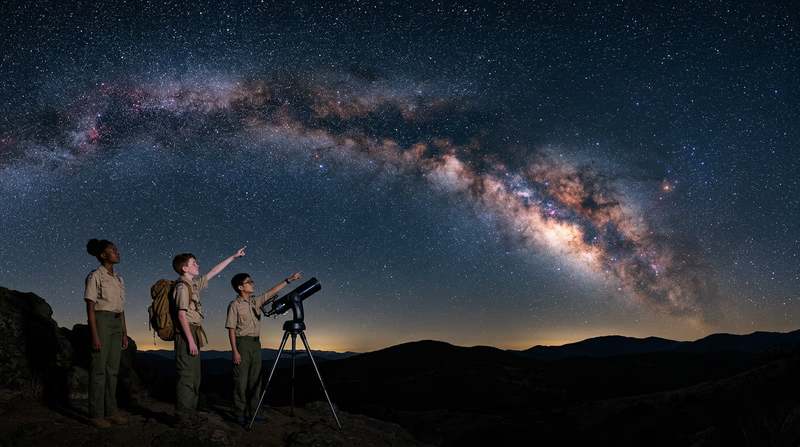
Where and When to See the Milky Way
The Milky Way is visible year-round, but the most spectacular part — the galactic center — is only visible during certain months:
- Best viewing: June through September, when the galactic center in Sagittarius rises high in the sky.
- Best time of night: After astronomical twilight (when the Sun is more than 18 degrees below the horizon).
- Best location: A dark site with a Bortle scale rating of 4 or lower. The Milky Way is invisible from most cities. Even in the suburbs, you may only see the faintest hint.
- Moon matters: Avoid nights near the full Moon, which brightens the sky and washes out the Milky Way.
Our Place in the Galaxy
Here are some key facts about our galaxy and our position within it:
- Diameter: The Milky Way is roughly 100,000 light-years across. A light-year is the distance light travels in one year — about 5.88 trillion miles.
- Our location: The Sun is about 26,000 light-years from the galactic center, in a region called the Orion Arm (or Orion Spur) of the spiral structure.
- Orbital speed: The Sun — and our entire solar system — is orbiting the galactic center at about 515,000 miles per hour. Even at that incredible speed, one orbit takes about 230 million years.
- Nearest large neighbor: The Andromeda Galaxy (M31) is our closest large galactic neighbor, about 2.5 million light-years away. It is actually visible to the naked eye from a dark site as a faint fuzzy patch in the constellation Andromeda.
Now that you have learned to navigate the night sky, it is time to focus on our closest planetary neighbors.