Req 5b — Planet Visibility Chart
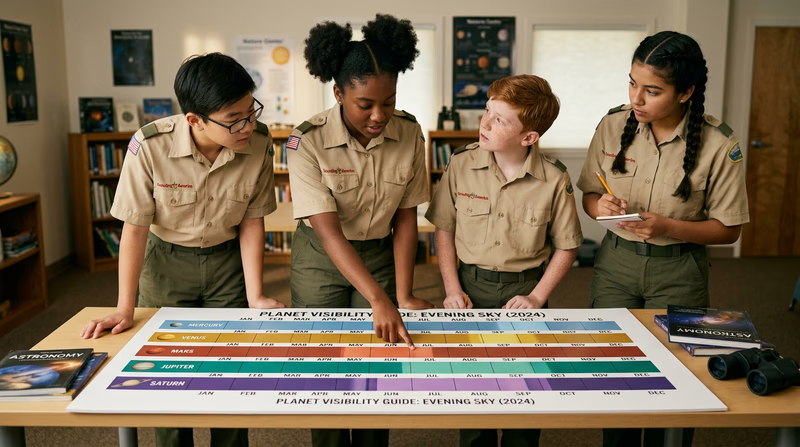
This requirement puts you in the role of a real astronomer — researching, planning, and organizing data about upcoming celestial events. When you are finished, you will have a personalized guide to planet-watching for the next year.
Where to Find Visibility Information
Several reliable websites provide planet visibility data that is updated regularly. Here are the best resources to use:
NASA Skywatching NASA's monthly skywatching guide with planet visibility, meteor showers, and other celestial events. EarthSky — Visible Planets Tonight Updated daily with information about which planets are visible and where to look for them. The Sky Live — Planets Visible Tonight Shows which planets are visible from your location right now, with rise and set times.How to Build Your Chart
Your chart should cover the next 12 months and include the following information for each planet:
Chart Information
What to include for each planet, each month
- Planet name.
- Whether it is visible in the evening sky that month (Yes/No or Evening/Morning/Not Visible).
- Which constellation it appears in.
- Approximate brightness (magnitude) if available.
- Any special events (opposition, conjunction, closest approach).
Here is a suggested format for your chart:
| Month | Mercury | Venus | Mars | Jupiter | Saturn |
|---|---|---|---|---|---|
| Month 1 | Evening/Not visible | Evening (in Pisces) | Morning | Evening (in Taurus) | Evening (in Aquarius) |
| Month 2 | … | … | … | … | … |
Key Planetary Events to Look For
As you research, watch for these special events and note them on your chart:
Opposition — When a superior planet (Mars, Jupiter, or Saturn) is directly opposite the Sun in our sky. At opposition, the planet rises at sunset, is visible all night, and is at its brightest and closest. Oppositions happen roughly once a year for Jupiter and Saturn, and about every 26 months for Mars.
Conjunction — When a planet appears very close to another planet, the Moon, or a bright star. These events are beautiful to observe and photograph.
Greatest Elongation — For Mercury and Venus, this is when they appear farthest from the Sun in our sky, making them easiest to spot. There are “greatest eastern elongation” (visible in the evening after sunset) and “greatest western elongation” (visible in the morning before sunrise).
Inferior Conjunction / Superior Conjunction — When Mercury or Venus passes between us and the Sun (inferior) or behind the Sun (superior). The planet is not visible during these times.
Understanding Why Visibility Changes
Planets are not always visible because they orbit the Sun at different speeds:
- Mercury completes an orbit in just 88 days, so it swings between evening and morning visibility several times a year. It is never visible for more than a few weeks at a time.
- Venus orbits in 225 days and alternates between being a brilliant “Evening Star” for several months and a “Morning Star” for several months.
- Mars orbits in about 2 years, so it spends many months close to the Sun (and invisible) before emerging for several months of visibility around its opposition.
- Jupiter orbits in about 12 years, so it is visible in the evening sky for roughly 6–8 months at a time, shifting to a new constellation each year.
- Saturn orbits in about 29 years, so like Jupiter it is visible for extended periods and moves slowly through the zodiac.
Now let’s explore how planets actually move through the sky — including one very strange trick they seem to play.