Req 5c — Planetary Motion
Planets do not stay in one spot in the sky like stars do. Over weeks and months, they slowly drift through the constellations of the zodiac, following the same general band of sky as the Sun and Moon. But their motion is not as simple as just moving in one direction — planets occasionally do something strange that puzzled astronomers for thousands of years.
The Nightly Motion
On any single night, planets appear to move across the sky from east to west, just like the Sun, Moon, and stars. This is not real motion — it is caused by Earth’s rotation. A planet that rises in the east at sunset will be in the south at midnight and set in the west by dawn. This nightly east-to-west sweep happens to everything in the sky and is not what makes planets special.
The Long-Term Drift
What makes planets different from stars is their motion over weeks and months. If you observe a planet’s position among the background stars night after night, you will see it slowly shift. This is the planet’s real orbital motion as seen from Earth.
Most of the time, planets move eastward (called prograde motion) through the constellations. This makes sense — all planets orbit the Sun in the same direction, and their progress around their orbits is visible as a slow eastward drift against the stars. Jupiter, for example, moves roughly one constellation per year as it completes its 12-year orbit.
Retrograde Motion — The Great Puzzle
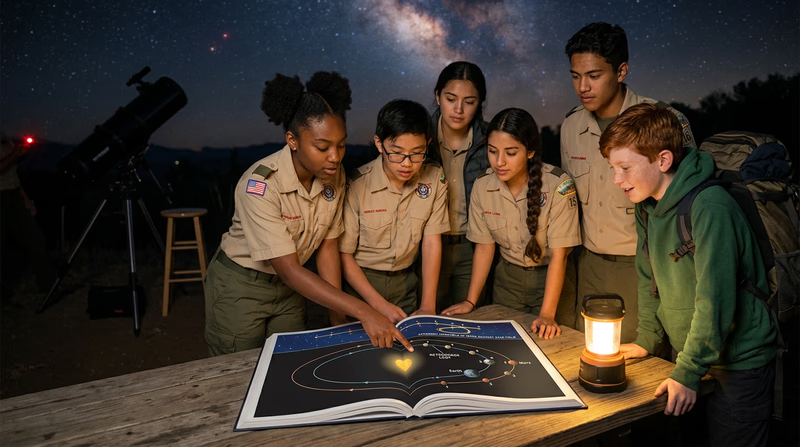
Occasionally, a planet appears to stop its eastward drift, reverse direction, and move westward (called retrograde motion) for several weeks before stopping again and resuming its eastward path. This creates a loop or zigzag pattern against the stars.
Ancient astronomers were baffled by retrograde motion. In the Earth-centered model of the universe, they had to invent complicated systems of circles-within-circles (called epicycles) to explain it. The explanation turned out to be much simpler.
Retrograde motion is an optical illusion caused by Earth overtaking a slower outer planet.
Think of it like passing a car on the highway. When you are far behind the other car, it appears to move forward relative to the distant mountains. As you catch up and pass it, the other car appears to move backward against the mountains — even though it is still going forward. Once you have pulled well ahead, it appears to move forward again.
The same thing happens with planets:
For superior planets (Mars, Jupiter, Saturn): Earth, moving faster in its closer orbit, periodically catches up and passes them. During this time, the outer planet appears to move backward against the stars. Retrograde motion for Mars, Jupiter, and Saturn always happens around opposition (when the planet is opposite the Sun in our sky and closest to Earth).
For inferior planets (Mercury, Venus): These planets orbit faster than Earth and periodically overtake us. When Mercury or Venus is on the near side of the Sun and moving “past” Earth, it appears to move retrograde briefly.
The Ecliptic — The Planetary Highway
All planets orbit the Sun in roughly the same flat plane, like marbles rolling on a tabletop. From Earth, this means planets always appear within a narrow band of sky called the ecliptic. The ecliptic passes through the 12 zodiac constellations, which is why planets are always found in or near a zodiac constellation.
The Moon also follows the ecliptic closely, which is why the Moon, Sun, and planets sometimes appear very close together or even eclipse each other.
Speed Differences
Not all planets move at the same rate:
- Mercury zips through the zodiac in about 3 months per orbit and changes position noticeably from week to week.
- Venus takes about 7.5 months to cross the zodiac and is easy to track over weeks.
- Mars completes the zodiac in about 2 years and moves noticeably from month to month.
- Jupiter takes about 12 years, moving roughly one constellation per year.
- Saturn takes about 29 years, creeping through the zodiac so slowly that it takes 2–3 years to cross a single constellation.
Time to go outside and actually observe a planet for yourself.