Req 5d — Observing a Planet
This is where all your learning comes together — you are going outside and looking at a real planet. Whether you use your naked eyes, binoculars, or a telescope, you will be amazed at what you can see. Here is how to plan a successful planet observation and what to report to your counselor.
Choosing Your Planet
Check your planet visibility chart (from Requirement 5b) or one of the recommended websites to see which planets are currently visible in the evening sky. Here is what each planet looks like:
Venus — The easiest planet to find. Look low in the west after sunset or low in the east before sunrise. It is so bright it is unmistakable. Through a telescope, you can see its phases (crescent, half, full) because it orbits between us and the Sun.
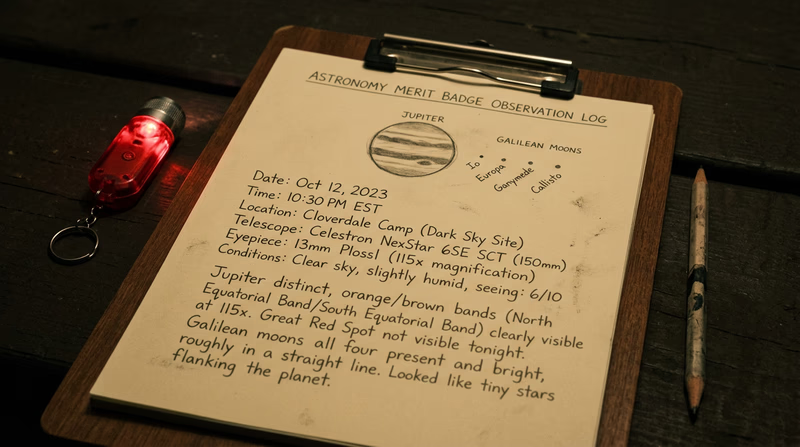
Jupiter — A brilliant, steady white point of light. Through binoculars, you can see up to four tiny dots lined up near it — those are its Galilean moons (Io, Europa, Ganymede, and Callisto). Through a telescope, you can see cloud bands crossing the planet’s disk.
Saturn — A golden point of light, fainter than Jupiter. Even a small telescope at 30x magnification will reveal its rings — one of the most breathtaking sights in astronomy. You may also spot its largest moon, Titan, as a small dot nearby.
Mars — Look for its distinctive orange-red color. During opposition (when Mars is closest to Earth), a telescope may reveal dark surface markings and a bright white polar ice cap. At other times, Mars may be too small and distant to show much detail.
Mercury — The trickiest to observe. It is always close to the horizon and visible only briefly during twilight. Look for it low in the west just after sunset or low in the east just before sunrise during its greatest elongation.
Preparing for Your Observation
Planet Observation Prep
Before heading out
- Check which planets are visible tonight using your chart or an app.
- Note the planet’s approximate location: which direction to look, how high above the horizon, and which constellation it is in.
- Choose a viewing spot with a clear view toward the planet’s direction. Avoid areas with bright lights or tall obstructions.
- If using a telescope, set it up at least 20 minutes early so the optics can cool to the outdoor temperature.
- Bring a notebook and red-light flashlight to record your observations.
What to Record
When you observe your planet, note the following details for your discussion with your counselor:
- Date and time of observation
- Which planet you observed
- Location — where you were observing from
- Direction and height — which direction you were looking and how high above the horizon the planet appeared
- Naked-eye appearance — color, brightness, whether it twinkled or shone steadily
- Telescope/binocular appearance (if used) — any features you could see (moons, rings, phases, cloud bands, surface features)
- Nearby objects — what constellation was the planet in? Were any stars or the Moon nearby?
- Conditions — was the sky clear, hazy, or partly cloudy? Was there much light pollution?
What You Might See with Different Equipment
| Equipment | Venus | Jupiter | Saturn | Mars |
|---|---|---|---|---|
| Naked eye | Brilliant white dot | Bright steady dot | Golden dot | Orange-red dot |
| Binoculars | Visible phase (crescent/gibbous) | 1–4 tiny moons in a line | Slightly elongated shape (rings!) | Small orange disk |
| Small telescope | Clear phase shape | Cloud bands, 4 moons with positions changing nightly | Rings clearly visible, Cassini Division possible, Titan | Surface markings, polar cap at opposition |
You have explored the planets — now let’s turn our attention to Earth’s closest companion in space.