Req 6a — Lunar Seas & Craters
The Moon is the easiest and most rewarding celestial object to observe. Even your naked eyes can see large features on its surface, and binoculars or a small telescope reveal a landscape of stunning detail — craters, mountain ranges, valleys, and vast dark plains. For this requirement, you will sketch the Moon and label some of its most prominent features.
The Dark Patches — Lunar “Seas” (Maria)
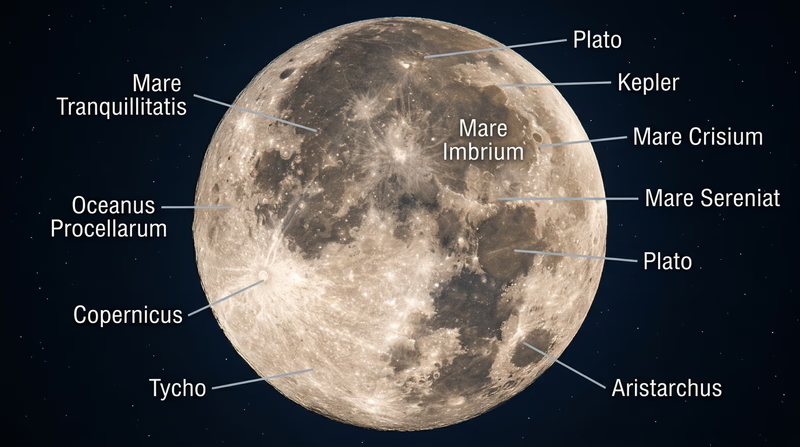
The most obvious features on the Moon are the large, dark, smooth areas visible to the naked eye. Early astronomers thought they were oceans, so they named them “maria” (the Latin plural of “mare,” meaning “sea”). We now know they are not seas at all — they are vast plains of solidified lava that flooded ancient impact basins billions of years ago. The lava cooled into dark basalt rock, which is why they appear darker than the surrounding highlands.
Here are some of the most prominent maria you can identify and label on your sketch:
Mare Tranquillitatis (Sea of Tranquility) — Located in the Moon’s eastern half (right side as you look at it). This is where Apollo 11 landed in 1969, making it the site of the first human footsteps on another world.
Mare Serenitatis (Sea of Serenity) — A roughly circular dark area just north of Mare Tranquillitatis. It is one of the most distinct and easy-to-find maria.
Mare Imbrium (Sea of Rains) — The largest clearly defined mare, occupying a huge area in the upper-left quadrant of the Moon’s face. It is bordered by mountain ranges created by the enormous impact that formed the basin.
Mare Crisium (Sea of Crises) — A dark oval near the Moon’s eastern edge (right side). It stands somewhat alone, making it one of the easiest maria to identify.
Oceanus Procellarum (Ocean of Storms) — The largest dark area on the Moon, sprawling across much of the western (left) side. It is not a single impact basin like most maria but a vast region of lava flows.
Mare Nubium (Sea of Clouds) — A dark area in the southern part of the Moon, below Mare Imbrium.
Mare Fecunditatis (Sea of Fertility) — A large dark area in the southeastern part of the Moon’s face, south of Mare Crisium.
The Bright Spots — Craters
Craters are circular depressions created by the impact of asteroids and comets over billions of years. The Moon has no atmosphere to burn up incoming objects and no weather to erode craters, so impacts from billions of years ago still look fresh. Here are five prominent craters to identify:
Tycho — Located in the Moon’s southern highlands. It is relatively young (85 million years old) and has a dramatic system of bright rays — streaks of ejected material that radiate outward for hundreds of miles. Tycho’s rays are especially visible during the full Moon.
Copernicus — A large, prominent crater near the center of the Moon’s visible face, on the southern edge of Mare Imbrium. It has terraced walls and a system of bright rays, though less extensive than Tycho’s.
Kepler — A bright crater west of Copernicus, also with a ray system. Smaller than Copernicus but easy to spot because of its brightness.
Plato — A dark-floored crater on the northern edge of Mare Imbrium. Its floor was flooded with lava, making it appear smooth and dark compared to the bright, rough highlands around it.
Aristarchus — The brightest spot on the entire Moon. This crater is so reflective that it is sometimes visible on the unlit (earthshine) portion of the Moon. It sits on the western edge of a large plateau.
How to Sketch the Moon
Moon Sketching Steps
Creating your lunar portrait
- Observe the Moon through binoculars or a telescope for the clearest view of features.
- Draw a circle to represent the Moon’s disk.
- Lightly shade in the dark maria areas first — they form the overall pattern you see on the Moon’s face.
- Add major craters as small circles. Note their positions relative to the maria.
- Label at least five seas and five craters with their names.
- The best time to observe detail is during a half Moon (first or last quarter phase), when shadows along the terminator (the line between light and dark) dramatically reveal crater walls and mountain peaks.
Now let’s track the Moon over several nights and watch it change.