Req 6b — Sketching Moon Phases
This requirement asks you to be a careful observer over several nights. By recording the Moon’s phase and position at the same time from the same location, you will see two changes happening at once — the Moon’s shape is changing and its position in the sky is shifting. These changes reveal important clues about the Moon’s orbit around Earth.
Planning Your Observations
Before you start, pick the right week and prepare your approach:
Timing your week: Check a Moon phase calendar to choose a good week. The best period is between the new Moon and full Moon (the waxing phases), when the Moon is visible in the evening sky and its illuminated portion grows each night. The first quarter (half Moon) phase is an excellent midpoint to aim for.
Pick your spot: Choose a location with a clear view of the sky and identifiable landmarks on the horizon — a building, a tree, a hill, or a flagpole. You will include these in every sketch so you can compare the Moon’s position relative to fixed objects.
Same time each night: Observe at the same clock time on each of your four nights. This is important because it lets you see how the Moon’s position shifts from night to night at a consistent time.
What You Will Observe
Over the course of your week, you should notice two things:
1. The phase is changing. Each night, the illuminated portion of the Moon grows (if waxing) or shrinks (if waning). The Moon gains or loses about one-seventh of its full illumination per day, so over four nights you will see a clear change. For example, a thin crescent early in the week may become a fat half Moon by the end.
2. The Moon’s position shifts eastward. If you look at the Moon at the same time each night, it will appear farther east (to the left in the Northern Hemisphere) and higher in the sky than the night before. This is because the Moon orbits Earth from west to east, completing one full orbit in about 29.5 days. Each day, the Moon moves roughly 12–13 degrees eastward against the star background.
Because the Moon moves eastward in its orbit, it also rises about 50 minutes later each day. If you observe at the same time each night, the Moon will have risen 50 minutes later, which means it will be in a slightly different position.
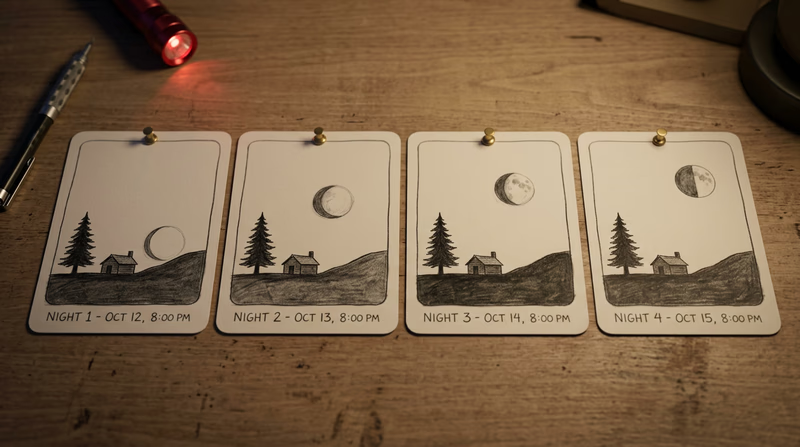
How to Make Your Sketches
For each of your four observation nights:
- Stand in your chosen spot at your chosen time.
- Draw the horizon line across the bottom of your paper, including the same landmarks each night.
- Note where the Moon is relative to those landmarks — how high above the horizon and in which direction.
- Draw the Moon at that position. Show its phase carefully: which side is illuminated and how much of the disk is lit.
- Record the date and time on each sketch.
Moon Sketch Checklist
Include these on every sketch
- Date and time of observation.
- Horizon line with at least 2–3 identifiable landmarks.
- Moon drawn at its correct position relative to the landmarks.
- Moon’s phase shown accurately (which side is lit, how much is lit).
- Direction you are facing (e.g., “Looking South”).
- Any nearby bright stars or planets visible near the Moon.
Explaining the Changes
When you discuss your sketches with your counselor, explain:
- Why the phase changes: The Moon orbits Earth, and as it moves, the angle between the Sun, Moon, and Earth changes. We see different amounts of the Moon’s sunlit side depending on where it is in its orbit. More detail on this comes in Requirement 6d.
- Why the position changes: The Moon orbits Earth in the same direction Earth rotates (eastward), so each night it has moved a little farther in its orbit. At the same clock time, it appears farther east.
- The connection: Both changes — phase and position — are caused by the same thing: the Moon orbiting Earth. As it moves in its orbit, both its position in the sky and the angle of sunlight hitting it change together.
Next, let’s explore the forces that keep the Moon orbiting Earth.