Req 6c — Moon's Orbit
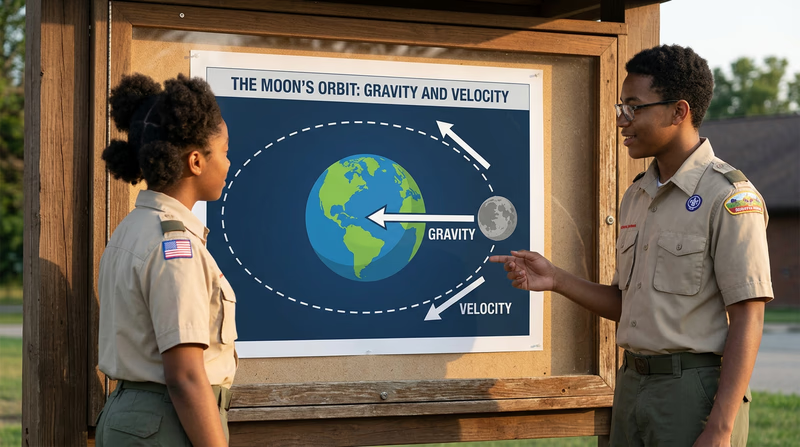
Why does the Moon circle Earth instead of flying off into space or crashing into us? The answer involves a beautiful balance between two factors — gravity pulling the Moon inward and the Moon’s velocity carrying it forward. Together, they create a stable orbit that has lasted for billions of years.
Factor 1: Gravity
Gravity is the force of attraction between any two objects with mass. The more massive an object is, the stronger its gravitational pull. Earth is much more massive than the Moon, so Earth’s gravity constantly pulls the Moon toward it.
Without any other factor, gravity alone would pull the Moon straight into Earth. But the Moon does not fall into Earth because of the second factor.
Factor 2: The Moon’s Orbital Velocity
The Moon is moving sideways — it has a velocity of about 2,288 miles per hour (3,683 km/h) along its orbital path. This sideways motion means the Moon is constantly “falling” toward Earth but also constantly moving forward, so it keeps missing.
Think of it this way: imagine throwing a ball horizontally from the top of a tall building. The ball falls toward the ground (gravity), but it also moves forward (velocity). If you could throw it fast enough — and the Earth’s surface curved away beneath it — the ball would fall around the Earth instead of into it. That is exactly what the Moon is doing. It is perpetually falling toward Earth but moving forward fast enough that Earth’s surface curves away beneath it at the same rate.
The Balance Between Gravity and Velocity
The Moon’s orbit is stable because these two factors are in balance:
- If the Moon moved faster, it would gradually spiral outward and eventually escape Earth’s gravity.
- If the Moon moved slower, gravity would pull it closer and it would eventually spiral inward.
- At its current speed, the inward pull of gravity exactly matches the Moon’s tendency to fly off in a straight line. The result is a nearly circular orbit about 239,000 miles (384,400 km) from Earth.
This balance is not a coincidence — it is a natural outcome of the laws of physics. If the Moon had ever been moving at a speed that did not match gravity’s pull, its orbit would have adjusted over time until it reached a stable configuration or was flung away. Our Moon achieved that stable balance early in the solar system’s history.
Inertia — The Hidden Factor
There is one more concept that ties this together: inertia. Inertia is the tendency of a moving object to keep moving in a straight line at a constant speed unless a force acts on it. This is Newton’s First Law of Motion.
The Moon’s inertia keeps it moving forward in a straight line. Gravity constantly bends that straight-line path into a curve. The combination of straight-line inertia and the curved pull of gravity produces the Moon’s elliptical orbit.
The Orbit Is Not a Perfect Circle
The Moon’s orbit is actually an ellipse (a slightly squished circle). At its closest point to Earth (perigee), the Moon is about 226,000 miles away. At its farthest point (apogee), it is about 252,000 miles away. This difference in distance is why the Moon appears slightly larger and brighter at perigee (sometimes called a “supermoon” in the media) and slightly smaller at apogee.
Summary of Factors
To summarize for your counselor, the Moon stays in orbit because of:
- Gravity — Earth’s gravitational pull constantly attracts the Moon inward.
- Orbital velocity — The Moon’s sideways speed of about 2,288 mph keeps it from falling straight into Earth.
- Inertia — The Moon’s tendency to keep moving in a straight line, as described by Newton’s First Law.
- The balance between these forces — Gravity bends the Moon’s straight-line path into a closed curve (an ellipse), creating a stable orbit.
Now let’s bring everything together by exploring eclipses and the phases of the Moon in detail.