Req 6d — Eclipses & Moon Phases
Understanding the geometry of the Sun, Earth, and Moon is the key to understanding both Moon phases and eclipses. Everything comes down to one simple idea: we see the Moon by reflected sunlight, and the amount of the sunlit side we can see depends on the Moon’s position relative to Earth and the Sun.
The Moon’s Phases
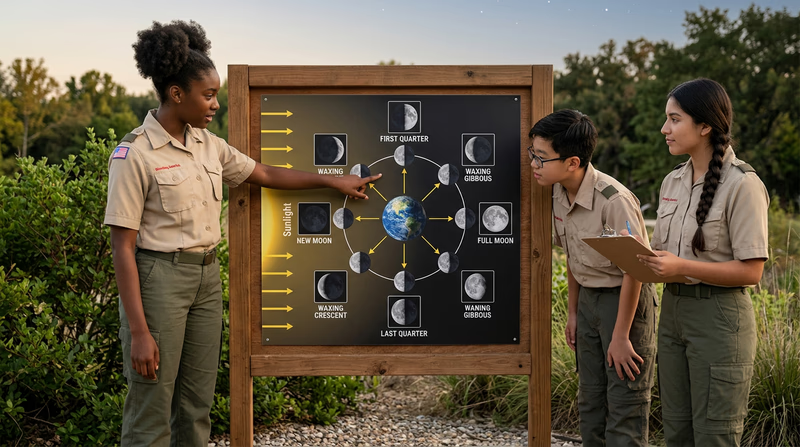
The Moon takes about 29.5 days to orbit Earth (this is called a synodic period or lunar month). As it orbits, the angle between the Sun, Earth, and Moon changes, and we see different amounts of the Moon’s sunlit half. Here are the four primary phases:
New Moon — The Moon is between Earth and the Sun (Sun → Moon → Earth). The sunlit side faces away from us, so the Moon is invisible or nearly invisible. The Moon rises and sets with the Sun, so it is in the daytime sky and cannot be seen at night.
First Quarter (Half Moon) — The Moon is 90 degrees from the Sun (a right angle). We see exactly half of the sunlit side. The Moon rises around noon and sets around midnight, making it visible in the afternoon and evening sky.
Full Moon — Earth is between the Sun and Moon (Sun → Earth → Moon). We see the entire sunlit face. The Moon rises at sunset and is visible all night long. It sets around sunrise.
Last Quarter (Half Moon) — The Moon is 90 degrees from the Sun on the opposite side from the first quarter. Again we see half the sunlit face, but the opposite half is lit. The Moon rises around midnight and is visible in the morning sky.
Between these four phases are the transitional phases: waxing crescent (between new and first quarter), waxing gibbous (between first quarter and full), waning gibbous (between full and last quarter), and waning crescent (between last quarter and new).
Waxing means the lit portion is growing. Waning means it is shrinking.
Why We Do Not Get Eclipses Every Month
If the Moon orbits Earth every 29.5 days, you might wonder: why do we not get a solar eclipse every new Moon and a lunar eclipse every full Moon? The answer is that the Moon’s orbit is tilted about 5 degrees relative to Earth’s orbit around the Sun. Most months, the Moon passes slightly above or below the Sun (at new Moon) or slightly above or below Earth’s shadow (at full Moon).
Eclipses only happen when the Moon crosses the plane of Earth’s orbit (at points called nodes) at exactly the time of new Moon or full Moon. This alignment happens two to five times per year.
Solar Eclipses
A solar eclipse occurs at new Moon when the Moon passes directly between Earth and the Sun, casting a shadow on Earth’s surface.
Position: Sun → Moon → Earth (aligned, with the Moon crossing the orbital plane)
There are three types:
- Total Solar Eclipse — The Moon completely covers the Sun’s disk. Observers in the Moon’s small, dark central shadow (umbra) see the Sun’s corona. The path of totality is narrow — typically only 60–100 miles wide.
- Partial Solar Eclipse — Only part of the Sun is covered. Observers in the Moon’s lighter outer shadow (penumbra) see a partial eclipse.
- Annular Eclipse — The Moon is near apogee (its farthest point from Earth) and appears too small to fully cover the Sun, leaving a bright ring (“annulus”) of sunlight visible.
Lunar Eclipses
A lunar eclipse occurs at full Moon when Earth passes directly between the Sun and Moon, and Earth’s shadow falls on the Moon.
Position: Sun → Earth → Moon (aligned, with the Moon crossing the orbital plane)
There are three types:
- Total Lunar Eclipse — The Moon moves entirely into Earth’s umbra (dark central shadow). The Moon does not go completely dark — instead, it turns a dramatic reddish-copper color because Earth’s atmosphere bends some red sunlight into the shadow. This is sometimes called a “Blood Moon.”
- Partial Lunar Eclipse — Only part of the Moon enters Earth’s umbra. Part of the Moon appears darkened while the rest remains bright.
- Penumbral Lunar Eclipse — The Moon passes through Earth’s faint outer shadow (penumbra). The dimming is subtle and hard to notice with the naked eye.
Comparing Solar and Lunar Eclipses
| Feature | Solar Eclipse | Lunar Eclipse |
|---|---|---|
| Occurs at | New Moon | Full Moon |
| Alignment | Sun → Moon → Earth | Sun → Earth → Moon |
| What is blocked | The Sun’s light is blocked by the Moon | The Moon enters Earth’s shadow |
| Who can see it | Only along a narrow path on Earth | Anyone on the nighttime side of Earth |
| Duration | Totality lasts 1–7 minutes | Totality can last over an hour |
| Safety | Requires solar filters (except during totality) | Safe to watch with naked eyes |
| Frequency | 2–5 per year (at any location, much rarer) | 2–3 per year (visible from half of Earth) |
Now let’s turn from reflected light to the original source — our Sun.