Req 7a — Composition of the Sun
The Sun is the star at the center of our solar system — a massive ball of hot gas (plasma) that produces energy through nuclear fusion. It is the source of almost all light, heat, and energy on Earth. Understanding the Sun helps you understand every other star you see in the night sky, because the Sun is a star, just like those distant points of light, only much closer.
What the Sun Is Made Of
The Sun is composed almost entirely of two elements:
- Hydrogen — About 73% of the Sun’s mass. Hydrogen is the lightest and most abundant element in the universe.
- Helium — About 25% of the Sun’s mass. Helium was actually discovered in the Sun before it was found on Earth (its name comes from “Helios,” the Greek god of the Sun).
- Everything else — About 2%. This includes small amounts of oxygen, carbon, neon, iron, and dozens of other elements.
The Sun generates energy through nuclear fusion in its core, where temperatures reach about 27 million degrees Fahrenheit (15 million degrees Celsius). At these extreme temperatures and pressures, hydrogen atoms are squeezed together so hard that they fuse into helium, releasing enormous amounts of energy in the process. Every second, the Sun converts about 600 million tons of hydrogen into helium — and the “missing” mass is converted directly into energy, following Einstein’s famous equation E = mc².
The Sun’s Structure
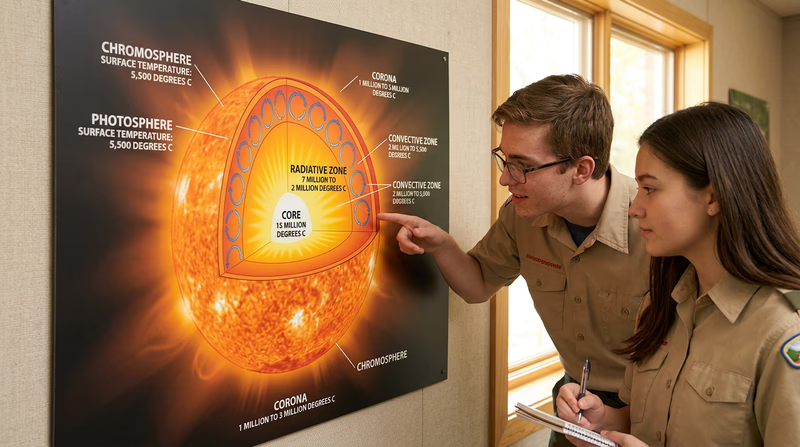
The Sun has several distinct layers:
- Core — Where fusion happens. Temperature: ~27 million °F.
- Radiative Zone — Energy slowly works its way outward through dense plasma. It can take a photon 100,000 years to travel through this zone.
- Convective Zone — Energy rises through churning convection currents, like water boiling in a pot.
- Photosphere — The visible “surface” of the Sun. Temperature: ~10,000 °F. This is what you see (safely, with proper filters!).
- Chromosphere — A thin layer above the photosphere, visible as a reddish glow during total solar eclipses.
- Corona — The Sun’s outer atmosphere, extending millions of miles into space. It is visible as a ghostly white halo during total solar eclipses. Strangely, the corona is far hotter than the photosphere — over 1 million °F — and scientists are still working to fully explain why.
The Sun Among the Stars
The Sun is classified as a G-type main-sequence star (also called a “yellow dwarf,” though it is actually white). It is a very ordinary star — not particularly large, hot, or luminous compared to the full range of stars in the galaxy. This is actually good news for us, because more extreme stars tend to be unstable or short-lived.
- Size comparison: The Sun is about 109 times the diameter of Earth. However, compared to giant stars like Betelgeuse (which is about 700 times the Sun’s diameter) or Rigel (about 79 times), the Sun is modest.
- Temperature comparison: The Sun’s surface temperature of about 10,000 °F (5,500 °C) makes it a medium-temperature star. Blue stars like Rigel are much hotter (over 20,000 °F), while red stars like Betelgeuse are cooler (about 6,000 °F).
- Age: The Sun is about 4.6 billion years old — roughly middle-aged for a star of its type. It has enough hydrogen fuel to last another 5 billion years.
- Luminosity: The Sun is brighter than about 85% of stars in the Milky Way, most of which are small, dim red dwarf stars.
Effects on Earth’s Weather
The Sun drives virtually all weather on Earth:
- Heating the atmosphere — Solar radiation heats Earth’s surface unevenly (more at the equator, less at the poles), creating temperature differences that drive wind patterns, ocean currents, and storm systems.
- The water cycle — Solar energy evaporates water from oceans and lakes, which rises as water vapor, forms clouds, and falls as rain or snow. Without the Sun, there would be no water cycle and no weather.
- Seasonal changes — Earth’s tilted axis means different hemispheres receive more or less direct sunlight throughout the year, creating seasons. This tilt — not our distance from the Sun — is why we have summer and winter.
Effects on Communications
The Sun also affects Earth’s technology, especially during periods of high solar activity:
- Solar flares — Sudden bursts of energy from the Sun’s surface can release intense radiation that reaches Earth in minutes. This radiation can disrupt high-frequency radio communications, especially those used by airlines and military.
- Coronal mass ejections (CMEs) — Massive clouds of charged particles ejected from the Sun. When they hit Earth’s magnetic field (1–3 days after leaving the Sun), they can cause geomagnetic storms that disrupt GPS signals, damage satellites, and even overload power grids.
- The ionosphere — Solar UV and X-ray radiation creates a layer of charged particles (the ionosphere) high in Earth’s atmosphere. Radio signals bounce off this layer, enabling long-distance radio communication. Changes in solar activity alter the ionosphere and can improve or degrade radio reception.
- Aurora — When charged particles from the Sun interact with Earth’s magnetic field, they produce the Northern Lights (Aurora Borealis) and Southern Lights (Aurora Australis) — beautiful curtains of colored light in the polar skies. During strong solar storms, aurorae can be visible from much lower latitudes.
Next, let’s zoom in on one of the most interesting features on the Sun’s surface — sunspots.