Req 7b — Sunspots
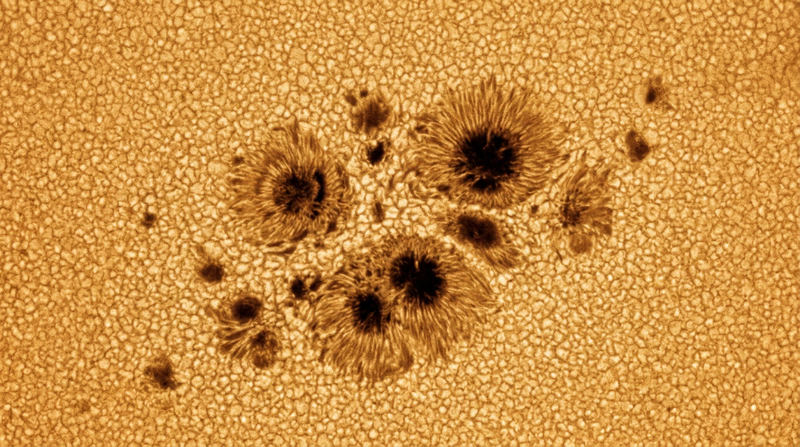
If you safely observe the Sun through a solar filter or by projection (as described in Requirement 1d), you may notice dark patches on its surface. These are sunspots — one of the most fascinating and important features of solar astronomy.
What Are Sunspots?
Sunspots are temporary regions on the Sun’s photosphere (visible surface) that appear darker than the surrounding area. They are caused by intense magnetic activity that inhibits convection — the normal process of hot gas rising to the surface. Because the magnetic field suppresses this flow, the sunspot region is cooler than the surrounding photosphere.
A typical sunspot has two parts:
- Umbra — The dark center, with a temperature of about 6,500 °F (3,600 °C).
- Penumbra — A lighter, striated halo surrounding the umbra, with temperatures between the umbra and the normal photosphere.
Despite appearing dark, sunspots are still incredibly hot and bright — they only look dark by contrast with the even brighter photosphere around them (which is about 10,000 °F). If you could isolate a sunspot and view it against the black sky, it would still be blindingly bright.
Sunspots can be enormous. A single sunspot can be larger than Earth, and sunspot groups can stretch across hundreds of thousands of miles of the Sun’s surface.
The Solar Cycle
Sunspot numbers are not constant — they rise and fall in a roughly 11-year cycle called the solar cycle (or sunspot cycle):
- Solar Minimum — The Sun has very few sunspots (sometimes none). Solar activity is quiet.
- Solar Maximum — The Sun is covered with sunspot groups, and solar activity (flares, CMEs) is at its peak.
The current solar cycle (Cycle 25) began around December 2019. Scientists track the number and size of sunspots to predict solar activity and its effects on Earth.
Effects on Solar Radiation
Sunspots themselves are cooler and emit less light than the surrounding photosphere. However, paradoxically, the Sun is actually slightly brighter overall during solar maximum (when sunspots are numerous). This is because sunspot regions are surrounded by bright areas called faculae that emit extra radiation, more than compensating for the dark spots.
More importantly, sunspots are associated with several types of energetic events that significantly affect solar radiation:
Solar Flares — Sudden, intense bursts of electromagnetic radiation (light, UV, X-rays) from the Sun’s surface, often originating near sunspot groups. Flares can increase the Sun’s X-ray output by a factor of 1,000 or more for brief periods. The radiation reaches Earth at the speed of light (about 8 minutes), and can:
- Disrupt shortwave radio communications
- Cause radio blackouts on the sunlit side of Earth
- Increase radiation exposure for astronauts and high-altitude aircraft passengers
- Temporarily alter Earth’s ionosphere
Coronal Mass Ejections (CMEs) — Massive eruptions of magnetized plasma from the Sun’s corona, often associated with sunspot regions. CMEs travel through space at 1–5 million miles per hour and can reach Earth in 1–3 days. When they interact with Earth’s magnetic field, they can:
- Trigger geomagnetic storms
- Damage satellites and spacecraft electronics
- Induce electrical currents in power grids, potentially causing blackouts
- Produce spectacular aurora displays at unusually low latitudes
Increased UV Output — During solar maximum, the Sun’s ultraviolet radiation output increases by up to 10%. While this is a small percentage change, UV radiation has significant effects on Earth’s upper atmosphere, ozone layer, and atmospheric chemistry.
Historical Effects of Solar Activity
Some of the most dramatic effects of sunspot-related solar activity include:
- The Carrington Event (1859) — The most powerful geomagnetic storm ever recorded. A massive CME hit Earth, causing telegraph systems worldwide to spark and catch fire. If a similar event happened today, it could cause trillions of dollars in damage to power grids and satellites.
- The Halloween Storms (2003) — A series of powerful solar flares and CMEs disrupted GPS systems, forced airlines to reroute flights away from the poles, and caused a power blackout in Sweden.
- Space weather monitoring — Today, NASA and NOAA continuously monitor the Sun for potentially dangerous solar activity and issue warnings to protect satellites, power grids, and astronauts.
Now let’s look at something you can observe with just your eyes — the different colors of stars and what they tell us.