Req 7c — Star Colors
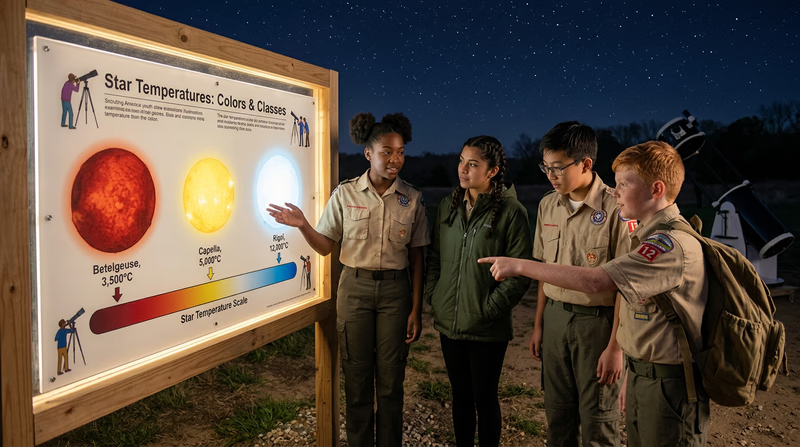
Look carefully at the stars on a clear night and you will notice they are not all the same color. Some glow warm orange-red, others shine bright white, and a few blaze blue-white. These colors are not random — they tell you something fundamental about each star: its surface temperature.
What Star Colors Mean
Star color is directly related to surface temperature:
- Blue and blue-white stars are the hottest, with surface temperatures of 18,000–50,000+ °F (10,000–30,000+ °C). They burn through their fuel very fast and live relatively short lives (millions of years).
- White stars have temperatures of about 13,000–18,000 °F (7,000–10,000 °C).
- Yellow-white and yellow stars (like the Sun) have temperatures of about 9,000–13,000 °F (5,000–7,000 °C). They are middle-of-the-road stars with long, stable lifetimes (billions of years).
- Orange stars have temperatures of about 6,500–9,000 °F (3,500–5,000 °C).
- Red stars are the coolest visible stars, with surface temperatures of 3,500–6,500 °F (2,000–3,500 °C). They can be either small, dim red dwarfs (the most common type of star) or enormous, bloated red supergiants near the end of their lives.
This relationship between color and temperature works just like heating a piece of metal. If you heat iron, it first glows dull red, then orange, then yellow, then white, and eventually blue-white as it gets hotter and hotter. Stars follow the same physics.
Astronomers classify stars by their color/temperature using a system of spectral types: O (hottest/blue) → B → A → F → G → K → M (coolest/red). The Sun is a G-type star.
Stars to Identify
Here are excellent examples of each color that you can find in the night sky:
Red Stars
Betelgeuse (in Orion) — A red supergiant at Orion’s upper-left shoulder. Its reddish-orange color is easy to see with the naked eye. Betelgeuse is enormous — if placed at the center of our solar system, it would extend past the orbit of Jupiter. It is near the end of its life and will eventually explode as a supernova.
Antares (in Scorpius) — The “heart of the Scorpion.” Its name literally means “rival of Mars” (anti-Ares) because its red color resembles the Red Planet. Antares is another red supergiant, about 700 times the diameter of the Sun. Best seen in summer.
Aldebaran (in Taurus) — An orange-red giant star that marks the bull’s eye. While not as red as Betelgeuse, its warm color is clearly visible. Best seen in winter.
Blue Stars
Rigel (in Orion) — A brilliant blue-white supergiant at Orion’s lower-right knee. Rigel is one of the brightest stars in the sky and about 120,000 times more luminous than the Sun. Compare its color directly to Betelgeuse — they are in the same constellation, making the contrast obvious.
Spica (in Virgo) — A hot blue-white star about 12,000 times more luminous than the Sun. Best seen in spring and early summer.
Vega (in Lyra) — One of the brightest stars overhead during summer, with a distinctive blue-white color. Vega was the first star (other than the Sun) to be photographed and the first to have its spectrum recorded.
Yellow Stars
Capella (in Auriga) — A brilliant golden-yellow star, the sixth-brightest in the night sky. It is actually a system of four stars, but the two dominant ones are both yellow giants similar in temperature to our Sun but much larger. Best seen in winter and spring.
Pollux (in Gemini) — An orange-yellow giant star, the brighter of the two “twin” stars in Gemini. Its warm golden hue is easy to see. Best seen in winter.
Alpha Centauri A — The brightest component of the nearest star system to our Sun. It is a yellow star very similar to our Sun in temperature and color. However, it is only visible from the southern United States and points farther south.
How to See Star Colors
Star colors are subtle — your eyes need to be dark-adapted, and you need to know where to look:
- Compare side by side. The easiest way to see color is to compare two stars. Look at Betelgeuse and Rigel in Orion — the red-orange vs. blue-white contrast is dramatic.
- Use binoculars. Binoculars gather more light than your eye and make star colors more vivid.
- Slightly defocus. If you deliberately defocus your binoculars slightly, stars become small colored disks instead of points, making colors easier to see.
- Avoid light-polluted skies. Light pollution washes out the subtle colors of fainter stars.
You have completed the core knowledge requirements. Now it is time for the most exciting part — choosing a hands-on astronomy project.