Req 8 — Choose Your Adventure
This is your chance to go beyond learning about astronomy and actually do astronomy. You will choose one of six hands-on projects, each offering a different way to engage with the night sky. Read through all the options, pick the one that excites you most, and get your counselor’s approval before you begin.
Remember: you only need to complete ONE of these options.
Option A: Visit a Planetarium or Observatory
A planetarium projects a realistic night sky onto a domed ceiling, letting you learn constellations and celestial events in a comfortable setting. An observatory houses real telescopes used for observation and research. Many observatories have public viewing nights.
Report Checklist
What to include in your report, scrapbook, or video
- The name and location of the facility you visited.
- What activities were going on (public viewing, show, lecture, research).
- What exhibits or displays you saw and what you learned from them.
- What telescopes and instruments you saw, including their type and size.
- What celestial objects you observed (if applicable) and what they looked like.
- Your personal highlights — what surprised or excited you most.
Option B: Extended Observation Session
This option is for Scouts who want to go deeper into observing. You will plan a session targeting at least 10 objects you have not yet observed for this badge.
Great objects to target:
- Messier objects — Charles Messier cataloged 110 deep-sky objects including nebulae, star clusters, and galaxies. Many are visible with binoculars or a small telescope:
- M31 (Andromeda Galaxy), M42 (Orion Nebula), M45 (Pleiades), M13 (Hercules Cluster), M44 (Beehive Cluster)
- Double stars — Stars that appear close together, like Albireo in Cygnus (a beautiful gold and blue pair through a telescope)
- Lunar features — Craters, mountains, and rilles beyond the five you identified in Req 6a
- The International Space Station — Track it at spotthestation.nasa.gov
Option C: Host a Star Party for Your Troop
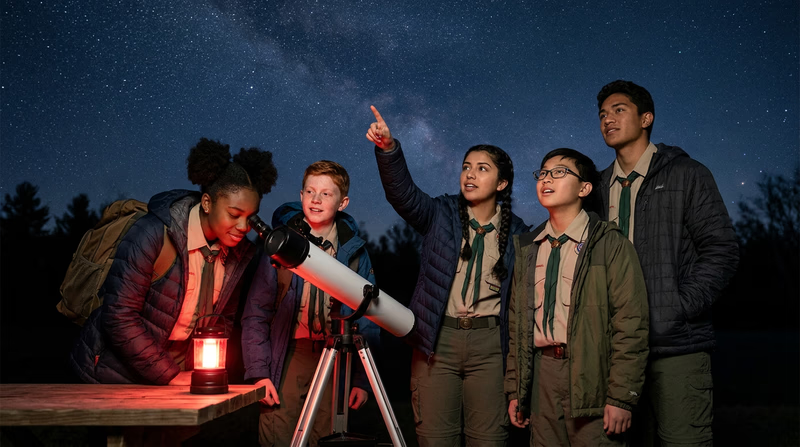
A star party is an event where you invite others to observe the sky with you. Hosting one means you are the guide — sharing your knowledge and excitement about astronomy.
Star Party Planning
Steps to a successful event
- Choose a date near new Moon for the darkest skies.
- Pick a location away from bright lights with a clear view of the sky.
- Check the weather forecast and have a rain date.
- Plan 3–5 objects to show your group (the Moon, a planet, a star cluster, and a bright double star are great choices).
- Practice finding your targets before the event.
- Prepare brief explanations for each object — share interesting facts.
- Remind attendees to bring warm clothing and use red-light flashlights.
- Consider having a star chart or app demonstration to start the evening.
Option D: Help an Astronomy Club Star Party
Local astronomy clubs regularly host public star parties where experienced members share their telescopes and knowledge with the community. Volunteering with a club lets you learn from experienced astronomers while helping introduce others to the sky.
How to find a club:
- Search for “astronomy club” + your city or state online
- Check the Astronomical League’s member club directory at astroleague.org
- Ask at your local planetarium, science museum, or library
How you can help:
- Set up and take down telescopes and equipment
- Guide visitors to viewing stations
- Help explain what people are looking at
- Manage lines and answer basic questions
- Distribute star charts or handouts
Option E: Astrophotography Project
This option combines astronomy with photography. You will document the movement of a celestial object over time and create a visual display.
Suggested projects:
- Moon movement: Photograph the Moon at the same time several nights in a row to show its changing phase and position.
- Planet tracking: Photograph a bright planet’s position among the stars over several weeks.
- Meteor shower: Set up a camera on a tripod during a meteor shower and capture streaks of light.
Option F: Online Observing
Several programs let you control real, professional-grade telescopes remotely through the internet. This is an incredible opportunity — you can observe objects that might be impossible from your location due to weather, light pollution, or geographic limitations.
Online observing resources:
Skynet Robotic Telescope Network University of North Carolina's network of robotic telescopes available for educational use. Request observations of galaxies, nebulae, and more. MicroObservatory — Harvard Free robotic telescopes operated by Harvard-Smithsonian Center for Astrophysics, designed for students.Which Option Should You Choose?
| Option | Best for… | Requires… |
|---|---|---|
| A — Planetarium/Observatory | Learning from experts, seeing professional equipment | Access to a facility, travel |
| B — Extended Observation | Going deeper into observing, building skills | Binoculars or telescope, dark sky |
| C — Host Star Party | Sharing knowledge, leadership practice | Equipment, a group to invite |
| D — Help Club Star Party | Learning from experienced astronomers | Finding a local club |
| E — Astrophotography | Photography enthusiasts, visual learners | Camera (smartphone works!), patience |
| F — Online Observing | Areas with bad weather or light pollution | Internet access, parent permission |
Talk with your counselor about which option works best for your situation, interests, and available resources.
You are almost done. One more requirement to go — exploring astronomy as a career or hobby.