Req 9 — Astronomy Careers or Hobbies
This final requirement asks you to think about how astronomy could fit into your future — either as a career or as a lifelong hobby. You only need to complete ONE of the two options below.
Option A: Astronomy Careers
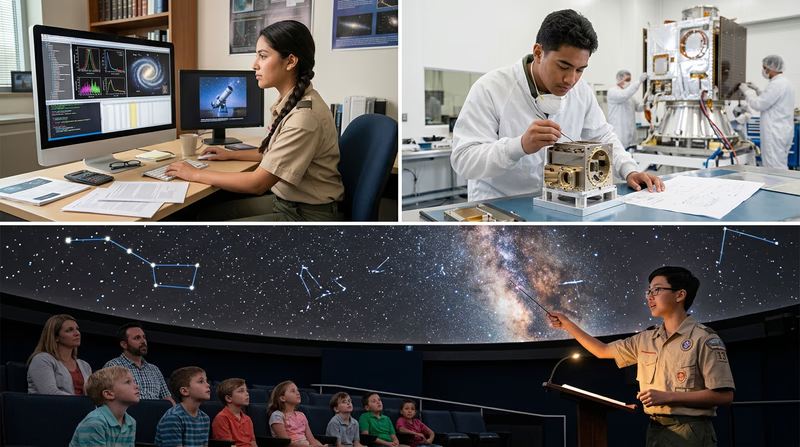
Astronomy opens doors to many career paths — not just “astronomer.” The skills you develop in astronomy (observation, data analysis, math, physics, problem-solving, and technical writing) are valuable across many fields.
Career paths to consider:
Astronomer / Astrophysicist — Research scientists who study celestial objects, develop theories about the universe, and analyze data from telescopes and space missions. They typically work at universities, research institutions, or government agencies like NASA or the National Science Foundation.
- Education: Ph.D. in astronomy, astrophysics, or physics (typically 5–7 years after a bachelor’s degree).
- Key skills: Advanced mathematics, physics, computer programming, data analysis.
- Starting salary: $60,000–$80,000 for postdoctoral positions; $90,000–$120,000+ for faculty positions.
- Outlook: Competitive but growing, especially in data science applications.
Aerospace Engineer — Designs spacecraft, satellites, telescopes, and instruments used in space exploration. Aerospace engineers apply physics and engineering to build the hardware that makes space science possible.
- Education: Bachelor’s degree in aerospace engineering, mechanical engineering, or physics. Master’s degree helpful for advanced positions.
- Key skills: Mathematics, physics, computer-aided design, materials science.
- Starting salary: $75,000–$95,000.
- Outlook: Strong demand, especially with growing commercial space industry.
Planetarium Director / Educator — Develops and presents astronomy programs for the public, manages planetarium facilities, and creates educational content. This career combines astronomy knowledge with communication and teaching skills.
- Education: Bachelor’s degree in astronomy, physics, education, or science communication. Master’s degree preferred for director roles.
- Key skills: Public speaking, multimedia production, curriculum design, astronomy knowledge.
- Starting salary: $40,000–$60,000 for educators; $60,000–$90,000 for directors.
Data Scientist (Astronomy Applications) — Analyzes massive datasets from telescopes and space missions. Modern astronomy generates enormous amounts of data — more than humans can review — so data scientists create algorithms to find patterns, classify objects, and make discoveries.
- Education: Bachelor’s or master’s degree in computer science, statistics, physics, or data science.
- Key skills: Programming (Python, SQL), machine learning, statistics, visualization.
- Starting salary: $80,000–$110,000.
Science Journalist / Writer — Translates complex astronomical discoveries into stories that the public can understand and get excited about. Works for media outlets, science publications, museums, or as freelancers.
- Education: Bachelor’s degree in journalism, science communication, or a science field.
- Key skills: Writing, interviewing, research, understanding scientific concepts.
- Starting salary: $40,000–$60,000.
Option B: Astronomy as a Hobby
Astronomy is one of the most accessible and rewarding hobbies in the world. You can start with nothing more than your eyes and a curiosity about the sky, and over time build a sophisticated personal observatory in your own backyard. Here are some hobby paths to explore:
Visual Observing — The traditional approach: you and a telescope under a dark sky. Many amateur astronomers work through observing programs like the Astronomical League’s Messier Certificate, which challenges you to find all 110 Messier objects. It is a lifelong pursuit that gets richer with experience.
- Startup cost: $200–$500 for a quality beginner telescope; $0 if you start with binoculars you already own.
- Ongoing costs: Star charts, eyepieces, travel to dark sites, astronomy club dues ($20–$50/year).
Astrophotography — Capturing images of celestial objects with cameras, from simple smartphone Moon shots to deep-sky images that rival professional observatories. This hobby blends technical skills (optics, image processing, equipment setup) with artistic vision.
- Startup cost: $0 (smartphone + tripod) to $2,000+ (dedicated camera, tracking mount, telescope).
- Ongoing costs: Software subscriptions, equipment upgrades, travel.
Citizen Science — Contributing to real scientific research. Programs like Galaxy Zoo, Planet Hunters, and the American Association of Variable Star Observers (AAVSO) let amateur astronomers contribute to real discoveries from their own observations.
- Startup cost: $0 for online programs; same as visual observing if doing your own observations.
- Ongoing costs: Minimal.
Outreach and Education — Sharing your knowledge with others by volunteering at public star parties, teaching astronomy classes, or mentoring younger Scouts. Many astronomy clubs have active outreach programs.
Getting Started as a Hobbyist
Short-term and long-term goals to discuss with your counselor
- Short-term: Join a local astronomy club and attend a meeting or star party.
- Short-term: Download a planetarium app and learn 20 constellations.
- Short-term: Save for and purchase a pair of 10x50 binoculars.
- Medium-term: Complete an observing program (like the Astronomical League’s Constellation Hunter list).
- Medium-term: Purchase a telescope and learn to use it confidently.
- Long-term: Build a personal observatory or permanent observing setup.
- Long-term: Contribute to a citizen science project or mentor new observers.
Congratulations — you have worked through all nine requirements! Head to the Extended Learning section for resources that will help you continue your astronomical journey.