Extended Learning
A. Introduction
Congratulations — you have completed the requirements for the Athletics merit badge! You have built a training program, learned about safety and nutrition, explored the rules and spirit of fair play, and pushed your body to improve across multiple athletic activities. But this is just the starting line. The world of athletics is enormous, and there is so much more to explore, practice, and enjoy.
B. Deep Dive: The Science of Recovery
Training breaks your body down. Recovery builds it back up — stronger than before. Understanding recovery science will help you train smarter and avoid the burnout and injuries that sideline so many young athletes.
Sleep and muscle repair. During deep sleep, your body releases human growth hormone (HGH), which triggers muscle repair and growth. Teens who sleep fewer than 8 hours per night recover more slowly and are significantly more likely to get injured. Prioritizing sleep is not being lazy — it is one of the most productive things an athlete can do.
Active recovery. The day after a hard training session, light movement (walking, easy swimming, gentle cycling) increases blood flow to sore muscles without adding stress. This flushes out metabolic waste products and delivers fresh nutrients to damaged tissue, speeding up the repair process.
Foam rolling and self-massage. Foam rolling applies pressure to tight spots in your muscles (called trigger points), helping to release tension and improve flexibility. Rolling your quadriceps, hamstrings, IT band, and calves for 1–2 minutes per area after training can noticeably reduce soreness the next day.
Nutrition timing. Eating protein and carbohydrates within 30–60 minutes after exercise jumpstarts recovery. The carbs replenish your glycogen (stored energy), while the protein provides the building blocks for muscle repair. Chocolate milk has become a popular recovery drink because it has an ideal ratio of carbs to protein — and it tastes good.
Periodization. Serious training programs use a concept called periodization — cycling through phases of high-intensity training and lower-intensity recovery. You might train hard for 3 weeks, then take a lighter “deload” week. This prevents overtraining and keeps your body adapting. Even professional athletes take planned rest periods throughout the year.
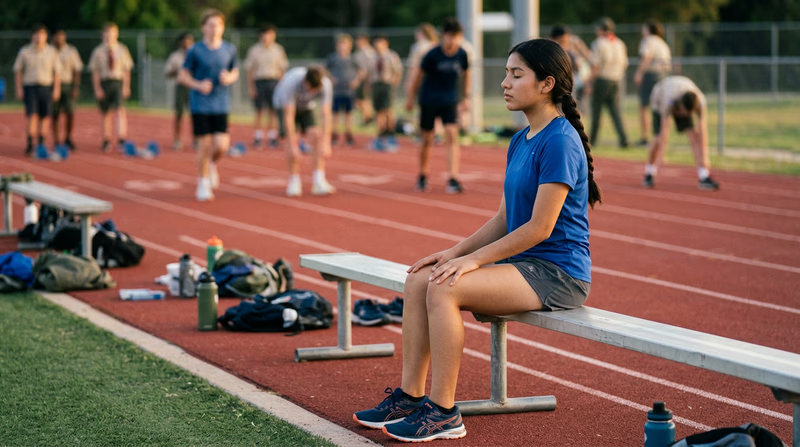
C. Deep Dive: Mental Toughness in Athletics
Physical fitness gets you to the starting line. Mental fitness carries you across the finish line. The best athletes in the world are not just physically gifted — they have trained their minds to handle pressure, setbacks, and the voice inside that says “quit.”
Goal setting. Effective athletes set three types of goals: outcome goals (win the race), performance goals (run a 7-minute mile), and process goals (maintain proper form through the last 200 meters). Process goals are the most powerful because they focus on what you can control in the moment.
Visualization. Before a race, a game, or a difficult workout, close your eyes and mentally rehearse every detail — the starting signal, the feel of the track under your feet, the sound of the crowd, the sensation of crossing the finish line. Studies show that athletes who visualize perform measurably better than those who do not. Your brain cannot fully distinguish between a vividly imagined experience and a real one.
Self-talk. The words you say to yourself during competition matter enormously. Replace “I can’t keep up this pace” with “I’ve trained for this — one more lap.” Replace “I’m going to miss this free throw” with “I’ve made this shot a thousand times in practice.” Positive, instructional self-talk has been shown to improve endurance, accuracy, and confidence under pressure.
Embracing failure. Every great athlete has a long history of losing. Michael Jordan was cut from his high school basketball team. Simone Biles fell during her first elite competition. The difference between a champion and someone who quits is how they respond to failure. Each loss is a data point — information that helps you improve. Each failure is proof that you are competing at a level that challenges you, which is exactly where growth happens.
D. Deep Dive: Adaptive and Inclusive Athletics
Athletics is for everyone. Adaptive sports modify rules, equipment, or techniques to enable athletes with physical, visual, or intellectual disabilities to compete. These athletes train just as hard, compete just as fiercely, and display the same sportsmanship as any other competitor.
Paralympic sports include wheelchair racing, seated throwing events, blind soccer, swimming with classifications for different abilities, and many more. The Paralympic Games are held immediately following the Olympic Games and feature over 4,000 athletes from around the world.
Special Olympics provides year-round training and competition in 32 Olympic-type sports for people with intellectual disabilities. The Special Olympics motto — “Let me win. But if I cannot win, let me be brave in the attempt” — captures the spirit of athletics perfectly.
Unified Sports pairs athletes with and without intellectual disabilities on the same team, promoting inclusion, understanding, and friendship through shared competition. If your community offers Unified Sports events, volunteering or participating is an incredible experience.
You can support inclusive athletics by volunteering at Special Olympics events, advocating for adaptive sports programs in your school or community, or simply recognizing that athletic achievement looks different for every person — and every version of it deserves respect.
E. Real-World Experiences
Ready to take your athletics beyond the backyard and the school track? These experiences will challenge you and connect you to the wider world of competitive and recreational sports.
Local 5K Road Race
USA Track & Field Junior Olympics
Parkrun
Special Olympics Volunteer
Tough Mudder or Obstacle Course Race
F. Organizations
Joining an organization connects you with other athletes, coaches, and events in your area. Here are some of the best resources for continuing your athletic journey.
The national governing body for track and field, cross country, and road running. Offers youth programs, competitions, and coaching resources.
Provides year-round sports training and competition for people with intellectual disabilities, promoting inclusion through athletics.
Governs high school sports and activities across the country. Offers rules, training, and officiating resources.
Promotes physical activity and healthy eating through programs, challenges, and resources for youth and adults.
Provides evidence-based resources on strength training, conditioning, and sports performance for athletes and coaches.
Develops better athletes, better people through resources for youth sports coaches, parents, and athletes focused on character and sportsmanship.