Req 3 — Personal Training Program
This is the heart of the Athletics merit badge. You will pick a sport or activity, design a training plan with your counselor, follow it for three months, and then reflect on how you have grown. Let’s break it down step by step.
Step 1: Choose Your Activity (Req 3)
The first question is simple: what athletic activity interests you? It could be one of the options listed in Requirement 5 (sprinting, distance running, swimming, basketball, etc.), or it could be something else entirely — soccer, tennis, martial arts, wrestling, or any sport that involves physical training and measurable performance.
Step 2: Build Your Training Program (Req 3a)
A good training program is not just “go practice whenever you feel like it.” It is a structured plan that builds your fitness gradually over time. Work with your counselor to design a program that includes these elements:
Frequency — How many days per week will you train? Most programs call for 3–5 training days with rest days built in.
Duration — How long is each session? Start with what you can manage (even 20–30 minutes) and increase gradually.
Intensity — How hard will you work? A mix of easy, moderate, and hard sessions prevents burnout and promotes steady improvement.
Progression — How will you make the program harder over time? The key to improvement is progressive overload — gradually increasing the challenge so your body continues to adapt. This could mean running farther, lifting heavier, swimming faster, or adding more repetitions.
Variety — A well-rounded program includes sport-specific practice, general fitness work (cardio, strength, flexibility), and rest days.
Here is a sample weekly framework you can adapt to any activity:
| Day | Focus | Example (Runner) |
|---|---|---|
| Monday | Sport-specific practice | Interval training (sprint/jog repeats) |
| Tuesday | Cross-training / strength | Bodyweight exercises, core work |
| Wednesday | Sport-specific practice | Tempo run (steady moderate pace) |
| Thursday | Rest or active recovery | Light walk, stretching, foam rolling |
| Friday | Sport-specific practice | Long, easy run |
| Saturday | Skills or fun play | Practice with friends, pickup game |
| Sunday | Full rest | Let your body recover |
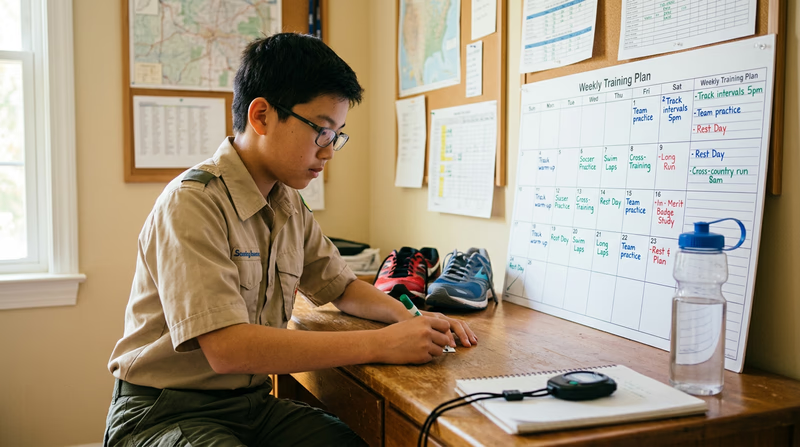
Step 3: Track Your Progress (Req 3b)
Tracking your progress is what separates a training program from just “working out.” A log helps you see patterns, celebrate improvements, and identify when something is not working.
Your training log should record:
- Date of each session
- Activity performed (what you did)
- Duration (how long)
- Performance metrics (times, distances, weights, reps — whatever measures progress in your sport)
- How you felt (energy level, soreness, mood)
- Notes (weather conditions, equipment changes, things you want to remember)
You can track in a notebook, a spreadsheet, or a phone app — whatever works for you. The important thing is consistency. Log every session, even the bad ones.
Athletics Training LogStep 4: Know Your Gear (Req 3c)
Every sport has its own equipment and clothing needs, and they change with the seasons. When you talk to your counselor about gear, think about:
Equipment:
- What is the minimum equipment needed to practice safely? (For running, it might be just shoes. For baseball, you need a glove, ball, bat, and helmet.)
- Does any of it require sizing, fitting, or safety certification?
- Where can you access equipment if you cannot buy your own? (School, community center, Scouting troop gear.)
Clothing by season:
| Season | Key considerations |
|---|---|
| Summer | Lightweight, moisture-wicking fabrics. Sun protection. Light colors to reflect heat. |
| Fall/Spring | Layers you can add or remove as temperatures change. Rain-resistant outer layer. |
| Winter | Insulating layers, wind protection, visibility gear for early darkness. Warm-up indoors first. |
Step 5: Reflect on Your Journey (Req 3d)
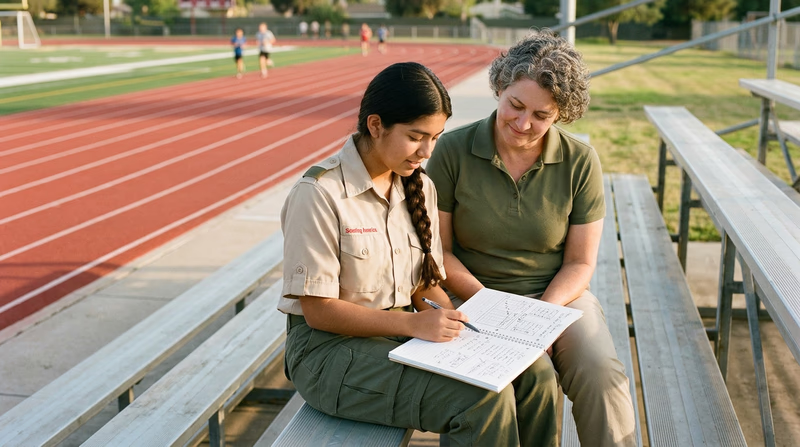
After three months, sit down with your training log and your counselor to review what happened. This is not a test — it is a conversation about growth. Be ready to discuss:
Physical changes:
- Did your times, distances, or performance numbers improve?
- Do you feel stronger, faster, or more coordinated?
- Did you notice changes in your endurance or recovery time?
Mental changes:
- Are you more disciplined about sticking to a schedule?
- How did you handle setbacks — a missed workout, a bad performance, or a minor injury?
- Do you feel more confident in your ability to take on physical challenges?
- Did training become something you looked forward to?
Cross-Reference: Requirement 5
Your training program connects directly to Requirement 5, where you will choose four athletic options and show improvement over three months. Consider selecting your Req 3 activity from the Req 5 options so your training program does double duty.
President's Council on Sports, Fitness & Nutrition Resources and programs promoting physical activity for youth and adults.