Req 4a — Rules of the Game
Every sport has rules, and understanding them is not just about avoiding penalties — it is about playing safely, fairly, and with respect for everyone involved. For this requirement, you need to know the rules for two activities: the one you chose for your training program in Requirement 3 and one additional activity.
Why Rules Matter
Rules exist for three main reasons:
Safety. Many rules prevent dangerous situations. In basketball, flagrant fouls are penalized harshly because they can cause serious injury. In swimming, false starts are disqualified partly because a chaotic start can lead to collisions.
Fairness. Rules create a level playing field. Lane assignments in track, pitch counts in baseball, and weight classes in wrestling all ensure that competition is equitable.
Structure. Rules define how the game is played — scoring, boundaries, time limits, and winning conditions. Without them, there is no game.
How to Learn the Rules
When preparing to discuss rules with your counselor, focus on these areas for each sport:
Rules Research Framework
Cover these topics for each activity
- Objective: How do you win or score?
- Playing area: What are the boundaries and markings?
- Equipment: What is required and what are the specifications?
- Timing: How long is a game, match, or event? Are there periods, quarters, or innings?
- Scoring: How are points awarded?
- Fouls and penalties: What actions are not allowed and what happens if you break a rule?
- Officials: Who enforces the rules and what are their roles?
- Starting and stopping: How does play begin, pause, and end?
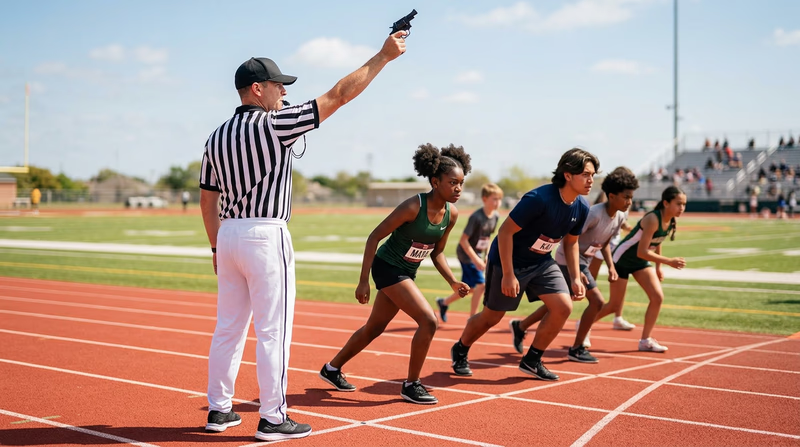
Examples Across Sports
Here are brief overviews of rules for several common athletics activities. Use these as a starting point for your own research into the two sports you have chosen.
Track (Sprinting/Distance)
- Runners must stay in their assigned lane for sprint events (100m, 200m).
- A false start results in disqualification — there are no second chances.
- In distance events, runners can move to the inside lane after the first curve.
- Runners are timed electronically, and finishes are determined by when the torso crosses the finish line.
Swimming
- Swimmers must start from the blocks (or in the water for backstroke) on the starter’s signal.
- Each stroke (freestyle, backstroke, breaststroke, butterfly) has specific rules about arm movement, kicks, and turns.
- Touching the wall at the finish and during turns must follow stroke-specific rules — two-hand touch for butterfly and breaststroke, one hand for backstroke and freestyle.
Basketball
- A game consists of four quarters (8 minutes for high school, 12 for the NBA).
- Scoring: 2 points for a field goal inside the arc, 3 points outside, 1 point per free throw.
- Key violations include traveling (moving without dribbling), double dribble, and shot clock violations.
- Personal fouls are tracked; five personal fouls disqualify a player in most youth and high school leagues.
Soccer
- Two halves (typically 40–45 minutes each for youth leagues).
- Only the goalkeeper may use their hands, and only inside the penalty area.
- Offside: An attacking player cannot be closer to the goal than the second-to-last defender when the ball is passed to them.
- Yellow card means a warning; two yellow cards (or a straight red card) means ejection.