Req 5d — Swimming
Activities: 100-meter swim and 200-meter swim.
Swimming is one of the most complete athletic activities you can do. It builds cardiovascular endurance, upper- and lower-body strength, and flexibility — all while being gentle on your joints. Unlike running, where impact forces stress your bones and muscles, swimming lets you train hard with almost zero impact.
Freestyle Fundamentals
For most swimmers working on this requirement, freestyle (front crawl) will be the primary stroke. Here are the key elements:
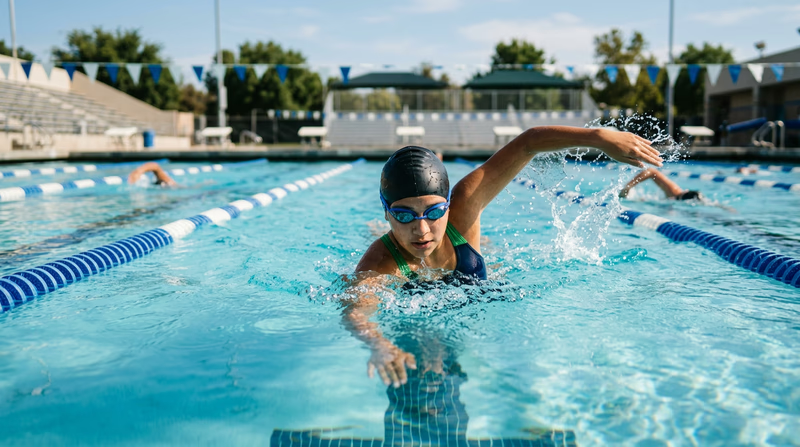
Body position: Lie flat in the water with your hips and legs near the surface. Think of your body as a long, straight line — the flatter you are, the less drag you create.
Arm stroke: Reach forward with one arm, enter the water fingertips first, and pull straight back under your body. As one arm pulls, the other recovers forward above the water. Each pull should feel like you are grabbing the water and pushing yourself past it.
Kick: A flutter kick with straight-ish legs (slight bend at the knee) provides propulsion and balance. Kick from the hips, not the knees. Big, splashy kicks waste energy — keep it compact.
Breathing: Turn your head to the side (do not lift it) to breathe during the arm recovery phase. Exhale underwater through your nose and mouth. Most distance swimmers breathe every two or three strokes.
Rotation: Your body should rotate slightly with each stroke, turning about 30 degrees to each side. This rotation adds power to your pull and makes breathing easier.
100m vs. 200m: Pacing Strategy
100 meters (4 lengths of a 25-meter pool): This is a sprint. You can afford to go hard from the start. Focus on strong turns, a powerful push-off the wall, and maintaining your stroke technique even as fatigue sets in during the last 25 meters.
200 meters (8 lengths): Pacing matters here. Start at a strong but sustainable effort — about 85–90% of your sprint speed. Save something for the last two lengths. Even splits (swimming each length in roughly the same time) is the goal.
Training for Swimmers
Swim Training Plan
Build speed and endurance in the pool
- Warm-up: 200–400 meters of easy swimming to loosen up before the main set.
- Drill work: Single-arm drills, catch-up drills, and kick-only sets improve technique.
- Interval sets: Swim repeated distances (e.g., 8 x 50m) with short rest (15–20 seconds) to build speed endurance.
- Distance sets: Swim 400–800 meters continuously at an easy-to-moderate pace to build your aerobic base.
- Sprint sets: Swim short distances (25–50m) at maximum effort with full rest to develop top-end speed.
- Cool-down: 100–200 meters of easy swimming to recover.
Turns and Push-Offs
In a pool, your turns and push-offs are free speed — you cover distance without any swimming effort. A good push-off can carry you 3–5 meters before your first stroke.
Flip turn (freestyle): As you approach the wall, tuck your chin and somersault forward. Plant both feet on the wall and push off in a streamlined position (arms extended overhead, body tight like a torpedo).
Open turn: Touch the wall with one hand, bring your knees to your chest, pivot, plant both feet, and push off. This is simpler than a flip turn and perfectly fine for this requirement.
USA Swimming — Learn to Swim Resources and programs from the national governing body for competitive swimming.