Req 5i — Weight Training
Activities:
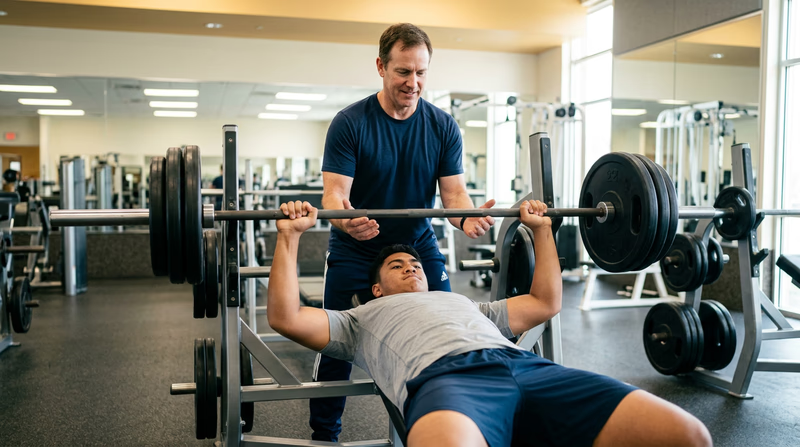
- Chest/bench press: 2 sets of 15 repetitions each
- Leg curls: 2 sets of 15 repetitions each
Weight training builds the raw strength that supports every other athletic activity. Whether you sprint, swim, throw, or kick, a stronger body performs better and resists injury. This option focuses on two foundational exercises: the bench press (upper body) and leg curls (lower body).
Bench Press
The bench press is the standard measure of upper-body pushing strength. It primarily works your chest (pectorals), shoulders (anterior deltoids), and the backs of your arms (triceps).
Proper form:
- Setup: Lie flat on the bench with your eyes directly under the bar. Feet flat on the floor. Grab the bar with a grip slightly wider than shoulder-width.
- Unrack: Lift the bar off the rack with your arms straight. Position it directly over your chest.
- Lower: Slowly lower the bar to your mid-chest (roughly at nipple level). Keep your elbows at a 45-degree angle from your body — not flared out to the sides.
- Press: Drive the bar back up to the starting position. Push through your chest and triceps. Exhale as you press.
- Rack: When your set is complete, guide the bar back onto the rack hooks.
Leg Curls
Leg curls target your hamstrings — the muscles on the back of your thigh. Strong hamstrings are critical for running, jumping, and preventing knee injuries.
Proper form (lying leg curl machine):
- Setup: Lie face down on the machine. Adjust the pad so it rests on the back of your ankles, just above your heels. Grip the handles.
- Curl: Bend your knees and curl the weight upward toward your glutes. Keep the movement smooth and controlled.
- Squeeze: At the top of the movement, pause briefly and squeeze your hamstrings.
- Lower: Slowly return to the starting position. Do not let the weight slam down — control the descent.
Starting Weight and Progression
For this requirement, you perform 2 sets of 15 repetitions for each exercise. Here is how to choose the right starting weight:
- Start light. Pick a weight you can complete 15 reps with good form and still feel like you could do 2–3 more. If the last rep is a struggle, the weight is too heavy.
- Progress gradually. When you can complete both sets of 15 comfortably, increase the weight by the smallest available increment (usually 5 pounds). This is progressive overload in action.
- Track everything. Write down the weight, sets, and reps for every session in your training log.
Training Plan for Weight Training
Weight Training Schedule
Three sessions per week
- Bench press: 2 sets of 15 reps. Rest 60–90 seconds between sets.
- Leg curls: 2 sets of 15 reps. Rest 60–90 seconds between sets.
- Supporting exercises (optional but recommended): Dumbbell rows, overhead press, squats, and planks round out your program.
- Warm-up: Always do 5 minutes of light cardio and one light set (50% of working weight) before your working sets.
- Cool-down: Stretch your chest, shoulders, and hamstrings after every session.
Gym Safety Rules
Weight Room Code of Conduct
Follow these every time
- Always use a spotter for bench press and any exercise where the weight is over your body.
- Wear closed-toe shoes with flat, stable soles. No sandals.
- Rerack your weights when you are done. This is both courtesy and safety.
- Wipe down equipment after use.
- Never drop weights or slam them on the ground.
- Do not distract other lifters during their sets.
- If you feel sharp pain during a lift, stop immediately.