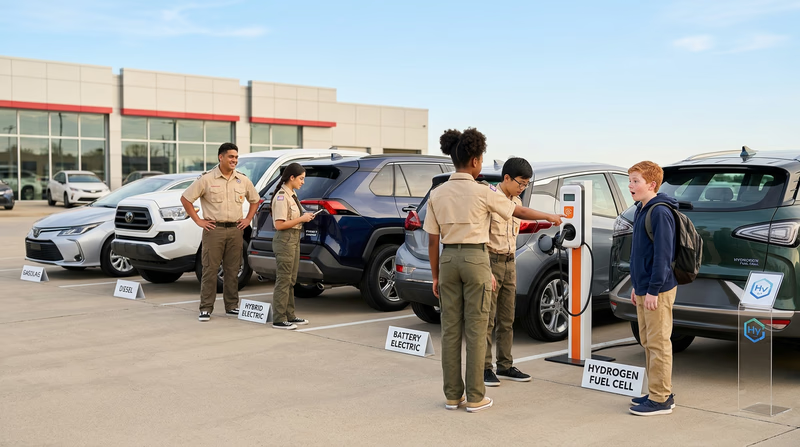
Req 1c — Vehicle Power Types
Not every vehicle on the road runs on the same type of fuel or uses the same kind of engine. Understanding how different powertrains work is important because each type has its own maintenance needs, safety considerations, and environmental impact. Let’s explore the major ways vehicles are powered today.
Gasoline Engines
The gasoline internal combustion engine (ICE) is the most common powertrain on the road. It works by mixing gasoline with air, compressing that mixture in a cylinder, and igniting it with a spark plug. The explosion pushes a piston down, which turns the crankshaft, which ultimately spins the wheels.
- Fuel: Gasoline (regular, mid-grade, or premium depending on the engine)
- How it ignites: Spark plugs create a precisely timed spark
- Maintenance needs: Oil changes, spark plug replacement, air filter changes, coolant flushes, and belt/hose inspections
You will learn much more about how internal combustion engines work in Requirement 5a.
Diesel Engines
Diesel engines are also internal combustion engines, but they work differently than gasoline engines. Instead of using a spark plug, a diesel engine compresses air so tightly that it gets extremely hot — hot enough to ignite the diesel fuel when it is injected into the cylinder. This is called compression ignition.
- Fuel: Diesel fuel (higher energy density than gasoline)
- How it ignites: Compression alone — no spark plugs needed
- Advantages: More fuel-efficient, produce more torque (pulling power), and tend to last longer
- Common in: Pickup trucks, commercial vehicles, buses, and heavy equipment
Hybrid Electric Vehicles (HEVs)
A hybrid vehicle combines a gasoline engine with one or more electric motors and a battery pack. The vehicle’s computer decides when to use the gas engine, the electric motor, or both — depending on driving conditions. Most hybrids also use regenerative braking, which captures energy that would normally be lost as heat when you brake and stores it in the battery.
- Fuel: Gasoline + electricity generated on board
- Types:
- Parallel hybrid — Both the engine and electric motor can drive the wheels directly
- Series hybrid — The gas engine only generates electricity; the electric motor drives the wheels
- Maintenance needs: Similar to gasoline vehicles, plus battery system maintenance
Plug-In Hybrid Electric Vehicles (PHEVs)
A plug-in hybrid is like a standard hybrid, but with a larger battery that can be charged by plugging in to an external power source. This allows the vehicle to drive a significant distance on electricity alone — typically 20 to 50 miles — before the gasoline engine kicks in.
- Fuel: Electricity (from charging) + gasoline as backup
- Charging: Can be plugged in at home or at public charging stations
- Best for: Drivers with short daily commutes who want the flexibility of a gas engine for longer trips
Battery Electric Vehicles (BEVs)
Battery electric vehicles — commonly just called “EVs” — have no gasoline engine at all. They run entirely on electricity stored in a large battery pack and are powered by one or more electric motors. No tailpipe, no engine oil, no spark plugs.
- Fuel: Electricity only
- Charging: Level 1 (household outlet, slowest), Level 2 (240V home or public charger), or DC fast charging (fastest)
- Maintenance needs: Far fewer moving parts than a gas engine. No oil changes, no transmission fluid, no spark plugs. Focus shifts to tires, brakes, battery health, and cabin air filters
- Range: Typically 200 to 350 miles per charge, depending on the vehicle and conditions
Hydrogen Fuel Cell Vehicles (FCEVs)
Fuel cell electric vehicles generate their own electricity on board by combining hydrogen gas with oxygen from the air in a fuel cell. The only byproduct is water. They are essentially electric vehicles that make their own power instead of storing it in a large battery.
- Fuel: Compressed hydrogen gas
- How it works: Hydrogen and oxygen combine in a fuel cell to produce electricity, which powers an electric motor
- Refueling: Takes about 5 minutes at a hydrogen fueling station — similar to filling up with gasoline
- Limitations: Hydrogen fueling stations are currently very rare (mostly in California)
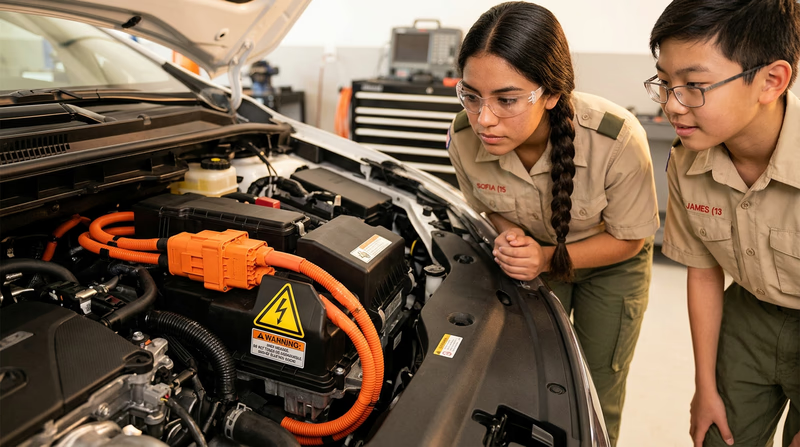
Requirement 1d — High-Voltage Safety
Hybrid, plug-in hybrid, and battery electric vehicles use high-voltage battery systems that operate between 200 and 800 volts. For comparison, a standard household outlet in the United States is 120 volts — and that is already dangerous enough to be fatal. The high-voltage systems in these vehicles demand serious respect and specific safety precautions.
Identifying High-Voltage Components
All high-voltage cables, connectors, and components in hybrid and electric vehicles are color-coded orange. This is an industry-wide safety standard. If you see orange wiring, orange connectors, or orange-labeled components under the hood or under the vehicle, do not touch them.
High-voltage components include:
- The main battery pack (usually located under the rear seats or floor)
- The electric motor(s)
- The inverter (converts DC battery power to AC for the motor)
- High-voltage wiring harnesses
- The onboard charger
- The DC-DC converter
Safety Rules for High-Voltage Vehicles
- Never cut, probe, or disconnect orange cables or connectors. Even with the vehicle turned off, the battery pack may still hold a lethal charge.
- Do not work on a high-voltage vehicle in wet conditions. Water conducts electricity and increases shock risk.
- Do not attempt to open or repair the battery pack. This requires specialized training, tools, and facilities.
- In an accident, if a high-voltage vehicle is damaged, stay away from any exposed battery cells or wiring and call emergency services. First responders are trained to handle these situations.
- Before any routine maintenance (like changing a tire or checking brake pads), verify that you are not near high-voltage components. Consult the owner’s manual for the location of high-voltage parts.