Req 1e — Maintenance Schedules
Every vehicle comes with an owner’s manual, and inside it is one of the most important sections you can read: the maintenance schedule. This chart tells you exactly what maintenance needs to be done and when — based on mileage, time, or both. Following this schedule is the single best thing you can do to keep a vehicle running reliably and hold its resale value.
Finding the Maintenance Schedule
The owner’s manual is usually stored in the glove compartment. Look for a section titled “Scheduled Maintenance,” “Maintenance Schedule,” or “Service Intervals.” If the physical manual is missing, most manufacturers make their owner’s manuals available for free on their websites — just search for the make, model, and year.
How to Read the Chart
A typical maintenance schedule is organized as a grid:
- Rows list the maintenance tasks (oil change, tire rotation, coolant flush, brake inspection, etc.)
- Columns list the intervals — either in miles (e.g., every 5,000 miles, 15,000 miles, 30,000 miles) or in months (every 6 months, 12 months, etc.)
- An “X” or checkmark in a cell means that task should be performed at that interval
Most schedules use the rule of “whichever comes first.” For example, if the manual says to change the oil every 5,000 miles or every 6 months, whichever milestone you hit first is when the oil should be changed — even if you have not driven many miles.
Normal vs. Severe Conditions
Many maintenance schedules have two columns: normal and severe (sometimes called “heavy-duty” or “special operating conditions”). Severe conditions call for more frequent maintenance. You might be surprised by what counts as “severe”:
- Frequent short trips (less than 10 miles)
- Stop-and-go city driving
- Driving in dusty or sandy conditions
- Towing a trailer or carrying heavy loads
- Driving in extreme heat or cold
- Driving on dirt or gravel roads
Common Maintenance Intervals
While every vehicle is different, here are some typical intervals you will see:
| Task | Typical Interval |
|---|---|
| Engine oil and filter | 5,000–10,000 miles or 6–12 months |
| Tire rotation | 5,000–7,500 miles |
| Air filter (engine) | 15,000–30,000 miles |
| Cabin air filter | 15,000–25,000 miles |
| Brake inspection | 15,000–30,000 miles |
| Coolant flush | 30,000–60,000 miles or 3–5 years |
| Transmission fluid | 30,000–60,000 miles |
| Spark plugs | 30,000–100,000 miles (varies widely) |
| Timing belt/chain | 60,000–100,000 miles (if applicable) |
Why Following the Schedule Matters
Skipping scheduled maintenance might save a little money in the short term, but it costs much more in the long run. A $50 oil change prevents a $5,000 engine replacement. A $20 coolant check prevents an overheated engine and a tow truck bill. Many vehicle warranties also require proof that scheduled maintenance was performed — skip it and you could void your warranty.

Requirement 1f — Safety Belts & Passive Restraints
Safety belts and passive restraints are your vehicle’s most important safety features. They are designed to keep you in your seat and slow your body’s forward motion during a crash, reducing the force of impact on your body.
Safety Belts (Seat Belts)
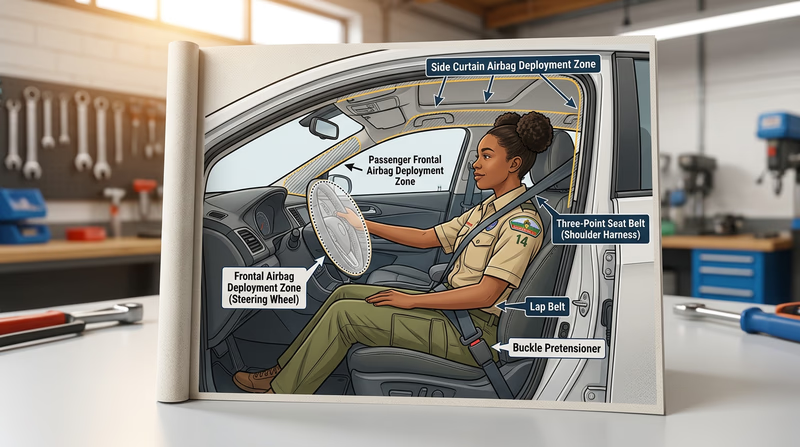
Modern seat belts are three-point harnesses — they go across your lap and over your shoulder. They work by distributing crash forces across the strongest parts of your body: your pelvis, chest, and shoulders.
How they work:
- During normal driving, the belt allows free movement so you can lean forward and turn.
- In a sudden stop or crash, a locking mechanism activates and holds the belt tight, preventing you from being thrown forward.
- Many modern seat belts also have pretensioners that instantly tighten the belt in a crash, removing any slack.
Limitations of seat belts:
- They only work if you wear them. An unbuckled seat belt protects no one.
- They must be positioned correctly — the lap portion across your hips (not your stomach) and the shoulder portion across your chest (not your neck).
- They are designed for one crash. After a collision, the belt and its mechanisms should be inspected and may need replacement.
Passive Restraints — Air Bags
Air bags are called “passive” because they work automatically — you do not need to do anything to activate them. They are designed to work with seat belts, not instead of them.
How air bags work:
- Crash sensors detect a sudden deceleration (rapid slowing) that indicates a collision.
- Within milliseconds, a chemical reaction inflates the air bag with nitrogen gas.
- The air bag cushions your head and upper body, then deflates almost immediately.
Types of air bags:
- Frontal air bags — Protect the driver (steering wheel) and front passenger (dashboard)
- Side air bags — Protect your torso in a side-impact crash
- Side curtain air bags — Drop from the ceiling to protect your head in a side impact or rollover
- Knee air bags — Protect your legs and help position your body correctly during a crash
Limitations of air bags:
- They deploy with tremendous force — fast enough to cause injury if you are too close. Keep at least 10 inches between your chest and the steering wheel.
- They are supplemental restraints — designed to work with seat belts, not replace them. Without a seat belt, you can slide forward into a deploying air bag, which can cause serious injury.
- They are single-use. After deployment, they must be replaced by a professional.