Req 2b — Fuses, Belts & Hoses
Understanding Fuses
Fuses are small, inexpensive electrical components that protect your vehicle’s wiring and electronic systems from damage caused by electrical overloads or short circuits. When too much current flows through a circuit, the thin metal strip inside the fuse melts (“blows”), breaking the circuit and preventing damage to the wiring or the component it protects.
Think of a fuse as a sacrificial guard — it is designed to fail so that something more expensive does not.
Locating the Fuse Boxes
Most vehicles have at least two fuse boxes:
- Interior fuse box — Usually located under the dashboard on the driver’s side, behind a kick panel, or in the center console area. This box protects interior systems like the radio, power windows, interior lights, and instrument panel.
- Under-hood fuse box — Located in the engine compartment, usually near the battery. This box protects engine-related systems like the fuel pump, cooling fans, headlights, and horn. It also contains larger relays (electromagnetic switches) for high-draw systems.
The owner’s manual has a fuse box diagram that labels each fuse by circuit name and amperage rating.
Types and Sizes of Fuses
Modern vehicles use blade-type fuses that plug into slots. There are three common sizes:
| Type | Size | Common Use |
|---|---|---|
| Mini (APM/ATM) | Smallest | Newer vehicles, interior circuits |
| Standard (ATO/ATC) | Medium | Most common; interior and under-hood |
| Maxi (APX) | Largest | High-current circuits (cooling fans, fuel pump) |
Each fuse is color-coded by amperage (how much current it can handle before blowing):
- Orange = 5A
- Red = 10A
- Blue = 15A
- Yellow = 20A
- Clear/White = 25A
- Green = 30A
How to Replace a Blown Fuse
- Turn off the ignition and the circuit you suspect is affected.
- Locate the correct fuse using the diagram in the owner’s manual or on the fuse box cover.
- Use a fuse puller (a small plastic tool often stored in the fuse box) to remove the fuse. Never use pliers or metal tools — you could short a circuit.
- Inspect the fuse — hold it up to the light. If the thin metal strip inside is broken or blackened, the fuse is blown.
- Insert a new fuse of the same amperage rating into the slot.
- Turn the ignition on and test the circuit.

Requirement 2c — Belts and Hoses
Belts
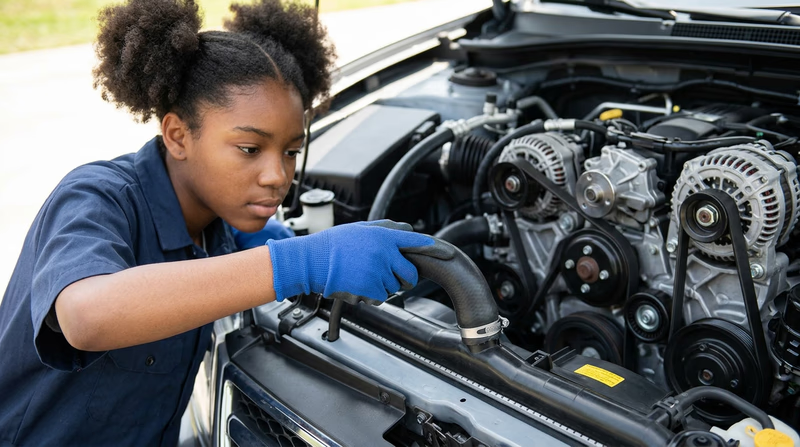
Most modern engines use a single serpentine belt — a long, flat, ribbed belt that winds around multiple pulleys to drive the alternator, power steering pump, water pump, and air conditioning compressor all at once. Older vehicles may have multiple V-belts, each driving a single component.
How to inspect a belt:
- Visual check: Look for cracks, fraying, glazing (a shiny, smooth surface), missing chunks, or separation of the ribs. Any of these mean the belt should be replaced.
- Tension check: Press on the belt midway between two pulleys with moderate thumb pressure. The belt should deflect about 1/4 to 1/2 inch. Too loose and it will slip (causing a squealing noise); too tight and it puts excessive strain on bearings.
- Most modern vehicles have an automatic tensioner — a spring-loaded pulley that maintains proper belt tension. If the tensioner is worn, the belt may appear loose even though you cannot manually adjust it.
Hoses
Rubber hoses carry coolant between the engine, radiator, and heater core. Over time, heat and chemicals cause hoses to deteriorate from the inside out.
How to inspect hoses:
- Visual check: Look for cracks, bulges, soft spots, or leaks at the connection points (where the hose meets the engine or radiator). White or green residue around a connection usually means coolant is seeping out.
- Squeeze test: When the engine is cool, gently squeeze the hoses. They should feel firm but flexible — like a thick rubber band. A hose that feels mushy, spongy, or crunchy is deteriorating and should be replaced.
- Check the clamps: The metal clamps that hold hoses in place should be tight and free of rust. Loose clamps cause leaks.
The two most critical hoses are:
- Upper radiator hose — Carries hot coolant from the engine to the radiator
- Lower radiator hose — Returns cooled coolant from the radiator to the engine