Req 3 — Dashboard & Driver Info
Your dashboard is your vehicle’s way of talking to you. Every gauge, light, and message tells you something important about what is happening under the hood and around the car. Learning to read your dashboard is like learning a new language — once you understand it, you can catch problems before they become emergencies.
The Five Key Gauges
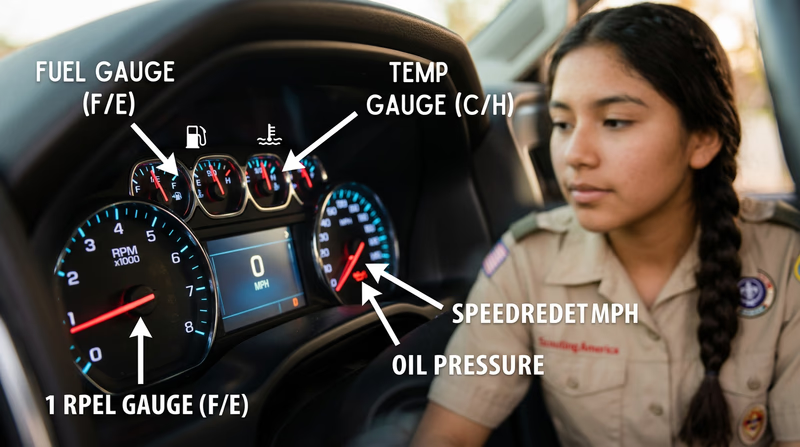
Fuel Gauge — Shows how much fuel is in the tank. The needle moves from “F” (full) to “E” (empty). Most vehicles also have a low-fuel warning light that turns on when you have roughly 2 to 3 gallons remaining. A small arrow next to the fuel pump icon on the gauge tells you which side of the car the gas cap is on.
Speedometer — Displays your current speed in miles per hour (MPH) and often kilometers per hour (km/h) on an inner scale. Modern vehicles may use a digital readout instead of a needle. This is the gauge you will use most — and it is your responsibility as a driver to keep it within the posted speed limit.
Tachometer — Measures engine speed in revolutions per minute (RPM). The numbers on the tachometer are usually multiplied by 1,000, so “3” means 3,000 RPM. Most tachometers have a redline zone — a red area at the high end. Running the engine in the redline can cause serious damage. The tachometer is especially useful for drivers of manual-transmission vehicles, who use it to know when to shift gears.
Oil Pressure Gauge — Indicates the pressure of the oil circulating through the engine. Normal readings vary by vehicle, but the needle should stay in the middle range during operation. Some vehicles replace this gauge with a simple warning light.
Engine Temperature Gauge — Shows the temperature of the engine coolant. The needle should settle in the middle of the gauge during normal driving. If it climbs toward the “H” (hot) zone, the engine is overheating — you need to pull over safely and turn off the engine immediately.
Dashboard Warning Light Colors
Warning lights follow a universal color system, similar to traffic lights:
- Red lights mean STOP — something is seriously wrong. Pull over as soon as it is safe and address the issue before driving further. Red lights indicate conditions that can cause immediate damage or danger (overheating, low oil pressure, charging system failure, open door).
- Yellow/amber lights mean CAUTION — something needs attention but is not an immediate emergency. You can usually continue driving to your destination or a service shop, but do not ignore it. Examples include the check engine light, tire pressure warning, and traction control alerts.
- Green or blue lights are informational — they tell you a system is active. Turn signals, high beams, cruise control, and eco-driving mode indicators are all green or blue.
Common Dashboard Warning Symbols
Here are some of the most important warning lights to recognize:
| Symbol | Color | Meaning |
|---|---|---|
| Engine outline (check engine) | Yellow | Engine or emissions system needs diagnosis |
| Oil can | Red | Low oil pressure — stop driving immediately |
| Thermometer in water | Red | Engine is overheating — pull over immediately |
| Battery | Red | Charging system failure — the alternator may have stopped working |
| Exclamation mark in circle (brakes) | Red/Yellow | Brake system issue — red means critical, yellow means ABS issue |
| Tire with exclamation mark (TPMS) | Yellow | One or more tires have low pressure |
| Seat belt icon | Red | Seat belt not fastened |
| Air bag icon | Red/Yellow | Air bag system malfunction |
| ABS | Yellow | Antilock brake system issue |
The Driver Information Center
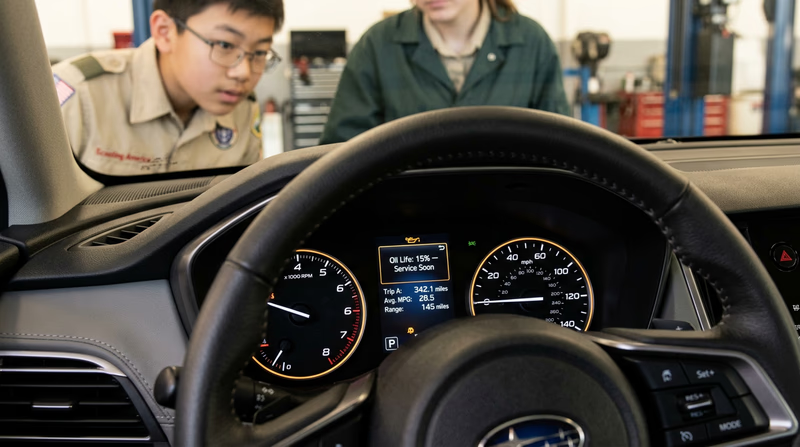
Modern vehicles have a driver information center (DIC) — usually a small screen in the instrument cluster that displays text messages and alerts. Unlike simple warning lights, the DIC can tell you specifically what is happening.
Types of messages you might see:
- Maintenance reminders: “Oil Life 15%” or “Service Due Soon” — the vehicle’s computer tracks driving conditions and estimates when maintenance is needed.
- Tire pressure alerts: “Low Tire Pressure — Right Rear” — the TPMS (Tire Pressure Monitoring System) can often identify which specific tire is low.
- Door/trunk ajar: “Trunk Open” or “Right Rear Door Ajar”
- Fuel reminders: “Low Fuel — Range 35 Miles”
- System status: “Traction Control Off” or “Lane Departure Warning Active”
- Trip information: Current fuel economy (MPG), distance to empty, trip distance, and average speed
Oil Life Monitors
Many vehicles use an oil life monitoring system that calculates when the engine oil needs to be changed based on driving conditions — not just mileage. It considers factors like engine temperature, RPM, trip length, and ambient temperature. When the oil life percentage drops to 15% or lower, the vehicle will display a maintenance reminder. After an oil change, the system must be reset following the procedure in the owner’s manual.