Req 4c — Alignment, Wear & Disposal
Wheel alignment refers to the precise angles at which your wheels are set relative to the vehicle and the road surface. When your wheels are properly aligned, your tires wear evenly, your vehicle handles predictably, and your fuel efficiency is maximized. When alignment is off, tires can wear out thousands of miles early, the vehicle may pull to one side, and steering can feel unstable.
The Three Alignment Angles
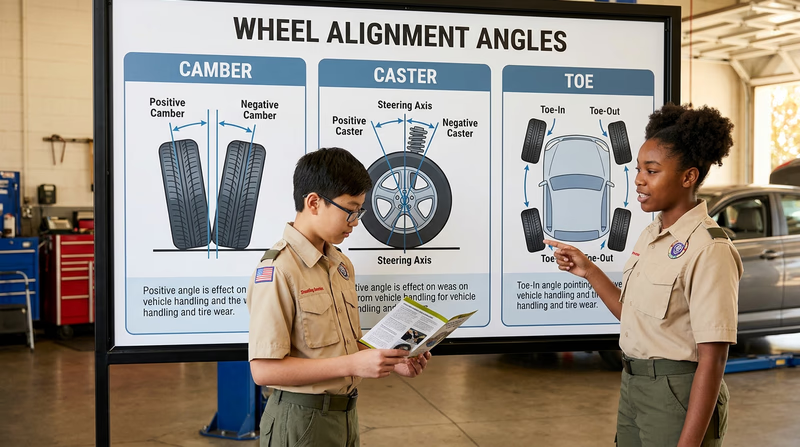
Alignment technicians adjust three main angles. Think of each one as a different way the wheel can tilt or turn:
Camber — Tilt In or Out
Camber is the angle of the wheel when viewed from the front of the vehicle. Imagine looking at the front tires head-on:
- Zero camber means the tire is perfectly vertical.
- Negative camber means the top of the tire tilts inward (toward the engine). A small amount of negative camber improves cornering grip.
- Positive camber means the top of the tire tilts outward. This was common on older vehicles but is rare today.
If camber is off, you will see uneven wear on the inner or outer edge of the tire tread.
Caster — Forward or Backward Lean
Caster is the angle of the steering axis when viewed from the side of the vehicle. Think of a bicycle’s front fork — it angles backward so the wheel trails behind the steering axis, which helps the bike go straight.
- Positive caster means the steering axis tilts toward the driver. This provides straight-line stability and helps the steering wheel return to center after a turn.
- Negative caster means the steering axis tilts toward the front bumper. This would make the vehicle feel unstable and is not desirable.
If caster is unequal side-to-side, the vehicle will pull toward the side with less positive caster.
Toe — Pointing In or Out
Toe is the angle of the tires when viewed from above the vehicle (bird’s-eye view):
- Toe-in means the fronts of the tires point slightly toward each other (like pigeon-toed feet).
- Toe-out means the fronts of the tires point slightly away from each other.
- Most vehicles are set with a very slight toe-in for stability.
Incorrect toe is the most common alignment problem and causes rapid, feathered tire wear — you can feel it by running your hand across the tread in one direction and then the other. It will feel smooth one way and rough the other.
Tread Wear Indicators
Every tire sold in the United States has built-in tread wear indicator bars (also called wear bars). These are small raised bars of rubber that sit in the grooves of the tire tread at a height of 2/32 of an inch — the legal minimum tread depth in most states.
When a tire is new, the wear bars are hidden deep in the grooves and are hard to see. As the tire wears down over thousands of miles, the tread surface gets closer and closer to the height of the wear bars. When the tread is flush (level) with the wear bars, the tire has reached the end of its usable life and must be replaced.
How to find them:
- Look for small raised rubber bridges running across the bottom of the tread grooves, perpendicular to the direction of travel.
- Small triangles or “TWI” (Tread Wear Indicator) markings on the sidewall point to the locations of the wear bars.
The Penny Test
A classic quick test: insert a penny into a tire groove with Lincoln’s head facing down. If you can see the top of Lincoln’s head, the tread is at or below 2/32 of an inch and the tire needs to be replaced. Many experts now recommend the quarter test instead — using a quarter with Washington’s head. If you can see the top of Washington’s head, the tread is at 4/32 of an inch, which is the point where wet-weather traction begins to degrade significantly.
Tire Disposal
Old tires cannot simply be thrown in the trash. In most states, it is illegal to dispose of tires in regular landfills because they take up space, trap methane gas, and collect water that breeds mosquitoes. Proper disposal is important for public health and the environment.
Legal disposal options:
- Tire retailers: When you buy new tires, the shop will typically remove and dispose of your old tires for a small fee (usually $3 to $5 per tire). This is the most common method.
- Municipal collection events: Many cities and counties hold periodic tire recycling drives or accept tires at household hazardous waste collection facilities.
- Recycling facilities: Dedicated tire recyclers shred old tires for use in:
- Rubberized asphalt for road surfaces
- Playground surfaces and athletic tracks
- Landscaping mulch
- Tire-derived fuel for cement kilns and power plants
- New rubber products