Req 5a — How Engines Work
The engine is the heart of a vehicle. Understanding how it works gives you the foundation for everything else in automotive maintenance. Let’s break down the three major powertrain types you need to know.
The Four-Stroke Cycle
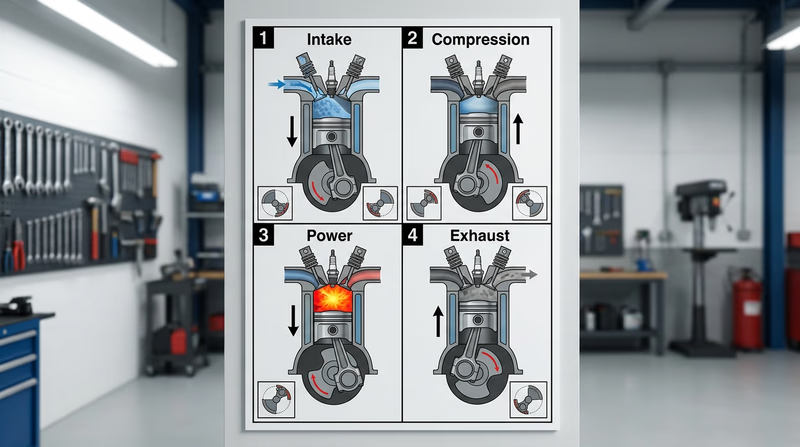
Most gasoline and diesel engines use a four-stroke cycle to convert fuel into motion. Each stroke is one movement of a piston inside a cylinder — either up or down. The four strokes repeat thousands of times per minute to keep the engine running.
1. Intake Stroke — The piston moves down, creating a vacuum that pulls a mixture of air and fuel into the cylinder through an open intake valve. (In a diesel engine, only air is pulled in during this stroke.)
2. Compression Stroke — The intake valve closes and the piston moves back up, compressing the air-fuel mixture into a much smaller space. Compression makes the mixture easier to ignite and increases the power of the explosion.
3. Power Stroke — This is where the energy is created. In a gasoline engine, the spark plug fires and ignites the compressed air-fuel mixture. In a diesel engine, the compressed air is so hot that diesel fuel injected at this point ignites on contact — no spark plug needed. The explosion forces the piston down with tremendous force, turning the crankshaft.
4. Exhaust Stroke — The exhaust valve opens and the piston moves back up, pushing the burned gases out of the cylinder and through the exhaust system. Then the cycle starts again.
From Pistons to Wheels
The up-and-down motion of the pistons is converted to rotational motion by the crankshaft — a heavy metal shaft with offset sections that the pistons push on via connecting rods. The crankshaft spins, and that spinning motion is transmitted through the transmission, drive shaft, and differential to the wheels.
Most passenger car engines have four or six cylinders arranged in a line (inline) or a V-shape. More cylinders generally means more power but also more fuel consumption.
Gasoline vs. Diesel — Key Differences
| Feature | Gasoline Engine | Diesel Engine |
|---|---|---|
| Ignition method | Spark plug | Compression (no spark plug) |
| Compression ratio | 8:1 to 12:1 | 14:1 to 25:1 |
| Fuel | Gasoline | Diesel fuel |
| Power delivery | Higher RPM, quicker revving | More torque at lower RPM |
| Fuel efficiency | Lower | Higher (more energy per gallon) |
| Emissions equipment | Catalytic converter | Catalytic converter + Diesel Particulate Filter (DPF) |
| Sound | Smoother, quieter | Distinctive “clatter” at idle |
How Hybrid Vehicles Work
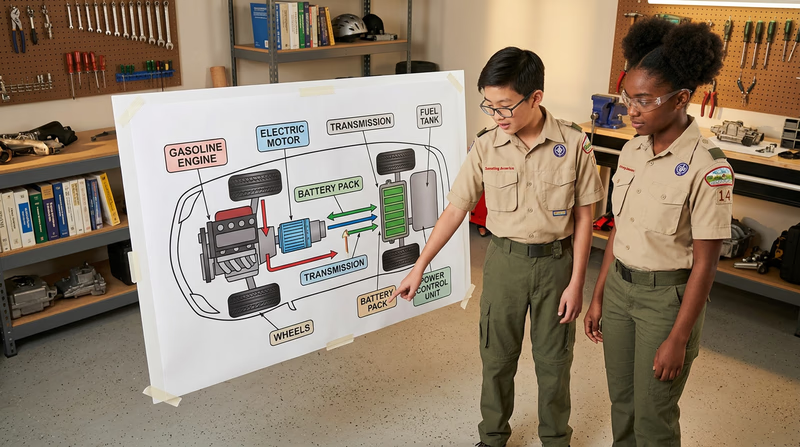
A gasoline-electric hybrid combines a gasoline engine with one or more electric motors and a battery pack. The vehicle’s computer constantly decides which power source — or combination of sources — is most efficient for the current driving conditions.
Key hybrid concepts:
- Low speeds and light acceleration: The electric motor drives the wheels alone, using battery power. The gas engine stays off, saving fuel.
- Highway cruising: The gas engine takes over because it is most efficient at steady speeds.
- Hard acceleration: Both the gas engine and electric motor work together to provide maximum power.
- Braking and coasting: The electric motor reverses its role and becomes a generator, capturing kinetic energy and converting it back to electricity to recharge the battery. This is called regenerative braking.
- Stopped in traffic: The gas engine shuts off completely. Accessories run on battery power. When you press the accelerator, the electric motor gets you moving silently before the gas engine restarts.