Req 5b — Engine Oil
Engine oil is one of the most important fluids in your vehicle. Without it, an engine would destroy itself in minutes. Understanding what oil does and how to read the labels on an oil bottle will help you make informed maintenance decisions.
What Engine Oil Does
Oil serves several critical functions inside the engine:
- Lubrication — Oil creates a thin film between moving metal surfaces (pistons, bearings, camshafts) to reduce friction and prevent metal-on-metal contact. Without lubrication, these parts would grind together, overheat, and seize.
- Cooling — Oil absorbs heat from hot engine components and carries it away, helping to regulate engine temperature alongside the cooling system.
- Cleaning — Oil contains detergent additives that pick up microscopic particles of dirt, metal shavings, and combustion byproducts, keeping them suspended in the oil so they can be removed during an oil change.
- Sealing — Oil helps fill the tiny gaps between piston rings and cylinder walls, maintaining compression and preventing combustion gases from escaping.
- Corrosion protection — Additives in the oil prevent moisture and acids from corroding internal engine surfaces.
The API Service Code
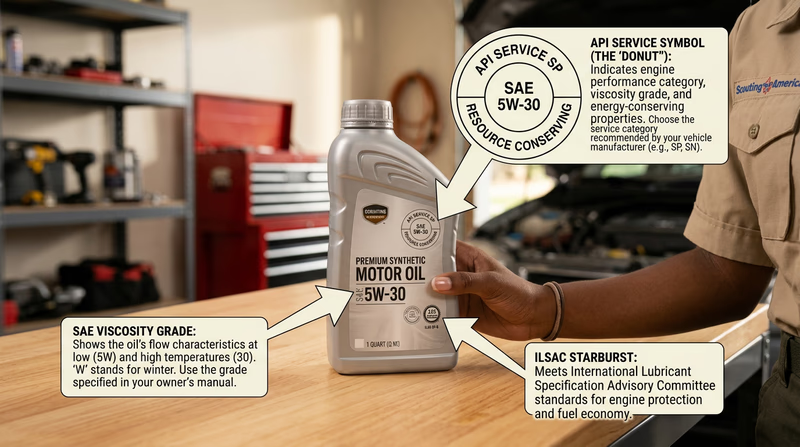
The API (American Petroleum Institute) service code tells you what type of engine the oil is designed for and how well it performs. You will find the API certification mark — often called the “donut” — on the back of every oil bottle.
The API donut has three parts:
- Top half: The API service category (e.g., “API SP” for gasoline engines or “API CK-4” for diesel engines)
- Center: The SAE viscosity grade (e.g., “SAE 5W-30”)
- Bottom half: Whether the oil is “Resource Conserving” (designed to improve fuel economy)
For gasoline engines, categories are designated with “S” (for “Spark ignition”):
- The current standard is API SP (introduced in 2020). Each new category supersedes the previous ones.
- Using an oil that meets the latest API standard ensures compatibility with modern engine technology.
For diesel engines, categories use “C” (for “Compression ignition”):
- The current standard is API CK-4 (for modern low-emission diesel engines).
The SAE Number and Viscosity
Viscosity is a measure of how thick or thin the oil is — how easily it flows. Think of it like comparing honey (high viscosity) to water (low viscosity). The SAE (Society of Automotive Engineers) developed a numbering system to rate oil viscosity.
Most modern engine oils are multi-grade, meaning they work well across a range of temperatures. A multi-grade oil has a label like 5W-30:
- 5W = The “winter” rating. The lower this number, the better the oil flows in cold temperatures. A 5W oil flows more easily in cold weather than a 10W oil, making it easier to start the engine on a freezing morning.
- 30 = The operating-temperature viscosity. This is the oil’s thickness when the engine is at normal running temperature (around 212°F). A 30-weight oil is thinner at operating temperature than a 40-weight oil.
Common multi-grade oils:
| Oil Grade | Cold Flow | Operating Protection | Typical Use |
|---|---|---|---|
| 0W-20 | Excellent | Lighter protection | Many modern engines, hybrids |
| 5W-30 | Very good | Moderate protection | Most common; wide range of vehicles |
| 10W-40 | Good | Heavier protection | Older engines, warmer climates |
Finding the Right Oil for Your Vehicle
Using the wrong oil — the wrong viscosity or the wrong API category — can cause poor lubrication, increased engine wear, and even void your warranty. Always use the oil specified by the vehicle manufacturer.
Where to find the recommended oil type and capacity:
- Owner’s manual — The specifications section lists the recommended oil viscosity grade (e.g., 5W-30), the API category, and the oil capacity in quarts.
- Oil filler cap — On many vehicles, the recommended viscosity is printed directly on the oil filler cap under the hood (e.g., “5W-20”).
- Door jamb or underhood sticker — Some manufacturers include oil specifications on informational stickers.
- Manufacturer’s website — Most automakers have an online owner’s manual or maintenance guide searchable by VIN (Vehicle Identification Number).
Oil capacity is listed in two ways:
- With filter change — The total amount needed when you also replace the oil filter (this is the number you use during a standard oil change).
- Without filter change — Slightly less, because the old filter still holds some oil.
A typical passenger car holds 4 to 6 quarts of oil. Larger trucks and SUVs may hold 7 to 8 quarts or more.