Req 8b — Firing Order & Spark Gap
What Is Firing Order?
In a multi-cylinder engine, the cylinders do not all fire at the same time. Instead, they fire in a specific sequence called the firing order. This sequence is carefully engineered by the manufacturer to achieve:
- Smooth power delivery — If all cylinders fired simultaneously, the engine would produce one massive pulse of power followed by nothing. By staggering the firing, the engine produces a steady, overlapping stream of power pulses.
- Reduced vibration — The firing order is designed so that adjacent cylinders do not fire consecutively. This distributes the forces more evenly across the crankshaft and reduces vibration.
- Even heat distribution — Alternating which cylinders fire helps spread heat more evenly across the engine block.
Common Firing Orders
Firing orders vary by engine design:
| Engine Type | Common Firing Order |
|---|---|
| Inline 4-cylinder | 1-3-4-2 |
| V6 | 1-2-3-4-5-6 (varies by manufacturer) |
| V8 (GM/Chevy) | 1-8-4-3-6-5-7-2 |
| V8 (Ford) | 1-3-7-2-6-5-4-8 |
The firing order is typically stamped on the intake manifold or printed in the owner’s manual and service manual.
What Is the Spark Gap?
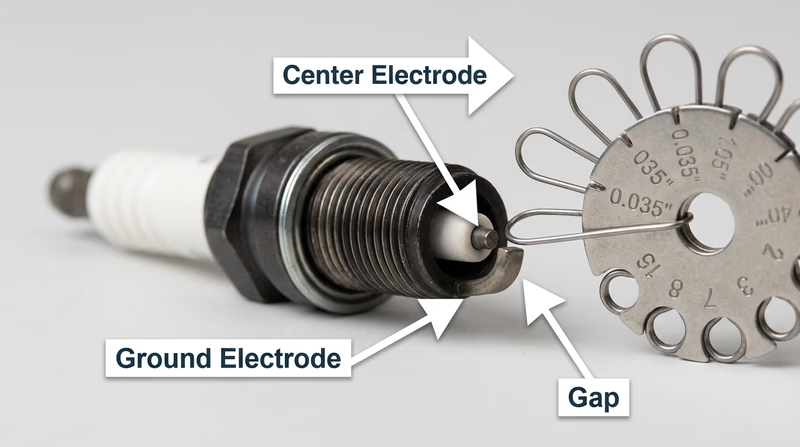
The spark gap (also called the electrode gap or simply the gap) is the distance between the center electrode and the ground electrode at the tip of a spark plug. This gap is where the spark actually jumps — creating the tiny bolt of electricity that ignites the air-fuel mixture in the cylinder.
Why the Gap Matters
The size of the gap directly affects how the engine runs:
- Correct gap — The spark is strong enough to reliably ignite the air-fuel mixture, resulting in complete combustion, smooth idle, good fuel economy, and clean emissions.
- Gap too small — The spark is weak and short. It may not ignite the mixture reliably, causing misfires, rough idle, and poor performance.
- Gap too large — The ignition coil may not produce enough voltage to bridge the wider gap, especially under high compression or heavy load. This can also cause misfires.
Setting the Gap
Every engine has a specified spark plug gap, measured in thousandths of an inch (e.g., 0.044 inches) or millimeters (e.g., 1.1 mm). You can find the correct gap in the owner’s manual, the service manual, or on a sticker under the hood.
To check and adjust the gap, you use a gap gauge (also called a feeler gauge or gap tool):
- Select the correct wire or blade on the gauge that matches the specified gap.
- Slide it between the two electrodes of the spark plug.
- If it fits snugly, the gap is correct.
- If the gap is too large, gently tap the ground electrode on a hard surface to close it slightly.
- If the gap is too small, carefully pry the ground electrode open with the gap tool.