Req 8d — Jump-Starting a Battery
8d.
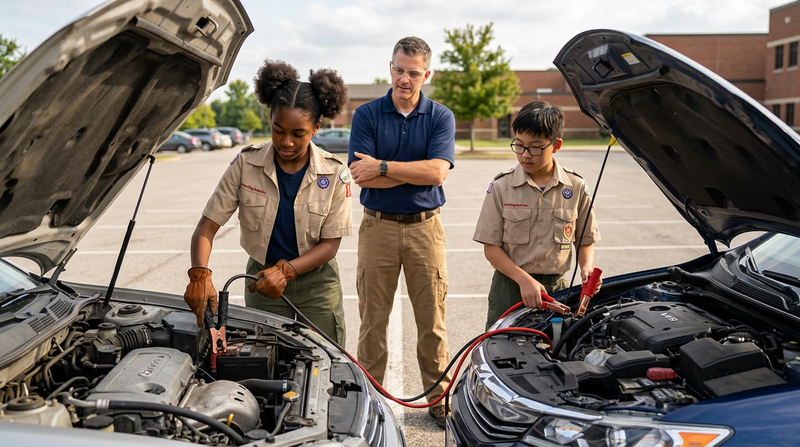
Demonstrate how to safely connect jumper cables to your car battery.
A dead battery is one of the most common roadside problems. Knowing how to safely jump-start a vehicle is a practical skill that every driver — and every Scout — should have. The process is straightforward, but the order of the connections matters for safety.
What You Need
- A set of jumper cables (also called booster cables) — heavier gauge cables (4 to 6 gauge) are better because they carry more current.
- A donor vehicle with a charged battery of the same voltage (12V for most passenger vehicles).
- Both vehicles should be parked close enough for the cables to reach, but not touching each other.
Step-by-Step: Connecting Jumper Cables
Jump-Start Procedure
Follow this order exactly
- Turn off both vehicles. Remove the keys from the ignition. Turn off all accessories (lights, radio, AC).
- Identify the positive (+) and negative (-) terminals on both batteries. Positive terminals are usually marked with a “+” sign and may have a red cover. Negative terminals are marked with a “-” sign and may have a black cover.
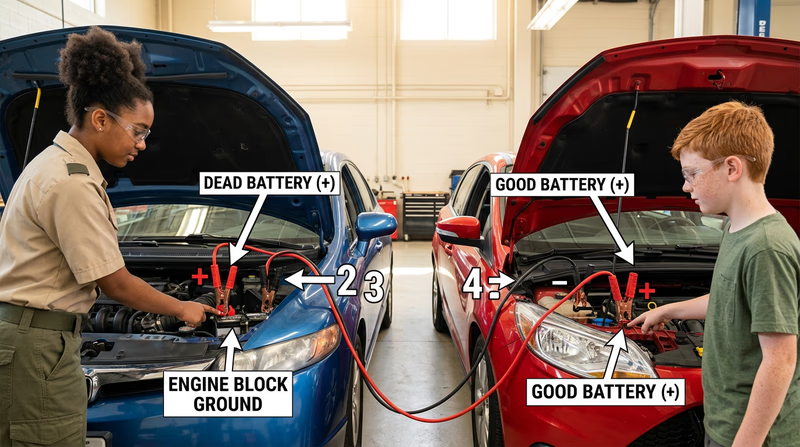
- Connect the RED (positive) cable to the POSITIVE (+) terminal of the DEAD battery.
- Connect the other end of the RED cable to the POSITIVE (+) terminal of the GOOD battery.
- Connect the BLACK (negative) cable to the NEGATIVE (-) terminal of the GOOD battery.
- Connect the other end of the BLACK cable to an UNPAINTED METAL SURFACE on the dead vehicle’s engine block — not to the dead battery’s negative terminal. A bolt or bracket on the engine works well. This is the ground connection.
- Start the donor vehicle and let it run for 2 to 3 minutes.
- Try to start the dead vehicle. If it does not start, wait a few more minutes and try again.
- Once the dead vehicle is running, disconnect the cables in REVERSE order: black from engine block, black from good battery, red from good battery, red from dead battery.
- Drive the jump-started vehicle for at least 15 to 20 minutes to allow the alternator to recharge the battery.
Why the Last Connection Goes to the Engine Block
The final connection (the black cable to the engine block of the dead vehicle) is made away from the battery on purpose. When you make this last connection, a small spark is likely. If that spark happened right next to the battery, it could ignite the hydrogen gas that dead batteries sometimes vent. By connecting to the engine block instead, the spark occurs safely away from the battery.