Req 8e — Electric Vehicles
If you drive a battery electric vehicle (BEV) or plug-in hybrid (PHEV), understanding what affects your range — and how to recharge efficiently — is just as important as knowing where the nearest gas station is for a conventional vehicle.
Factors That Affect EV Range
The range displayed on an EV’s dashboard is an estimate, not a guarantee. Many factors cause actual range to vary:
Temperature:
- Cold weather is the biggest range reducer. At 20°F, range can drop by 25% to 40% compared to ideal conditions. This happens because the battery’s chemical reactions slow down in the cold, and heating the cabin draws significant power.
- Extreme heat also reduces range, though less dramatically, because the battery cooling system works harder and air conditioning draws power.
Driving Speed:
- Aerodynamic drag increases with the square of speed. Driving at 75 mph uses significantly more energy per mile than driving at 55 mph. Highway driving at high speeds can reduce range by 15% to 25% compared to city driving.
Driving Style:
- Aggressive acceleration, hard braking, and frequent speed changes consume more energy. Smooth, gradual acceleration and coasting to decelerate (which activates regenerative braking) maximize range.
Climate Control:
- Heating and air conditioning are the largest non-driving power draws. Seat heaters and steering wheel heaters are more efficient than running the cabin heater because they warm you directly instead of heating all the air in the car.
Terrain and Load:
- Driving uphill uses more energy (though going downhill recovers some through regenerative braking). Carrying heavy loads or towing reduces range.
Tire Pressure:
- Under-inflated tires increase rolling resistance, reducing range. Keep tires at the recommended pressure.
Battery Age and Health:
- Over time, batteries gradually lose some maximum capacity. A new battery that once provided 300 miles of range might deliver 270 miles after several years.
How to Recharge an Electric Vehicle
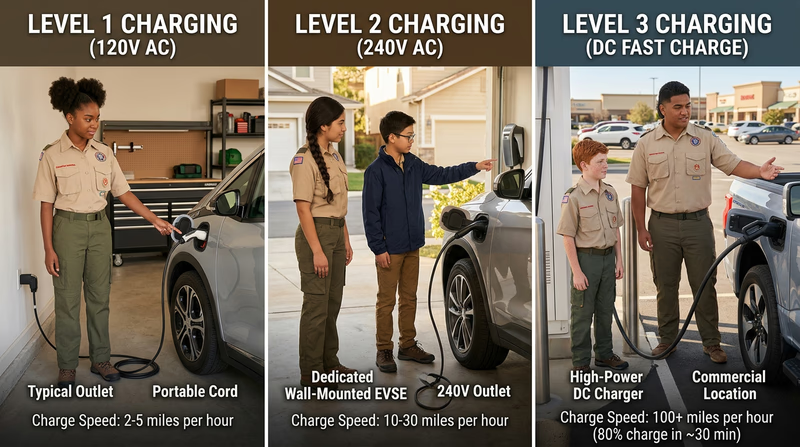
There are three levels of EV charging, each progressively faster:
Level 1 — Standard Household Outlet (120V):
- Uses the portable charging cord that comes with most EVs — plugs into a regular wall outlet.
- Adds about 3 to 5 miles of range per hour of charging.
- Best for: Overnight charging at home when daily driving is short (under 40 miles).
- A full charge from empty can take 24 to 48+ hours.
Level 2 — Dedicated 240V Circuit:
- Uses a wall-mounted charging station (called an EVSE — Electric Vehicle Supply Equipment) connected to a 240-volt circuit, like the ones used for clothes dryers.
- Adds about 15 to 30 miles of range per hour of charging.
- Best for: Home charging (overnight gives a full charge), workplace charging, and public charging stations at shopping centers and parking garages.
- A full charge from empty typically takes 6 to 12 hours.
Level 3 — DC Fast Charging (DCFC):
- Uses high-powered commercial charging stations found along highways and in urban areas.
- Adds about 100 to 200+ miles of range in 30 minutes (varies widely by vehicle and charger).
- Best for: Long road trips when you need to charge quickly.
- Not recommended for daily use — frequent DC fast charging can accelerate battery degradation over time.
Systems That Depend on Electricity
In a modern vehicle, almost every system relies on the electrical system to function. If the battery dies or the alternator fails, the consequences go far beyond not being able to start the engine.
Engine management:
- The ECU/PCM, fuel injectors, ignition coils, and all engine sensors need power. Without electricity, the engine cannot run.
Safety systems:
- Antilock brakes (ABS), electronic stability control, traction control, and air bag deployment all depend on electrical power and electronic sensors.
Comfort and convenience:
- Power windows, power locks, power seats, climate control (heating and AC), and infotainment systems are all electrically powered.
Lighting:
- Headlights, taillights, interior lights, and instrument panel illumination all require electricity.
Communication and navigation:
- Bluetooth, GPS navigation, backup cameras, and hands-free phone systems are all electrical.
Advanced driver-assistance systems (ADAS):
- Lane-keeping assist, adaptive cruise control, automatic emergency braking, blind-spot monitoring, and parking sensors all rely on cameras, radar, and ultrasonic sensors powered by the electrical system.