Req 9a — Drive Train & Transmissions
The drive train (also called the drivetrain or powertrain) is the system that transfers power from the engine to the wheels. Understanding its components helps you appreciate how a vehicle actually moves — and why proper maintenance of these parts is essential.
Drive Train Components
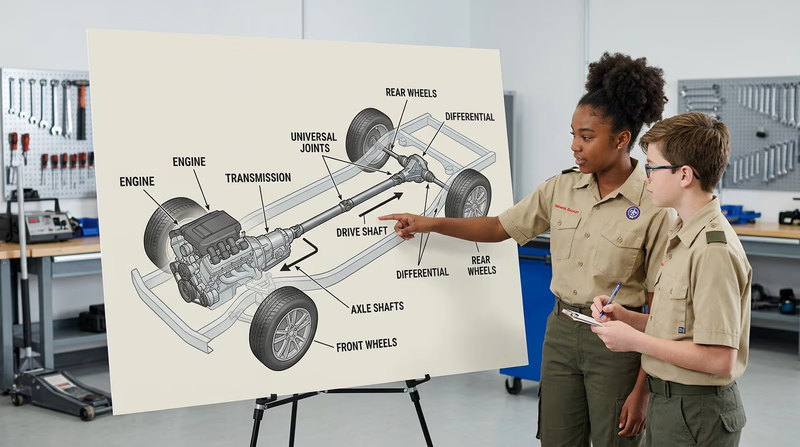
Transmission — Connected directly to the engine, the transmission uses gears to multiply the engine’s torque and match engine speed to vehicle speed. At low speeds, the transmission uses lower gears (more torque, less speed). At highway speeds, it shifts to higher gears (less torque, more speed). Think of it like the gears on a bicycle — you use a low gear to start pedaling from a stop and shift to a higher gear once you are rolling.
Drive shaft (or propeller shaft) — A long, rotating metal tube that connects the transmission to the differential. Found primarily in rear-wheel-drive and four-wheel-drive vehicles. Front-wheel-drive vehicles use shorter half shafts (axle shafts) instead.
Universal joints (U-joints) — Flexible couplings at each end of the drive shaft that allow it to move up and down with the suspension while still spinning. They compensate for the angle between the transmission (which is fixed to the frame) and the differential (which moves with the axle).
Differential — A gearbox between the drive wheels that serves two purposes:
- It turns the rotational direction 90 degrees (from the lengthwise drive shaft to the sideways axles).
- It allows the two drive wheels to spin at different speeds when turning a corner. The outside wheel travels a longer distance than the inside wheel, so it must spin faster.
Axle shafts (half shafts) — Connect the differential to the drive wheels. They transmit the rotational force from the differential to the wheel hubs.
CV joints (Constant Velocity joints) — Found on front-wheel-drive vehicles and independent rear suspensions. They do the same job as U-joints but are designed to operate at sharper angles and maintain a constant speed, which is necessary because front wheels must both steer and be driven.
Manual (Standard) Transmission
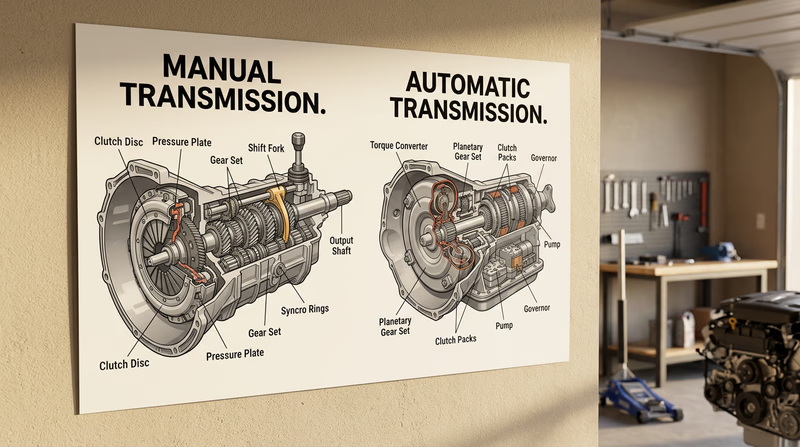
A manual transmission requires the driver to select gears manually using a gear shift lever and a clutch pedal.
- Clutch pedal — Pressing the clutch disconnects the engine from the transmission momentarily, allowing the driver to change gears without grinding.
- Gear shift — The driver moves the lever into the desired gear position (1st, 2nd, 3rd, 4th, 5th, and sometimes 6th, plus reverse).
- How it works: The driver presses the clutch, moves the shifter to the next gear, and releases the clutch to re-engage power. The driver decides when to shift based on engine RPM, speed, and driving conditions.
Advantages: More driver control, often more fuel-efficient in older designs, lower maintenance costs (no automatic transmission fluid changes), and some drivers simply enjoy the engagement of shifting.
Disadvantages: Requires more skill, can be tiring in stop-and-go traffic, and is harder to learn.
Automatic Transmission
An automatic transmission shifts gears on its own — the driver just selects Drive (D), Reverse (R), Neutral (N), or Park (P).
- Torque converter — Replaces the clutch pedal. It uses fluid (automatic transmission fluid, or ATF) to transfer power from the engine to the transmission. The torque converter allows the engine to keep running while the vehicle is stopped.
- Planetary gear sets — Instead of the sliding gears in a manual, automatics use sets of interlocking gears controlled by clutch packs and bands inside the transmission. The vehicle’s computer decides when to shift.
Advantages: Easier to drive, better in traffic, and modern automatics are often more fuel-efficient than manuals.
Disadvantages: More complex, more expensive to repair, and requires periodic automatic transmission fluid changes.
CVT (Continuously Variable Transmission)
A CVT is a type of automatic transmission that uses a belt and two variable-diameter pulleys instead of fixed gears. It can smoothly adjust to any ratio between its minimum and maximum, giving the engine the most efficient speed at all times. You will notice that the engine RPM stays relatively constant while the vehicle accelerates — there are no distinct “shifts.”