Req 9c — Fluids & Drive Configurations
Automatic Transmission Fluid (ATF)
ATF does far more than just lubricate — it is the hydraulic fluid that makes an automatic transmission work. It transmits power through the torque converter, activates the clutch packs and bands that change gears, cools the transmission, and cleans internal components.
Not all ATF is the same. Different transmissions require different fluid formulations, and using the wrong type can cause shifting problems, increased wear, or outright transmission failure.
Common ATF types:
| Type | Description |
|---|---|
| DEXRON (various versions) | Developed by GM. DEXRON VI is the current standard. Used in many GM, BMW, and Toyota vehicles. |
| MERCON (various versions) | Developed by Ford. MERCON V and MERCON LV are current standards. |
| ATF+4 | Developed by Chrysler/Stellantis. Required for most Dodge, Jeep, Ram, and Chrysler vehicles. |
| CVT Fluid | Specifically formulated for continuously variable transmissions. Never use conventional ATF in a CVT. |
| Multi-Vehicle ATF | Aftermarket formulations designed to work in multiple vehicle brands. Convenient but always verify compatibility. |
How to identify the correct ATF:
- Check the owner’s manual — it lists the exact specification required.
- The transmission dipstick handle (if equipped) sometimes lists the ATF type.
- The vehicle’s door jamb sticker may include fluid specifications.
Manual Transmission Fluid
Manual transmissions do not use ATF (with a few exceptions). Instead, they typically use one of these lubricants:
- Gear oil — A thick, high-viscosity oil rated by the API GL (Gear Lubricant) system. GL-4 is common for manual transmissions; GL-5 is for hypoid gears in differentials.
- Manual transmission fluid (MTF) — Some manufacturers specify a lighter, special-purpose fluid designed for smoother shifting.
- Engine oil — A few manual transmissions (like some Honda models) actually use regular engine oil.
Always use the exact type specified in the owner’s manual — the wrong lubricant can cause hard shifting, gear damage, or synchronizer wear.
Differential Fluid (Gear Oil)
The differential contains gears that operate under heavy loads and high pressures. They need thick, durable gear oil — typically rated 75W-90 or 80W-90.
- GL-5 rated gear oil is the standard for most differentials.
- Some limited-slip differentials (LSD) require a friction modifier additive mixed into the gear oil. If you hear a chattering or clunking noise from the rear end when turning (especially in parking lots), it often means the limited-slip additive is needed.
Transfer Case Fluid
The transfer case is found only in four-wheel-drive (4WD) and all-wheel-drive (AWD) vehicles. It splits power from the transmission between the front and rear axles.
Transfer cases may use:
- ATF (in some older designs)
- Gear oil
- A manufacturer-specific transfer case fluid
The owner’s manual specifies the correct fluid and the recommended change interval (often every 30,000 to 60,000 miles).
Drive Configurations
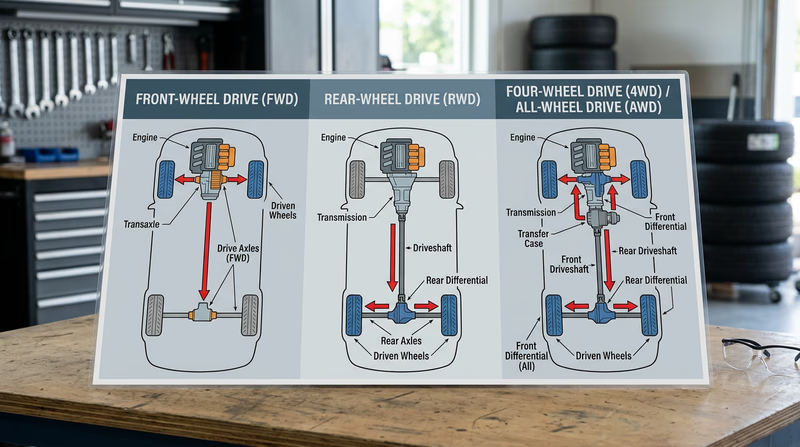
The drive configuration describes which wheels receive power from the engine. Each has advantages and trade-offs.
Front-Wheel Drive (FWD):
- The engine, transmission, and differential are all in the front of the vehicle, and power goes to the front wheels only.
- Advantages: Better traction in rain and light snow (the weight of the engine sits over the drive wheels), more interior space (no drive shaft tunnel), and generally better fuel economy.
- Disadvantages: The front wheels handle both steering and driving, which limits performance in hard cornering. Not ideal for towing heavy loads.
- Common in: Most sedans, hatchbacks, and compact SUVs.
Rear-Wheel Drive (RWD):
- The engine is in the front, and a drive shaft sends power to the rear wheels.
- Advantages: Better weight distribution (front wheels steer, rear wheels push), better handling and performance, and better for towing because acceleration shifts weight onto the rear drive wheels.
- Disadvantages: Less traction in slippery conditions because less weight sits over the drive wheels.
- Common in: Pickup trucks, sports cars, luxury sedans, and most large SUVs.
Four-Wheel Drive (4WD):
- Power is sent to all four wheels through a transfer case that splits power between the front and rear axles.
- Part-time 4WD: The driver selects 4WD mode when needed (off-road, snow, mud). The vehicle normally operates in 2WD. Should not be used on dry pavement — the locked transfer case can cause drivetrain binding.
- Full-time 4WD: The system operates in 4WD at all times, with a center differential that allows for use on dry pavement.
- Common in: Trucks and off-road SUVs.
All-Wheel Drive (AWD):
- Similar to 4WD, but operates automatically — no driver input needed. The vehicle’s computer continuously varies the power split between front and rear axles based on traction conditions.
- Common in: Crossover SUVs, performance sedans, and wagons.