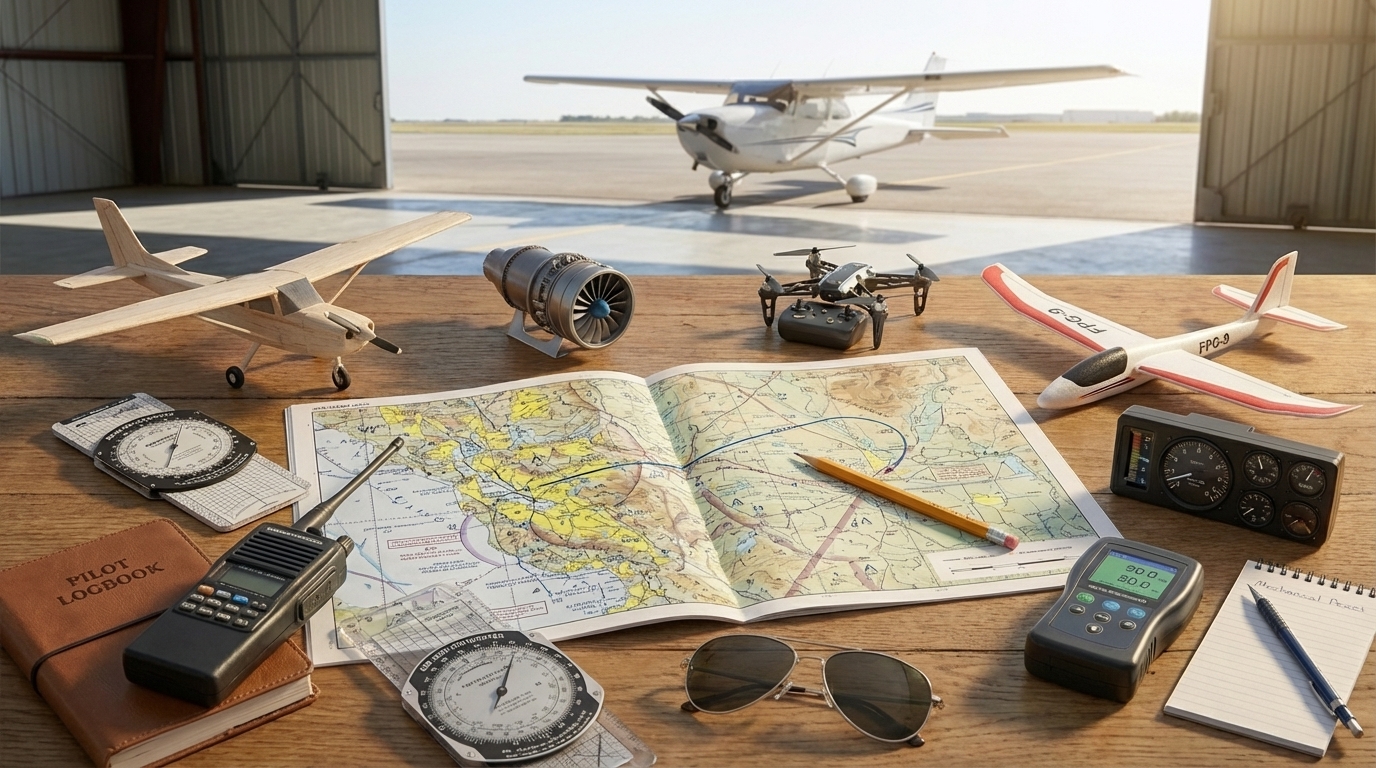
Aviation Merit Badge — Complete Digital Resource Guide
https://merit-badge.university/merit-badges/aviation/guide/
Introduction & Overview
Have you ever looked up at a jet streaking across the sky and wondered what it would be like to sit at the controls? The Aviation merit badge is your chance to find out. You will learn how aircraft fly, how pilots navigate, and what it takes to turn a fascination with flight into a real-world skill — or even a career.
Aviation is about more than airplanes. It is about the human desire to explore, push boundaries, and solve problems. From the first glider experiments to modern drones delivering packages, aviation has shaped the world you live in. This guide will help you understand the science, the history, and the future of flight.
Then and Now
Then — The Dream of Flight
For thousands of years, humans watched birds and dreamed of joining them. Leonardo da Vinci sketched flying machines in the 1480s, but none of them could actually fly. In 1783, the Montgolfier brothers launched the first hot-air balloon in France — proving that people could leave the ground. But powered, controlled flight remained out of reach for another 120 years.
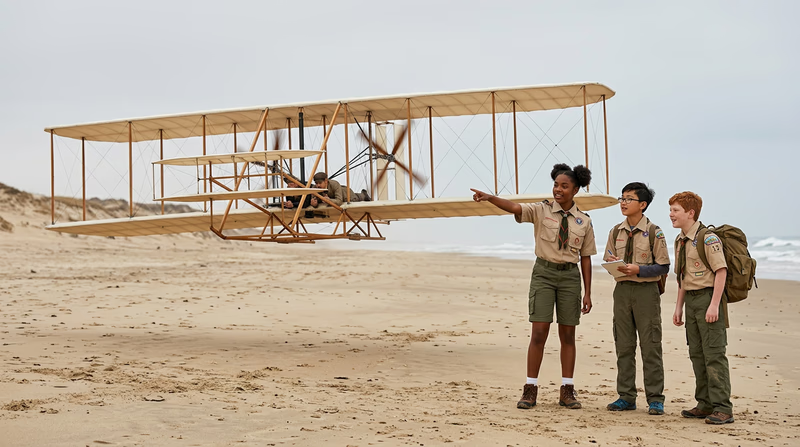
On December 17, 1903, Orville and Wilbur Wright made four flights at Kitty Hawk, North Carolina. The longest lasted just 59 seconds and covered 852 feet — less than the length of three football fields. Within a decade, airplanes were crossing the English Channel. Within half a century, jets were carrying passengers across oceans.
- Purpose: Exploration, military advantage, delivering mail and cargo
- Mindset: “Can it be done?” — every flight was an experiment
Now — The Age of Aviation
Today, more than 100,000 commercial flights take off every day around the world. Aviation connects people, moves goods, fights wildfires, rescues stranded hikers, and monitors weather from the edge of space. Meanwhile, drones are opening an entirely new chapter — from aerial photography to package delivery to search-and-rescue in disaster zones.
- Purpose: Transportation, commerce, defense, science, recreation
- Mindset: “How can we do it better?” — safer, faster, greener, and more accessible
Get Ready! Whether you dream of becoming a pilot, an aerospace engineer, or you just want to understand the science behind every flight, this guide will get you off the ground. Let’s clear the runway.
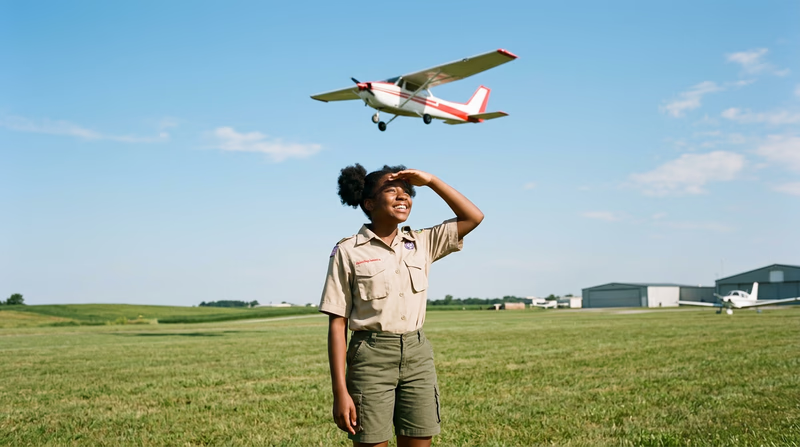
Kinds of Aviation
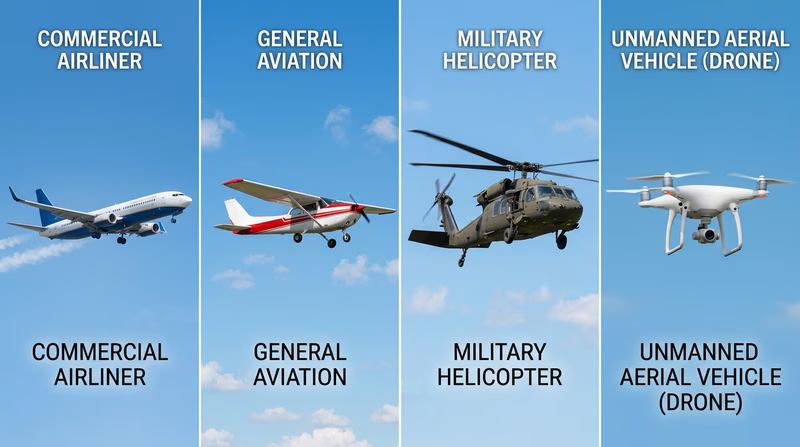
Aviation is a huge field. Before you dive into the requirements, take a look at the major categories of flight.
Commercial Aviation
Commercial aviation is what most people think of when they hear the word “aviation.” Airlines carry billions of passengers every year on scheduled routes around the globe. From regional turboprops hopping between small cities to wide-body jets crossing the Pacific, commercial aviation keeps the world connected.
General Aviation
General aviation covers everything that is not a military flight or a scheduled airline flight. That includes private pilots flying for fun on a Saturday morning, crop dusters treating farm fields, air ambulances rushing patients to hospitals, and flight schools training the next generation of pilots. In the United States, there are more general aviation airports than commercial ones.
Military Aviation
Military aviation includes fighter jets, bombers, transport aircraft, helicopters, and surveillance drones operated by the armed forces. Military needs have driven some of the biggest leaps in aviation technology — jet engines, radar, stealth design, and in-flight refueling all started as military innovations before finding their way into civilian life.
Unmanned Aircraft (Drones & UAS)
Unmanned Aircraft Systems — commonly called drones — are the fastest-growing segment of aviation. They range from palm-sized quadcopters to large fixed-wing platforms that can stay airborne for hours. Drones are used for aerial photography, agriculture, infrastructure inspections, search and rescue, and even delivering medical supplies to remote areas.
Space and Emerging Aviation
The boundary between aviation and space is blurring. Companies are developing aircraft that fly at the edge of space, electric-powered air taxis designed to carry passengers across cities, and supersonic jets that could cut transoceanic flight times in half. The next chapter of aviation is being written right now — and you could be part of it.
Now let’s take to the sky and explore the requirements for the Aviation merit badge.
Req 1a — What Is an Aircraft?
Let’s start with the most basic question in aviation: what exactly is an aircraft?
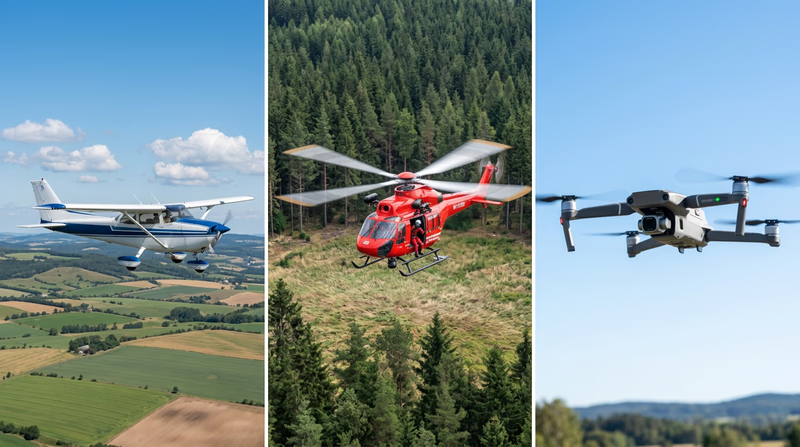
An aircraft is any vehicle or machine that is designed to fly by gaining support from the air. That support can come from wings that generate lift, from spinning rotors, from lighter-than-air gases like helium, or even from the thrust of a rocket engine pushing against the atmosphere. If it is built to fly through the air, it is an aircraft.
That definition covers a lot of machines. Here are some of the most common kinds you will encounter.
Fixed-Wing Airplanes
Fixed-wing airplanes are probably what you picture when you hear the word “aircraft.” They have rigid wings attached to a fuselage (the body of the plane), and they generate lift by moving forward through the air. The forward motion comes from propellers or jet engines.
Typical uses: Commercial passenger travel, cargo transport, crop dusting, aerial surveying, private recreation, military combat and reconnaissance.
Fixed-wing airplanes range from tiny single-seat ultralights to massive four-engine cargo planes that can carry tanks and helicopters inside their fuselage.
Helicopters (Rotorcraft)
Helicopters use spinning rotor blades mounted on top of the aircraft to generate lift. Because the rotor can change its angle and speed, helicopters can take off and land vertically, hover in place, and fly in any direction — including backward and sideways.
Typical uses: Emergency medical transport, search and rescue, law enforcement, news reporting, firefighting, offshore oil rig support, military operations.
Helicopters trade speed and efficiency for versatility. They cannot fly as fast or as far as airplanes on the same amount of fuel, but they can go places no airplane can reach.
Unmanned Aircraft Systems (Drones)
Drones — formally called Unmanned Aircraft Systems (UAS) — are aircraft that fly without a pilot on board. They are controlled remotely by an operator on the ground or follow a pre-programmed flight path using GPS.
Typical uses: Aerial photography and videography, agricultural monitoring, infrastructure inspection (bridges, power lines, pipelines), package delivery, search and rescue, scientific research, military surveillance and operations.
Other Kinds of Aircraft
Your counselor may ask about additional types. Here are a few more worth knowing:
- Lighter-than-air craft (balloons and airships): These float because they are filled with a gas that is lighter than the surrounding air, such as helium or heated air. Hot-air balloons are used for recreation, while blimps and airships are used for advertising and surveillance.
- Gliders (sailplanes): These are fixed-wing aircraft with no engine. They are towed to altitude by a powered airplane and then released to soar on rising air currents called thermals. Gliders are used for recreation and pilot training.
- Tiltrotor aircraft: These combine features of helicopters and airplanes. The V-22 Osprey, used by the U.S. military, can take off vertically like a helicopter, then tilt its rotors forward to fly like an airplane at much higher speeds.
Req 1b — History of Flight
The story of flight is one of the greatest adventure stories ever told. It stretches from ancient myths to the edge of space, and almost every chapter involves someone who was told “that’s impossible” and did it anyway.
The Evolution of Flight
The dream of flying is as old as civilization itself. The ancient Greek myth of Daedalus and Icarus imagined wings made of feathers and wax. In China, people flew kites more than 2,000 years ago — the first human-made objects to ride the wind.
Real progress began in the late 1700s and accelerated through the 1800s:
- 1783: The Montgolfier brothers launched the first hot-air balloon flight with passengers in Paris, France. Humans left the ground for the first time.
- 1804: Sir George Cayley built and flew the first successful glider, establishing the basic principles of aerodynamics that aircraft still use today.
- 1891–1896: Otto Lilienthal made over 2,000 glider flights in Germany, carefully recording data about lift and control. His published research directly inspired the Wright brothers.
- 1903: Orville and Wilbur Wright achieved the first powered, sustained, and controlled airplane flight at Kitty Hawk, North Carolina.
From that point, aviation advanced at an astonishing pace. Within 66 years of the Wright brothers’ first flight, humans walked on the Moon.
Three Notable Moments in Aviation History
Your counselor will ask you to discuss three notable times in history that were important to aviation. Here are several to choose from — pick the ones that interest you most and be ready to explain why each one mattered.
1. The Wright Brothers’ First Flight (1903)
On December 17, 1903, at Kill Devil Hills near Kitty Hawk, North Carolina, Orville Wright piloted the Wright Flyer for 12 seconds, covering 120 feet. That same day, Wilbur flew 852 feet in 59 seconds. These flights proved that powered, controlled flight was possible.
Why it matters: Everything in modern aviation traces back to this moment. The Wrights did not just build a flying machine — they solved the problem of control. Their system of wing warping (twisting the wings to turn) was the ancestor of the ailerons used on every airplane today.
2. Charles Lindbergh Crosses the Atlantic (1927)
On May 20–21, 1927, Charles Lindbergh flew solo from New York to Paris in the Spirit of St. Louis, covering 3,610 miles in 33.5 hours without stopping. He had no copilot, no radio, and at times he could barely stay awake.
Why it matters: Lindbergh’s flight captured the world’s imagination and proved that long-distance air travel was practical. Investment in aviation exploded afterward, leading to the first commercial airlines.
3. Breaking the Sound Barrier (1947)
On October 14, 1947, U.S. Air Force Captain Chuck Yeager flew the Bell X-1 rocket plane faster than the speed of sound — Mach 1 — over the Mojave Desert. Many engineers believed the “sound barrier” would destroy any aircraft that tried to cross it.
Why it matters: Yeager’s flight opened the door to supersonic aviation and, eventually, to the space program. It proved that the laws of physics could be worked with, not just feared.
Other Notable Moments Worth Knowing
- Amelia Earhart’s solo Atlantic crossing (1932): The first woman to fly solo across the Atlantic Ocean, proving that aviation was not limited by gender.
- The jet age begins (1952): The de Havilland Comet became the first commercial jet airliner, slashing travel times and making air travel affordable for ordinary people.
- Apollo 11 (1969): While technically spaceflight, the Apollo program relied on aviation technology and pilots — including Neil Armstrong, who was a former Navy aviator and test pilot.
- First drone strike / UAS operations (2000s): Military drones changed modern warfare and opened the door to civilian drone applications that are now part of everyday life.
Req 1c — Fixed Wing vs. Rotary Wing
All aircraft that are heavier than air need wings to fly. The big question is: how do those wings move through the air to generate lift? That single question divides aircraft into two major families.
Fixed-Wing Aircraft
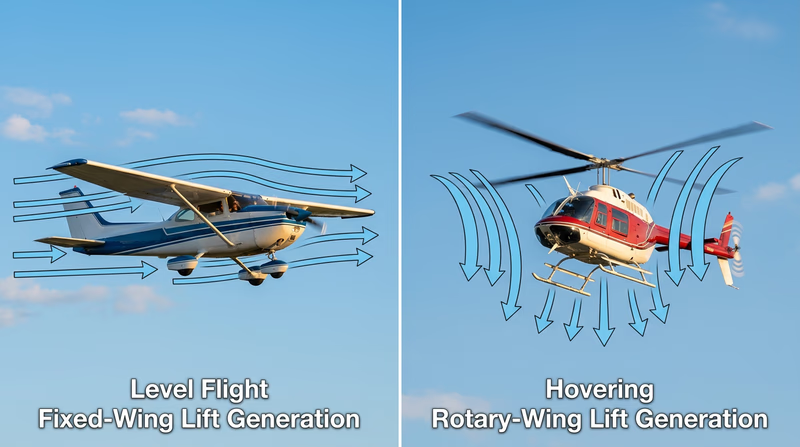
A fixed-wing aircraft has wings that are rigidly attached to the fuselage. The wings do not move on their own — instead, the entire airplane moves forward through the air, and that forward motion causes air to flow over the wings and generate lift.
Think of it this way: a fixed-wing aircraft must keep moving forward to stay in the air. If it slows down too much, the wings stop generating enough lift and the aircraft stalls — meaning it can no longer maintain altitude.
Benefits of fixed-wing aircraft:
- Speed: Fixed-wing airplanes are generally faster than helicopters. Commercial jets cruise at 500–600 mph, while the fastest helicopters top out around 250 mph.
- Range: Airplanes can fly farther on the same amount of fuel because forward flight is more aerodynamically efficient.
- Fuel efficiency: The streamlined shape and forward-flight design mean airplanes burn less fuel per mile than helicopters.
- Payload capacity: Airplanes can carry heavier loads — from passengers to military cargo — over long distances.
- Altitude: Fixed-wing aircraft can fly at higher altitudes, above weather and turbulence.
Examples: Cessna 172, Boeing 737, F-16 fighter jet, gliders
Rotary-Wing Aircraft
A rotary-wing aircraft — most commonly a helicopter — has wings that spin. The rotor blades on top of a helicopter are actually long, narrow wings rotating in a circle. As they spin, they push air downward and generate lift, even when the aircraft is not moving forward.
Because the rotor generates lift independently of forward motion, rotary-wing aircraft can do things that fixed-wing aircraft cannot:
Benefits of rotary-wing aircraft:
- Vertical takeoff and landing (VTOL): Helicopters do not need a runway. They can take off and land in a parking lot, a rooftop, a forest clearing, or a ship deck.
- Hovering: A helicopter can stay in one spot in the air — critical for rescue hoists, aerial crane work, and surveillance.
- Low-speed flight: Helicopters can fly slowly or even backward, making them ideal for search patterns and precision work.
- Access to confined areas: Helicopters can reach places no airplane can, like mountain ledges, offshore platforms, and dense urban areas.
Examples: Bell 206, Black Hawk (UH-60), CH-47 Chinook, Robinson R22
So Which Is Better?
Neither — they are built for different jobs. That is the key insight your counselor is looking for. Aviation is about picking the right tool for the mission.
| Feature | Fixed Wing | Rotary Wing |
|---|---|---|
| Needs a runway? | Yes | No |
| Can hover? | No | Yes |
| Faster? | Yes | No |
| More fuel-efficient? | Yes | No |
| Better for long distances? | Yes | No |
| Better for tight spaces? | No | Yes |
What About Tiltrotors?
Some aircraft try to get the best of both worlds. The V-22 Osprey, used by the U.S. Marine Corps, has rotors that point upward for vertical takeoff and then tilt forward for high-speed cruising flight. It can hover like a helicopter and fly fast like an airplane — but it is more complex and expensive than either.
NASA — How Do Helicopters Fly? NASA's interactive guide explaining how helicopter rotors generate lift and how pilots control them. Link: NASA — How Do Helicopters Fly? — https://www.grc.nasa.gov/www/k-12/helicopter/helicopter.htmlReq 1d — How Engines Work
Every powered aircraft needs an engine to generate thrust — the force that pushes (or pulls) the aircraft through the air. There are three main types of aircraft engines, and they each work in a different way. Let’s break them down.
Piston Engines
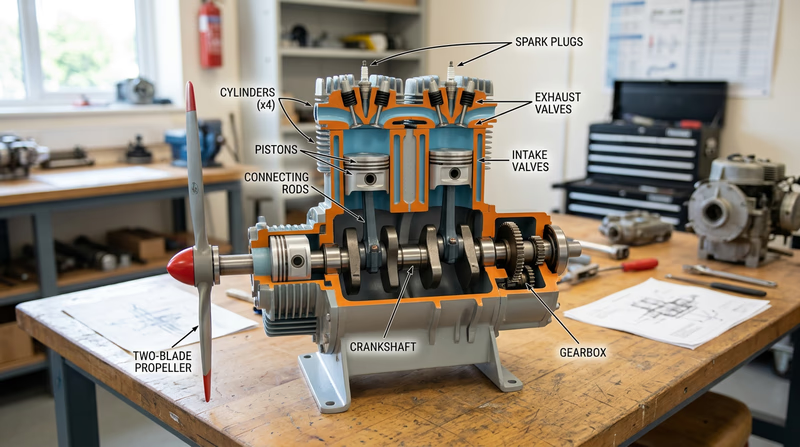
A piston engine (also called a reciprocating engine) works the same way as a car engine. Inside the engine, pistons move up and down inside cylinders, and that motion turns a crankshaft. The crankshaft is connected to a propeller, and the spinning propeller pulls the aircraft forward through the air.
How it works (four-stroke cycle):
- Intake: The piston moves down, pulling a mixture of fuel and air into the cylinder.
- Compression: The piston moves up, squeezing the fuel-air mixture into a small space.
- Power: A spark plug ignites the compressed mixture. The explosion pushes the piston back down with great force.
- Exhaust: The piston moves up again, pushing the burned gases out of the cylinder.
This cycle repeats thousands of times per minute across multiple cylinders, spinning the propeller and generating thrust.
Where you find them: Most small, single-engine aircraft like the Cessna 172 and Piper Cherokee use piston engines. They are reliable, relatively inexpensive, and efficient for low-altitude, low-speed flight.
Turbine Engines (Turboprops)
A turbine engine uses a rapidly spinning turbine — a wheel with many angled blades — to generate power. Instead of pistons moving up and down, a turbine engine uses a continuous flow of air and fuel.
How it works:
- Compressor: Air enters the front of the engine and is squeezed to high pressure by spinning compressor blades.
- Combustion chamber: Fuel is sprayed into the compressed air and ignited. The burning mixture expands rapidly.
- Turbine: The hot, expanding gases rush through the turbine blades, causing them to spin. The spinning turbine drives the compressor at the front (keeping the cycle going) and also drives a propeller through a gearbox.
- Exhaust: The remaining gases exit out the back.
In a turboprop aircraft, the turbine engine drives a propeller — just like a piston engine does. But turbine engines are lighter, more powerful, and more reliable at higher altitudes.
Where you find them: Regional airliners (like the Dash 8), military transport planes (like the C-130 Hercules), and some business aircraft use turboprop engines.
Jet Engines (Turbojets and Turbofans)
A jet engine is actually a type of turbine engine — but instead of using the turbine to drive a propeller, it generates thrust by pushing a high-speed stream of exhaust gases out the back of the engine. Newton’s Third Law of Motion is the key: for every action (hot gas shooting backward), there is an equal and opposite reaction (the engine — and the airplane — being pushed forward).
How it works:
- Fan / Intake: Air enters the front of the engine. In a modern turbofan, a large fan at the front pushes most of the air around the outside of the engine core (bypass air), which produces the majority of the thrust.
- Compressor: The remaining air enters the engine core and is compressed to very high pressure.
- Combustion chamber: Fuel is mixed with the compressed air and ignited.
- Turbine: The hot gases spin the turbine, which drives the compressor and the front fan.
- Exhaust nozzle: The hot gases blast out the back at high speed, producing thrust.
Where you find them: Commercial airliners (Boeing 737, Airbus A320), military fighters (F-22, F-35), and large cargo aircraft. Nearly all modern jets use high-bypass turbofan engines because they are quieter and more fuel-efficient than pure turbojets.
Comparing the Three Engine Types
| Feature | Piston | Turboprop | Jet (Turbofan) |
|---|---|---|---|
| Speed range | Slow (up to ~250 mph) | Medium (250–400 mph) | Fast (400–600+ mph) |
| Best altitude | Low (below 15,000 ft) | Medium (15,000–30,000 ft) | High (30,000–45,000 ft) |
| Fuel efficiency | Best at low speed/altitude | Good at medium speed | Best at high speed/altitude |
| Complexity | Simplest | Moderate | Most complex |
| Typical aircraft | Cessna 172, Piper Cherokee | King Air, C-130 | Boeing 737, F-16 |
Req 1e — Four Forces of Flight
Grab a model airplane — a plastic kit, a balsa wood glider, even a paper airplane will do. Hold it in front of you. There are four invisible forces acting on every aircraft in flight, and understanding them is the key to understanding everything else in aviation.
The Four Forces
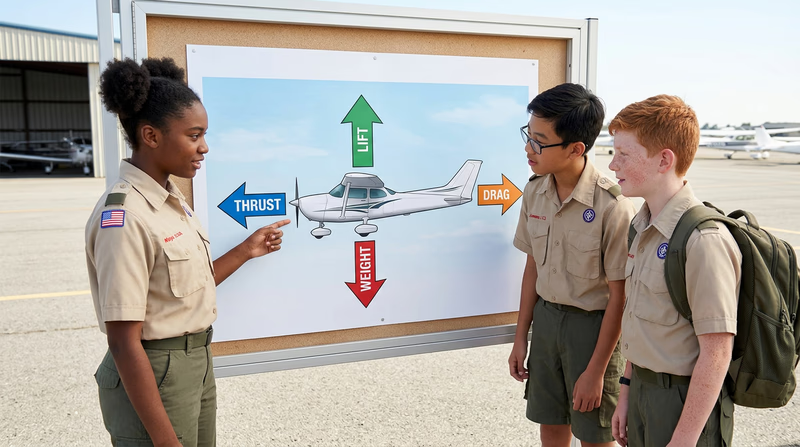
Imagine your model airplane in level, straight flight — not climbing, not descending, not turning. At that moment, four forces are perfectly balanced:
1. Lift
Lift is the upward force generated by the wings. As air flows over and under the wing, the special shape of the wing (called an airfoil) creates a pressure difference that pushes the aircraft upward. Lift acts perpendicular to the direction of flight — straight up when the airplane is flying level.
Lift must be equal to or greater than the aircraft’s weight to keep it in the air.
2. Weight (Gravity)
Weight is the downward force of gravity pulling the aircraft toward the Earth. It includes everything — the airplane itself, the fuel, the passengers, the cargo, and all the equipment on board.
Weight always acts straight down, toward the center of the Earth. An aircraft that is too heavy for its wings to support will not be able to take off.
3. Thrust
Thrust is the forward force that moves the aircraft through the air. It comes from the engine — whether that is a propeller, a jet, or a rocket. Thrust pushes (or pulls) the aircraft in the direction it is pointed.
Without thrust, the aircraft would slow down, lose airflow over the wings, and lose lift.
4. Drag
Drag is the backward force that resists the aircraft’s motion through the air. Think of it as air friction. Every part of the aircraft that is exposed to the airstream creates drag — the fuselage, the wings, the landing gear, even the rivets on the skin.
Drag always acts in the opposite direction of the aircraft’s motion.
How the Forces Work Together
When all four forces are balanced, the aircraft flies in steady, level flight:
- Lift = Weight → The aircraft maintains its altitude (not climbing or sinking)
- Thrust = Drag → The aircraft maintains its speed (not speeding up or slowing down)
When a pilot wants to change what the aircraft is doing, they change the balance:
- To climb: Increase thrust (add power) or increase lift (pull back on the stick to raise the nose). Now lift is greater than weight.
- To descend: Reduce thrust (reduce power) or reduce lift (push forward on the stick to lower the nose). Now weight is greater than lift.
- To speed up: Increase thrust. Now thrust is greater than drag.
- To slow down: Reduce thrust or increase drag (such as extending flaps or landing gear). Now drag is greater than thrust.
A Simple Experiment
Hold a sheet of paper by one edge so it droops down. Now blow steadily across the top surface. The paper rises! You just demonstrated lift — the faster-moving air across the top of the paper creates lower pressure, and the higher pressure below pushes the paper up. This is the same principle that holds an airplane in the sky.
NASA — Four Forces of Flight NASA's interactive guide to the four forces with animations showing how they interact during different phases of flight. Link: NASA — Four Forces of Flight — https://www.grc.nasa.gov/www/k-12/airplane/forces.htmlReq 1f — Airfoils & Lift
You know that lift is the force that holds an airplane in the sky. But how does a wing actually create lift? The answer starts with the shape of the wing — a shape called an airfoil.
What Is an Airfoil?
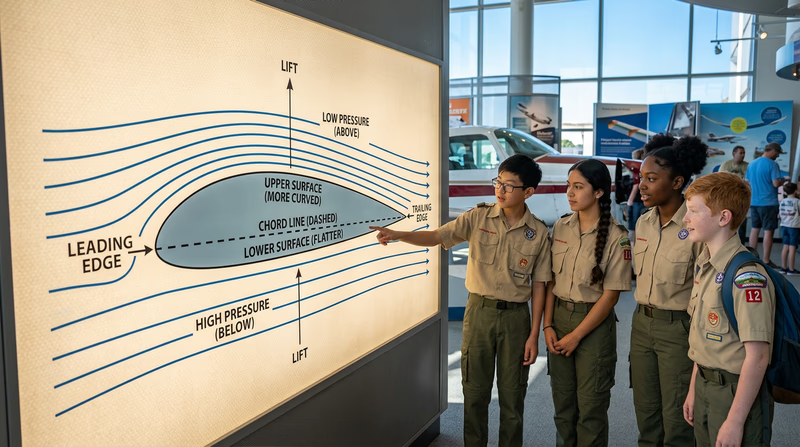
An airfoil is the cross-sectional shape of a wing when you slice through it from front to back. If you could cut a wing in half and look at the cut edge, you would see a teardrop-like shape: rounded and thick at the front (the leading edge), thinner toward the back (the trailing edge), and slightly curved on top.
That curve is critical. The top surface of an airfoil is more curved than the bottom surface. This difference in shape is what makes flight possible.
Bernoulli’s Principle
In the 1700s, a Swiss mathematician named Daniel Bernoulli discovered something important about fluids (which includes air): when a fluid speeds up, its pressure drops. When a fluid slows down, its pressure rises.
This is called Bernoulli’s principle, and it is one of the main reasons airplanes can fly.
Here is how it works on a wing:
- Air approaches the wing and splits at the leading edge. Some air goes over the top, and some goes under the bottom.
- The curved upper surface forces the air traveling over the top to travel a longer path. To keep up with the air going underneath, the air on top speeds up.
- According to Bernoulli’s principle, the faster-moving air on top creates lower pressure above the wing.
- The slower-moving air on the bottom creates higher pressure below the wing.
- This pressure difference pushes the wing upward. That upward push is lift.
Angle of Attack
Bernoulli’s principle is the primary explanation, but there is another factor that contributes to lift: the angle of attack.
The angle of attack is the angle between the wing’s chord line (an imaginary straight line from the leading edge to the trailing edge) and the direction the air is coming from. When a pilot tilts the nose of the airplane up slightly, the angle of attack increases. The wing deflects more air downward, and by Newton’s Third Law (every action has an equal and opposite reaction), the wing is pushed upward.
But there is a limit. If the angle of attack gets too steep, the smooth airflow over the top of the wing breaks apart into turbulent swirls. The wing suddenly loses most of its lift. This is called a stall, and it has nothing to do with the engine — it is purely about the wing losing its grip on the air.
Try It Yourself
You can demonstrate Bernoulli’s principle with a simple experiment:
- Hold a strip of paper (about 1 inch wide and 8 inches long) by one short end so it droops down in front of you.
- Blow a steady stream of air across the top surface of the paper.
- Watch the paper rise! The fast-moving air you blew across the top created lower pressure than the still air below. The pressure difference pushed the paper up — exactly how a wing generates lift.
Req 1g — Control Surfaces
You already know the four forces and how a wing generates lift. Now it is time to learn how a pilot actually steers the airplane. Unlike a car, which turns left and right on a flat surface, an airplane moves in three dimensions — it can pitch up and down, roll side to side, and yaw left and right. Each of these movements is controlled by a specific set of control surfaces.
The Three Axes of Flight
Before we look at the control surfaces, you need to understand the three axes an airplane rotates around:
- Lateral axis (wing tip to wing tip): Rotation around this axis is called pitch — the nose goes up or down.
- Longitudinal axis (nose to tail): Rotation around this axis is called roll — one wing goes up while the other goes down.
- Vertical axis (top to bottom): Rotation around this axis is called yaw — the nose swings left or right.
Each axis has a dedicated control surface.
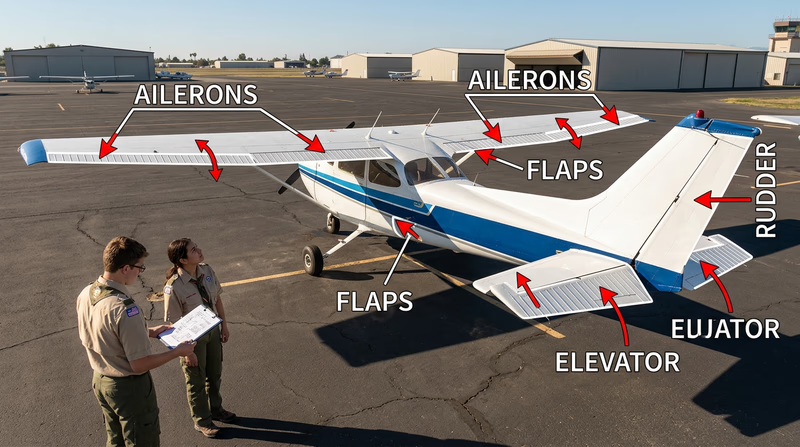
Ailerons — Control Roll
Ailerons are hinged panels on the trailing edge (back edge) of each wing, near the wing tips. They work in opposite directions: when the left aileron goes up, the right aileron goes down.
- The wing with the aileron deflected down generates more lift and rises.
- The wing with the aileron deflected up generates less lift and drops.
- The result: the airplane rolls (banks) in the direction the pilot wants to turn.
The pilot controls the ailerons with the control yoke (or stick) — turning it left rolls the airplane left; turning it right rolls the airplane right.
Elevator — Controls Pitch
The elevator is a hinged panel on the trailing edge of the horizontal stabilizer — the small horizontal “wing” at the tail of the airplane.
- When the pilot pulls back on the yoke, the elevator deflects up, which pushes the tail down and the nose up. The airplane pitches up and climbs.
- When the pilot pushes forward on the yoke, the elevator deflects down, which pushes the tail up and the nose down. The airplane pitches down and descends.
Some aircraft use a stabilator (also called an all-moving tail) instead of a separate elevator. The entire horizontal tail surface pivots as one piece.
Rudder — Controls Yaw
The rudder is a hinged panel on the trailing edge of the vertical stabilizer — the tall fin at the very back of the airplane.
- When the pilot pushes the left rudder pedal, the rudder swings to the left, and the nose yaws left.
- When the pilot pushes the right rudder pedal, the rudder swings to the right, and the nose yaws right.
The rudder is mainly used to coordinate turns (keeping the airplane from slipping sideways) and to keep the airplane straight during takeoff and landing. It is not the primary way to turn — that job belongs to the ailerons.
Secondary Control Surfaces
Beyond the three primary controls, most airplanes have additional surfaces that help with specific situations:
- Flaps: Located on the inboard (inner) trailing edge of the wings. Flaps extend downward to increase both lift and drag. Pilots use them during takeoff and landing to fly at slower speeds safely.
- Trim tabs: Small adjustable surfaces on the elevator (and sometimes the ailerons and rudder) that let the pilot fine-tune the control forces. Once trimmed, the pilot can fly with less physical effort on the yoke.
- Spoilers: Panels on the top surface of the wings that pop up to “spoil” (disrupt) the lift. Used to help descend quickly and to slow down after landing.
Control Surface Summary
How the pilot controls each axis- Ailerons (on wings): Control roll — turning the yoke left or right banks the airplane.
- Elevator (on horizontal tail): Controls pitch — pulling the yoke back raises the nose; pushing forward lowers it.
- Rudder (on vertical tail): Controls yaw — left pedal swings nose left; right pedal swings nose right.
- Flaps (on inner wings): Increase lift and drag for slower flight during takeoff and landing.
- Trim tabs (on control surfaces): Fine-tune control pressure so the pilot does not have to hold constant force.
Req 1h — Flight Instruments
Step inside the cockpit of a single-engine airplane and you will see a panel full of dials, gauges, and displays. It can look overwhelming at first, but each instrument has a specific job. A pilot scans these instruments constantly to know exactly what the airplane is doing — even when they cannot see the ground or the horizon.
The “Six Pack” — Core Flight Instruments
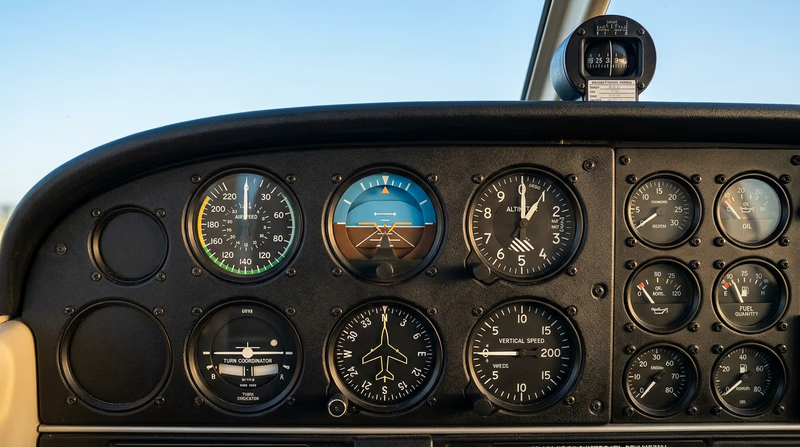
Most single-engine aircraft arrange six primary flight instruments in two rows of three, directly in front of the pilot. Pilots call this layout “the six pack.”
Attitude Indicator (Artificial Horizon)
The attitude indicator shows the airplane’s position relative to the horizon — is the nose pointed up, down, or level? Is the airplane banking left or right? It displays a miniature airplane symbol against a split background: blue on top (sky) and brown on bottom (ground).
This is the most important instrument for flying in clouds or at night when the pilot cannot see the real horizon.
Heading Indicator (Directional Gyro)
The heading indicator shows which compass direction the airplane is pointed — north, south, east, west, or anything in between. It uses a gyroscope to provide a stable, easy-to-read heading without the wobbling and errors that affect a magnetic compass.
Pilots periodically check the heading indicator against the magnetic compass and reset it if necessary, because gyroscopes can drift over time.
Altimeter
The altimeter tells the pilot how high the airplane is above sea level, measured in feet. It works by measuring air pressure — the higher you go, the lower the air pressure. The pilot sets a reference pressure (provided by air traffic control) to ensure the reading is accurate.
Airspeed Indicator
The airspeed indicator shows how fast the airplane is moving through the air, measured in knots (nautical miles per hour). It works by comparing the pressure of the air hitting the airplane head-on (ram air pressure) to the static air pressure around it.
The face of the airspeed indicator has color-coded arcs:
- Green arc: Normal operating range
- Yellow arc: Caution range — fly here only in smooth air
- White arc: Flap operating range
- Red line: Never-exceed speed — structural damage may occur beyond this point
Turn and Bank Indicator (Turn Coordinator)
The turn and bank indicator shows two things at once: the rate at which the airplane is turning, and whether the turn is coordinated (meaning the airplane is not slipping sideways through the air). It has a miniature airplane that tilts to show the turn direction and a ball in a curved tube that slides left or right if the turn is not balanced.
Pilots use the phrase “step on the ball” — if the ball slides left, press the left rudder pedal to center it.
Vertical Speed Indicator (VSI)
The vertical speed indicator shows whether the airplane is climbing, descending, or flying level, and how fast. It measures the rate of climb or descent in feet per minute. If the needle points to zero, the airplane is in level flight. Pointing up means climbing; pointing down means descending.
The Magnetic Compass
The magnetic compass is the simplest and most reliable navigation instrument in the cockpit. It is a magnetized needle (or card) floating in liquid that always points toward magnetic north. Unlike the heading indicator, it does not need electrical power or a gyroscope to work.
However, the compass has quirks. It wobbles during turns, it lags behind when accelerating or decelerating, and it can be affected by metals and electronics in the cockpit. That is why pilots use the heading indicator for moment-to-moment navigation and cross-check with the compass periodically.
Navigation Instruments
Navigation instruments help the pilot figure out where the airplane is and how to get where it is going:
- VOR (VHF Omnidirectional Range): Shows the airplane’s position relative to a ground-based radio beacon. The pilot tunes in a VOR station and the instrument shows whether the airplane is on course, left of course, or right of course.
- GPS (Global Positioning System): Modern aircraft use GPS receivers that show the airplane’s exact position on a moving map. GPS has largely replaced older radio-based navigation.
- ADF (Automatic Direction Finder): Points toward an AM radio beacon (NDB). Older technology, but still found in some aircraft.
Communication Equipment
A pilot’s radios are essential for safety:
- COM radio: Used to talk with air traffic control, other pilots, and airport ground services. Most aircraft have at least one VHF communication radio, tunable to specific frequencies.
- Transponder: Broadcasts the airplane’s identity and altitude to air traffic control radar. This is how controllers see airplanes on their screens.
Engine Performance Indicators
These gauges monitor the health and performance of the engine:
- Tachometer: Shows engine RPM (revolutions per minute) — how fast the engine is running.
- Oil pressure gauge: Indicates oil pressure. Low oil pressure is an emergency — the engine could seize.
- Oil temperature gauge: Shows engine oil temperature. Too hot means something is wrong.
- Fuel gauges: Show how much fuel remains in each tank.
- Exhaust gas temperature (EGT): Helps the pilot adjust the fuel-air mixture for efficient engine operation.
- Manifold pressure gauge: Shows the pressure of the fuel-air mixture entering the engine cylinders (on aircraft with constant-speed propellers).
Req 2 — Build & Fly
This is where you take everything you have learned about lift, drag, thrust, and weight and put it to the test with your own hands. You will pick one of the three options below, build (or obtain) a flying machine, and fly it. Each option teaches a different set of skills.
Option A: Build an FPG-9 Glider
An FPG-9 (Foam Plate Glider — 9 inch) is a simple, elegant glider made from a foam plate. It has no engine — you launch it by hand, and it glides on lift and momentum alone. The beauty of the FPG-9 is that small adjustments to the wing shape, tail angle, or center of gravity can dramatically change how it flies.
What you will need:
- A 9-inch foam plate (the kind used for picnics)
- Scissors
- A ruler
- A pen or marker for tracing the template
Tips for a great FPG-9:
- Keep the cuts clean and symmetrical. Even a small unevenness can cause the glider to veer off course.
- Adjust the elevon (the small tab at the back) up or down to control whether the glider climbs, dives, or flies level.
- Move a small piece of clay or tape to the nose to adjust the center of gravity. A nose-heavy glider dives; a tail-heavy glider stalls.
Running the competition: Set up a target landing zone (a hula hoop or a taped circle works great) and have each Scout launch from the same spot. Score based on how close each glider lands to the target. This tests precision and consistency, not just distance.
Option B: Build a Rubber-Band Airplane
A rubber-band powered balsa wood airplane uses a wound-up rubber band to spin a propeller, providing thrust. As the rubber band unwinds, the propeller pulls the airplane forward through the air, and the wings generate lift — just like a real piston-powered airplane.
What you will need:
- A balsa wood airplane kit (available at hobby shops and online) or individual balsa wood sheets, sticks, and a propeller kit
- Rubber bands (the long, thin kind designed for model aircraft)
- A small propeller and hook assembly
- Glue, sandpaper, and a craft knife
Tips for straight-line flight:
- Make sure the wing is mounted perfectly level and centered on the fuselage. A crooked wing makes the airplane turn.
- Adjust the thrust line — the direction the propeller pulls. If the airplane curves left, angle the propeller slightly to the right, and vice versa.
- Add a tiny amount of “up thrust” (angling the propeller slightly upward) to prevent the airplane from diving when power is on.
- Wind the rubber band consistently. More winds = more thrust, but too many can break the band.
Achieving 25 feet in a straight line: This takes patience and many test flights. Launch gently — do not throw the airplane. Let the propeller do the work. Adjust after every flight until the airplane tracks straight.

Option C: Fly a Powered Model or Drone
This option puts you in the pilot’s seat of a powered model airplane or a drone. Before you fly, though, there is an important legal requirement: you must pass The Recreational UAS Safety Test (TRUST).
What is TRUST? TRUST stands for The Recreational UAS Safety Test. It is a free, online knowledge test required by the FAA for all recreational drone and model aircraft pilots in the United States. The test covers airspace rules, safety guidelines, and FAA regulations. It typically takes 20–30 minutes to complete.
Getting your TRUST certification: The FAA has approved several free test providers. Visit the FAA’s TRUST page for a list of approved providers. The test is free and you receive a completion certificate immediately.
Tips for a successful flight:
- Read the manual for your specific aircraft or drone before powering it on.
- Find an open area free of obstacles, people, and overhead wires.
- Start with a hover (for drones) or a low-altitude pass (for airplanes) before attempting a full takeoff-and-landing cycle.
- Check wind conditions — gusty winds are challenging for beginners.
- Always perform a pre-flight check: battery charge, propeller condition, control response.
Req 3 — Flight Operations
Now it is time to experience the real world of aviation operations. You will choose two of the five options below. Each one gives you hands-on exposure to a different part of how aircraft actually get from point A to point B safely.
Option A: Flight Simulator
Flight simulators are not just video games — they are training tools used by real pilots. Modern simulators model realistic physics, weather, and aircraft systems. For this requirement, you will plan a course with specific headings, then fly that course from takeoff to landing.
Getting started with a simulator:
- Popular options include Microsoft Flight Simulator, X-Plane, and FlightGear (which is free and open source).
- Start with a simple single-engine aircraft like the Cessna 172 — the same plane most real student pilots begin with.
- Choose a departure airport and a destination airport that are 30–60 miles apart. Use the simulator’s map to plan your route.
Planning your headings:
- Determine the magnetic heading from your departure to your destination.
- Note any intermediate waypoints or heading changes.
- Write down your flight plan before you start: departure airport, initial heading, cruise altitude, heading changes, and destination airport.
Option B: Preflight Inspection
Every flight begins on the ground with a preflight inspection — a careful, methodical walk-around of the aircraft to check that everything is safe and ready to fly. No pilot skips this step, no matter how experienced they are.
How to arrange a preflight inspection:
- Contact a local flight school, flying club, or a pilot you know. Most flight schools are happy to let a Scout participate in a preflight with an instructor present.
- The EAA (Experimental Aircraft Association) Young Eagles program is another great resource — volunteer pilots often welcome Scouts.
What a preflight inspection covers:
Typical Preflight Checklist
Items checked during a walk-around of a single-engine airplane- Fuel level and quality: Check fuel quantity in each tank and drain a sample to check for water or contamination.
- Oil level: Check engine oil dipstick — must be within the acceptable range.
- Control surfaces: Move ailerons, elevator, and rudder to verify free and correct movement.
- Tires and brakes: Check tire condition, inflation, and brake pads.
- Propeller: Inspect for nicks, cracks, or damage. Even a small nick can cause vibration.
- Lights: Verify navigation lights, landing light, and beacon are working.
- Pitot tube and static ports: Ensure these openings are clear — they feed data to the airspeed indicator and altimeter.
- Skin and structure: Look for dents, cracks, or missing rivets on the fuselage and wings.
- Antennas: Confirm all antennas are attached and undamaged.
- Windshield: Check for cleanliness and cracks that could obscure the pilot’s view.
Option C: Aircraft Maintenance
Aircraft maintenance is the behind-the-scenes work that keeps flying safe. Every aircraft has a required maintenance schedule set by the manufacturer and enforced by the FAA.
How to find a maintenance activity:
- Contact a local FBO (Fixed Base Operator) at a general aviation airport. Many have maintenance shops on-site.
- Ask your merit badge counselor if they know a licensed A&P (Airframe and Powerplant) mechanic who would allow you to observe.
Key maintenance concepts:
- Annual inspection: Every aircraft must have a comprehensive inspection by a certified mechanic at least once a year to remain airworthy.
- 100-hour inspection: Aircraft used for hire (flight training, charter) require an additional inspection every 100 hours of flight time.
- Scheduled maintenance: Manufacturers publish specific maintenance intervals — oil changes every 50 hours, spark plug replacement every 500 hours, and so on.
- Airworthiness Directives (ADs): The FAA issues mandatory maintenance orders when a safety issue is discovered with a specific aircraft type.
Option D: Aeronautical Charts
An aeronautical chart (also called a sectional chart) is a pilot’s map. It shows airports, airspace boundaries, terrain elevations, radio navigation aids, and obstacles like towers and power lines. Learning to read one is like learning a new language — but once you understand the symbols, a huge amount of information fits on a single sheet.
Getting a chart:
- You can buy paper sectional charts from aviation supply stores or order them online.
- Free digital charts are available through the FAA’s website or apps like SkyVector.
Measuring a true course:
- Draw a straight line on the chart from your departure airport to your destination.
- Use a plotter (a special aviation ruler) to measure the angle of your course line relative to a meridian (a line of longitude). This angle is your true course.
Correcting for magnetic variation:
- True north (geographic) and magnetic north (where your compass points) are not in the same place. The difference is called magnetic variation (or declination).
- The chart shows lines of magnetic variation called isogonic lines. Read the variation for your area and add or subtract it from your true course to get your magnetic course.
- Memory aid: “East is least, west is best” — subtract east variation, add west variation.
Correcting for compass deviation:
- Every compass has small errors caused by metals and electronics in the aircraft. A compass deviation card posted near the compass shows these errors for different headings.
Correcting for wind drift:
- Wind pushes the airplane sideways. To fly a straight-line course, the pilot must point the nose slightly into the wind. The correction angle depends on wind speed and direction.
- A flight computer (manual E6B or electronic) calculates the wind correction angle.
Option E: Discovery Flight
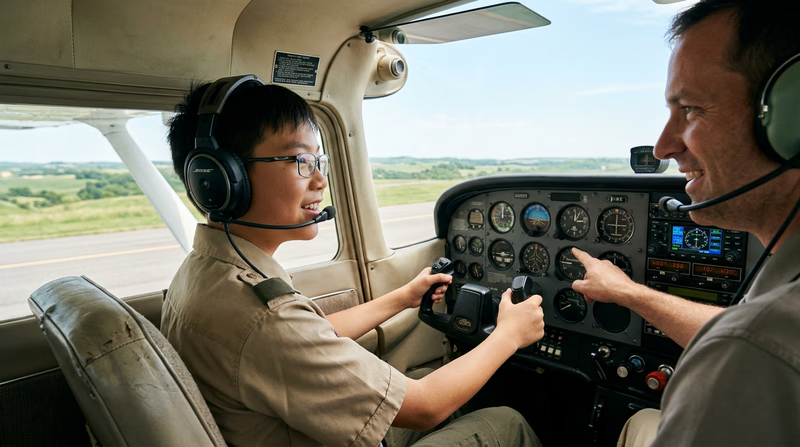
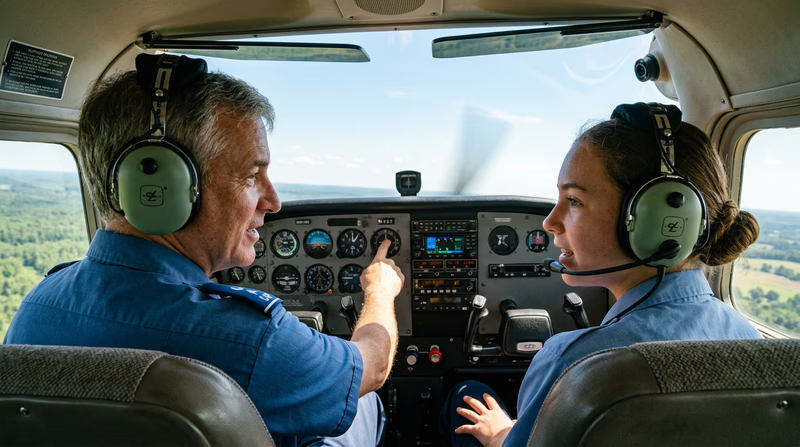
A discovery flight is an introductory flight lesson with a certified flight instructor. You will sit in the pilot’s seat, and after the instructor handles the takeoff, you will actually take the controls and fly the airplane. This is not a passenger ride — you are the pilot (with the instructor right beside you).
How to book a discovery flight:
- Call a local flight school and ask for an “introductory” or “discovery” flight. Most cost between $100 and $250 for 30–60 minutes of flight time.
- The EAA Young Eagles program offers free introductory flights to youth ages 8–17. Visit their website to find a chapter near you.
What to record:
- Date of the flight
- Airport name and identifier (e.g., “Centennial Airport — KAPA”)
- Type of aircraft (e.g., “Cessna 172 Skyhawk”)
- Duration of the flight
- Your impressions: What did it feel like to control the airplane? What surprised you? What was harder or easier than you expected?
Req 4 — Airport Operations
Airports are where aviation meets the ground. They are complex operations with strict rules designed to keep everyone safe — from the passengers in the terminal to the mechanics on the ramp to the controllers in the tower. For this requirement, you will choose one of the four visit options below and report on what you learned.
Option A: Visit an Airport
Visiting a general aviation airport (not just a big commercial terminal) is a great way to see the full scope of airport operations. Many small airports welcome visitors and some even have observation areas.
Key things to learn about:
How facilities are used:
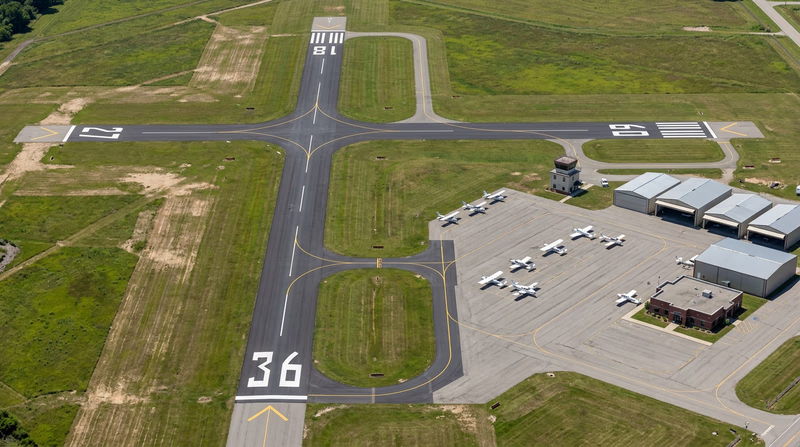
- Runway: The paved strip where aircraft take off and land.
- Taxiway: Paths connecting runways to hangars and ramps. Taxiways have yellow centerline markings; runways have white.
- Ramp (apron): The paved area where aircraft park, load passengers, and refuel.
- FBO (Fixed Base Operator): A business on the airport that provides fuel, parking, maintenance, and pilot services.
- Hangars: Enclosed buildings where aircraft are stored and maintained.
- Control tower: The tower from which air traffic controllers direct aircraft on the ground and in the air near the airport.
- AWOS/ASOS: Automated weather stations that broadcast current conditions to pilots.
How runways are numbered: Runways are numbered based on their magnetic heading, rounded to the nearest 10 degrees, with the last digit dropped. For example:
- A runway pointing due north (360°) is numbered 36.
- A runway pointing due east (090°) is numbered 09.
- A runway pointing due south (180°) is numbered 18.
Every runway has two numbers — one for each direction. Runway 36 and Runway 18 are the same strip of pavement, just approached from opposite ends.
How the “active” runway is determined: Pilots take off and land into the wind whenever possible, because headwind increases the aircraft’s airspeed relative to the ground, which means shorter takeoff rolls and slower landing speeds. The active runway is the one that points most directly into the current wind direction. At towered airports, controllers designate the active runway. At non-towered airports, pilots choose based on the wind.
Option B: Visit an FAA Facility
The FAA operates different types of facilities, each with a specific role in keeping the airspace safe:
- ATCT (Airport Traffic Control Tower): Controllers here manage aircraft on the ground (taxiing) and in the air within about 5 miles of the airport and up to about 3,000 feet. They give takeoff and landing clearances and sequence arriving and departing traffic.
- TRACON (Terminal Radar Approach Control): Controllers manage aircraft within roughly 30–50 miles of a major airport, using radar to guide aircraft toward the runway for landing or out of the airport area after takeoff.
- ARTCC (Air Route Traffic Control Center): These centers manage aircraft flying at high altitudes across large regions of the country. There are 20 ARTCCs in the United States, and together they cover all the airspace.
- FSDO (Flight Standards District Office): FSDOs handle pilot certification, aircraft registration, accident investigation, and regulatory enforcement. This is where pilots go for check rides and where inspectors work.
Option C: Visit a Military Aviation Facility
Military bases with aviation units — Air Force bases, Naval Air Stations, Army airfields, and Coast Guard air stations — offer a unique perspective on how aviation serves national defense and public safety.
How to arrange a visit:
- Many military bases host open houses and air shows that allow public access.
- Some bases offer guided tours for educational groups like Scout units. Contact the base’s Public Affairs Office well in advance.
- Coast Guard air stations often have community engagement programs and may be more accessible than larger military facilities.
Things to learn about:
- What types of aircraft are based there and what missions they fly
- How military aviation supports civilian needs (search and rescue, disaster relief, medical evacuation)
- How military air traffic control coordinates with civilian ATC
- Career paths for military aviators and support personnel
Option D: Visit an Aviation Museum or Air Show
Aviation museums and air shows bring the history and excitement of flight to life in ways that textbooks cannot.
Notable aviation museums worth visiting:
- Smithsonian National Air and Space Museum (Washington, DC) — Home to the Wright Flyer, the Spirit of St. Louis, and the Apollo 11 command module.
- National Museum of the United States Air Force (Dayton, Ohio) — The world’s largest and oldest military aviation museum.
- Museum of Flight (Seattle, Washington) — Includes the original Boeing factory and dozens of historic aircraft.
- Pima Air & Space Museum (Tucson, Arizona) — Over 400 aircraft on display, plus tours of the nearby AMARG “boneyard.”
Many smaller cities have regional aviation museums with hands-on exhibits, cockpit simulators, and volunteer docents who are retired pilots.
At an air show: Watch for different types of aircraft in action — aerobatic teams, warbird flyovers, military demonstrations, and static displays. Pay attention to how aircraft sound, how they maneuver, and how different designs perform different roles.
Smithsonian National Air and Space Museum Explore the world's largest collection of historic air and spacecraft, including the Wright Flyer and Apollo 11. Link: Smithsonian National Air and Space Museum — https://airandspace.si.edu/ EAA AirVenture Oshkosh The world's largest annual aviation gathering, held every summer in Oshkosh, Wisconsin. Features air shows, exhibits, and thousands of aircraft. Link: EAA AirVenture Oshkosh — https://www.eaa.org/airventureReq 5a — Pilot Certificates
If you want to fly, you need a certificate from the FAA. Think of it like a driver’s license — but for the sky. Each certificate has different privileges, requirements, and limitations. Let’s walk through the four certificates you need to know.
Student Pilot Certificate
The student pilot certificate is where every pilot’s journey begins. It is not really a license to fly on your own — it is a permission slip to learn. With a student pilot certificate, you can fly an aircraft under the supervision of a certified flight instructor (CFI).
Key facts:
- Minimum age to apply: 14 years old (for gliders and balloons) or 16 years old (for powered aircraft)
- How to get it: Apply through the FAA’s IACRA system (Integrated Airman Certification and Rating Application) online, with an aviation medical examiner (AME) or your flight instructor
- Privileges: Fly with an instructor; eventually solo (fly alone) after the instructor endorses you
- Limitations: Cannot carry passengers; cannot fly for compensation; must have instructor endorsements for solo flights
Recreational Pilot Certificate
The recreational pilot certificate is a limited version of the private pilot certificate. It was designed for people who want to fly for fun close to home without investing in the full private pilot training.
Key facts:
- Minimum age: 17 years old
- Flight hours required: 30 hours minimum (vs. 40 for private pilot)
- Privileges: Fly a single-engine aircraft with no more than four seats and one passenger
- Limitations: Cannot fly at night; cannot fly more than 50 nautical miles from home airport without additional training; cannot fly in airspace requiring communication with air traffic control; cannot fly in conditions that require instrument flight rules
Remote Pilot Certificate
The remote pilot certificate (also called Part 107 certification) is the FAA certificate for flying drones and unmanned aircraft systems commercially — meaning for business purposes, not just for fun.
Key facts:
- Minimum age: 16 years old
- How to get it: Pass the Part 107 Knowledge Test (a 60-question multiple-choice exam at an FAA testing center) and pass a TSA background check
- Privileges: Fly drones commercially — aerial photography for hire, real estate marketing, inspections, surveying, agriculture, and more
- Limitations: Must keep the drone within visual line of sight; must fly below 400 feet AGL; must fly during daytime (or civil twilight with anti-collision lighting); cannot fly over people without a waiver
Important distinction: Recreational (hobby) drone pilots only need the free TRUST certification you learned about in Requirement 2. But if you want to make money flying drones — even selling a single aerial photo — you need the Part 107 remote pilot certificate.
Private Pilot Certificate
The private pilot certificate is the most common certificate for people who fly for personal and recreational purposes. It gives you the freedom to fly almost anywhere in the country, carry passengers, and fly at night.
Key facts:
- Minimum age: 17 years old
- Flight hours required: 40 hours minimum (national average is about 60–70 hours)
- Exams: Written knowledge test (multiple choice) and a practical test (check ride) with an FAA examiner
- Medical certificate: Requires at least a Third Class medical certificate from an Aviation Medical Examiner
- Privileges: Fly any single-engine airplane you are rated for; carry passengers; fly at night; fly in controlled airspace; fly cross-country to any airport
- Limitations: Cannot fly for compensation or hire; cannot fly in instrument meteorological conditions (clouds, low visibility) without an instrument rating
Certificate Comparison
At a glance- Student Pilot: Age 16+, learn to fly with an instructor, eventually solo. No passengers.
- Recreational Pilot: Age 17+, 30 hours, one passenger, limited to daytime and 50 miles from home.
- Remote Pilot: Age 16+, knowledge test, fly drones commercially. No manned aircraft.
- Private Pilot: Age 17+, 40 hours minimum, carry passengers, fly cross-country, fly at night.
Req 5b — Instrument Rating
After earning a private pilot certificate, many pilots pursue an instrument rating — and for good reason. An instrument rating is not a separate certificate; it is an add-on qualification that dramatically expands what a pilot can do.
What Is an Instrument Rating?
An instrument rating certifies that a pilot can fly an aircraft solely by reference to the instruments in the cockpit — without being able to see the ground or the horizon. This is called flying under Instrument Flight Rules (IFR), as opposed to Visual Flight Rules (VFR), where the pilot navigates by looking outside.
Why Does It Matter?
Without an instrument rating, a pilot with a private pilot certificate can only fly in clear weather — when visibility is good and the sky is mostly free of clouds. That sounds fine, until you realize how often weather can disrupt a flight plan.
Benefits of the Instrument Rating
1. Fly in more weather conditions
This is the biggest benefit. An instrument-rated pilot can fly through clouds, in rain, and in reduced visibility that would ground a VFR-only pilot. You are no longer stuck on the ground waiting for perfect weather.
2. Greater safety and confidence
Instrument training makes you a fundamentally better pilot. You learn to trust your instruments instead of your body’s unreliable senses (which can trick you in clouds), and you develop the precision and discipline needed to fly exact headings, altitudes, and approach procedures.
3. Access to the air traffic control system
IFR pilots are in constant communication with air traffic control, receiving radar guidance, traffic advisories, and separation from other aircraft. This is especially valuable in busy airspace near major cities.
4. More reliable travel
If you fly for personal transportation — to visit family, attend events, or go on trips — an instrument rating means you complete far more flights. VFR-only pilots cancel or delay a significant percentage of planned trips due to weather.
5. Required for professional aviation careers
Every professional pilot certificate beyond private pilot requires an instrument rating. If you dream of becoming a commercial pilot or airline captain, the instrument rating is a mandatory stepping stone.
What Does It Take?
- Prerequisites: Hold a private pilot certificate
- Flight time: At least 50 hours of cross-country flight time as pilot in command, plus 40 hours of actual or simulated instrument time
- Training: Ground school covering weather theory, instrument approach procedures, IFR regulations, and air traffic control procedures
- Exams: Written knowledge test and a practical test (check ride) demonstrating proficiency in instrument flight procedures
Req 5c — Advanced Certificates
These three certificates represent the upper tiers of pilot certification. Each one opens new doors — from getting paid to fly, to commanding an airliner, to teaching the next generation of pilots.
Commercial Pilot Certificate
The commercial pilot certificate is the first certificate that allows a pilot to fly for money. A private pilot can share expenses with passengers, but a commercial pilot can actually be hired to fly.
Key facts:
- Minimum age: 18 years old
- Flight time required: 250 hours minimum (including time in specific categories like cross-country, night, and instrument flight)
- Prerequisites: Private pilot certificate and instrument rating
- Exams: Written knowledge test and a practical test (check ride) with higher performance standards than the private pilot check ride
- Medical certificate: Requires at least a Second Class medical certificate (more rigorous than the Third Class required for private pilots)
What a commercial pilot can do:
- Fly charter flights
- Tow banners and gliders
- Conduct aerial photography and surveying
- Fly air tours
- Serve as a copilot for a regional airline (with the right type ratings)
- Fly cargo
What a commercial pilot cannot do (yet):
- Serve as pilot-in-command (captain) of a scheduled airline flight — that requires the ATP certificate
Airline Transport Pilot Certificate (ATP)
The airline transport pilot certificate is the highest level of pilot certification. If the commercial certificate is a driver’s license, the ATP is a CDL for the sky. An ATP is required to serve as the captain (pilot-in-command) of a scheduled airline.
Key facts:
- Minimum age: 23 years old (21 for restricted ATP under certain military or collegiate programs)
- Flight time required: 1,500 hours minimum (1,000 for military pilots; 1,250 for graduates of approved aviation degree programs)
- Prerequisites: Commercial pilot certificate with instrument rating
- Exams: ATP written knowledge test and a rigorous practical test
- Medical certificate: First Class medical certificate (the most stringent — includes EKG screening for pilots over 40)
What an ATP pilot can do:
- Serve as captain of any scheduled airline flight
- Fly for major airlines (Delta, United, American, Southwest, etc.)
- Command international flights carrying hundreds of passengers
Certified Flight Instructor (CFI)
A Certified Flight Instructor is a pilot who is authorized to teach others to fly. The CFI certificate is not higher than the commercial or ATP — it is a separate authorization that allows a pilot to provide flight instruction and sign off student pilots for solo flights, check rides, and endorsements.
Key facts:
- Minimum age: 18 years old
- Prerequisites: Commercial pilot certificate (or ATP); instrument rating is required for CFII (Certified Flight Instructor — Instrument)
- Exams: Written knowledge test on the fundamentals of instruction (FOI) and a practical test where the applicant demonstrates the ability to teach
- What makes the CFI unique: The practical test is not just about flying well — it is about explaining what you are doing and teaching the examiner as if they were a student
Why become a CFI?
- Build hours: Most aspiring airline pilots become CFIs to accumulate the flight hours needed for an ATP certificate. Teaching is one of the best ways to log hours while getting paid.
- Give back: Many pilots become instructors because they love sharing their passion for flight. The CFI who taught you is the reason you know how to fly.
- Stay sharp: Teaching forces you to understand aviation concepts deeply. If you can explain a stall recovery to a nervous student, you truly understand it.
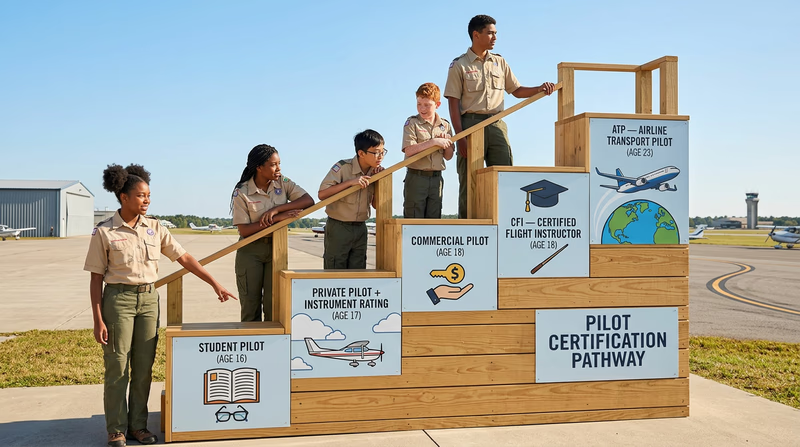
The Certification Ladder
Here is how the certificates typically build on each other:
- Student Pilot → Learn to fly, solo
- Private Pilot + Instrument Rating → Fly for personal use in most conditions
- Commercial Pilot → Fly for pay
- CFI → Teach others and build hours
- ATP → Captain an airliner
Req 5d — Aviation Organizations
You do not have to wait until you are 17 to start your aviation journey. Two organizations — Aviation Exploring and the Civil Air Patrol — offer young people hands-on aviation experience right now. This requirement asks you to find one (or both) in your area and learn what they do.
Aviation Exploring
Exploring is a career-focused program run by Learning for Life, an affiliate of Scouting America. An Aviation Exploring post connects young people with professional pilots, mechanics, and aviation businesses for real-world exposure to the field.
What Aviation Exploring posts do:
- Tour airports, control towers, maintenance facilities, and aviation museums
- Attend air shows and fly-ins
- Experience introductory and discovery flights
- Learn about career paths from working aviation professionals
- Some posts offer ground school instruction and even discounted flight training
Membership requirements:
- Ages 14–20 (or 13 if you have completed 8th grade)
- Open to all youth regardless of Scouting membership
- Annual membership fee (varies by post)
- Must complete an Exploring application
How to find a post:
- Visit the Exploring website and search for posts in your area with an “Aviation” career focus
- Ask your local council’s Exploring coordinator
- Contact nearby flight schools or FBOs — some sponsor or host Exploring posts
Civil Air Patrol (CAP)
The Civil Air Patrol is the official civilian auxiliary of the United States Air Force. Its cadet program is one of the best pathways into aviation for young people. CAP cadets participate in real-world missions, earn flight time, and can even earn pilot certificates through the program.
What CAP cadets do:
- Fly in CAP aircraft with certified CAP pilots (orientation flights)
- Participate in search and rescue missions as ground team members
- Attend encampments — week-long immersive programs at military bases
- Earn promotions through a structured achievement program covering leadership, aerospace education, fitness, and character
- Compete for flight scholarships — CAP awards powered flight and glider scholarships that can cover much of the cost of earning a private pilot certificate
- Participate in the International Air Cadet Exchange (IACE), visiting other countries to learn about their air forces
Membership requirements:
- Cadet membership: Ages 12–18
- Senior membership: Ages 18 and older (mentors, pilots, mission staff)
- Membership dues (approximately $45/year for cadets, depending on the unit)
- Must complete an online application and attend local squadron meetings
How to find a CAP squadron:
- Visit the CAP website and use the unit locator to find squadrons near you
- Many squadrons meet at local airports or community centers, usually one evening per week
Which One Should You Join?
Both organizations offer tremendous value. Here is a quick comparison:
| Feature | Aviation Exploring | Civil Air Patrol |
|---|---|---|
| Focus | Career exploration | Aerospace, emergency services, leadership |
| Ages | 14–20 | 12–18 (cadets) |
| Uniforms | Varies by post | Air Force-style uniforms required |
| Military connection | None | Official USAF auxiliary |
| Flight opportunities | Discovery flights, tours | Orientation flights, flight scholarships |
| Time commitment | Varies (usually monthly meetings) | Weekly meetings plus activities |
You can be a member of both at the same time, and both count toward your aviation experience.
Civil Air Patrol — Cadet Programs Learn about CAP's cadet program, find a squadron near you, and apply for membership. Link: Civil Air Patrol — Cadet Programs — https://www.gocivilairpatrol.com/programs/cadets Exploring — Find a Post Search for Aviation Exploring posts and other career-focused Exploring programs in your area. Link: Exploring — Find a Post — https://www.exploring.org/join/Req 5e — Aviation Careers
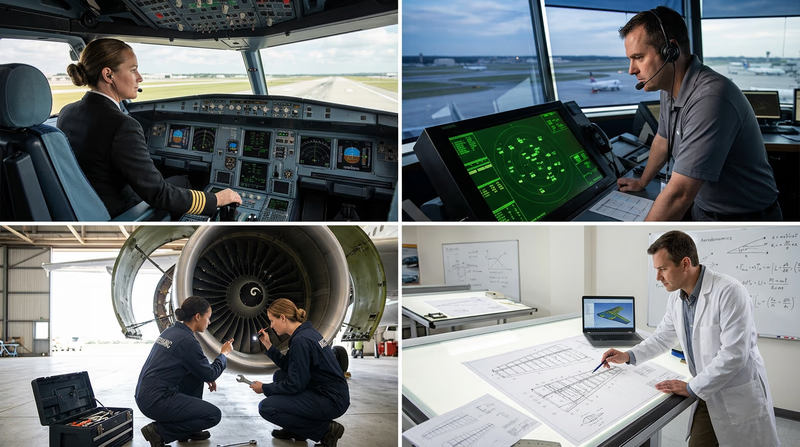
Aviation is not just about pilots. Thousands of careers keep aircraft flying safely, and many of them do not involve sitting in a cockpit at all. This requirement asks you to explore three of those careers, then take a deep dive into one.
Career Categories in Aviation
Here are several career areas to consider. Pick three that interest you and then research one in depth.
Airline Pilot
Airline pilots fly commercial aircraft for passenger and cargo airlines. They progress from first officer (copilot) to captain over several years.
- Education: Many airlines prefer a bachelor’s degree (any field), though it is not always required
- Certification: ATP certificate, instrument rating, type rating for specific aircraft
- Experience: 1,500 hours minimum for ATP; most successful applicants have 2,000–5,000+ hours
- Starting salary: $50,000–$90,000 as a first officer at a regional airline; major airline captains can earn $200,000–$400,000+
- Outlook: Strong demand — the aviation industry is experiencing a global pilot shortage
Air Traffic Controller
Air traffic controllers manage the flow of aircraft in the sky and on the ground, keeping everyone safely separated.
- Education: Bachelor’s degree or 3 years of work experience (or a combination), or graduation from an FAA-approved Collegiate Training Initiative (CTI) program
- Training: FAA Academy in Oklahoma City (2–5 months), followed by on-the-job training at a facility (1–3 years)
- Starting salary: $45,000–$60,000 during training; experienced controllers earn $100,000–$180,000+
- Age limit: Must begin training before age 31
- Outlook: Competitive but steady demand, with retirements creating openings
Aircraft Mechanic (A&P Technician)
Airframe and Powerplant (A&P) mechanics inspect, maintain, and repair aircraft. Nothing flies unless a mechanic signs it off as airworthy.
- Education: Graduate from an FAA-approved aviation maintenance technician school (18–24 months) or gain experience through military service
- Certification: FAA A&P certificate (two written exams and a practical test)
- Starting salary: $45,000–$55,000; experienced mechanics at major airlines earn $80,000–$100,000+
- Outlook: Strong demand — there is a shortage of qualified mechanics, and the fleet of aircraft keeps growing
Aerospace Engineer
Aerospace engineers design and develop aircraft, spacecraft, satellites, and missiles. They work on everything from wing design to avionics systems to propulsion.
- Education: Bachelor’s degree in aerospace engineering, mechanical engineering, or a related field (4 years); many positions prefer a master’s degree
- Certification: Engineers can earn a Professional Engineer (PE) license, though it is not always required
- Starting salary: $70,000–$85,000; senior engineers earn $120,000–$160,000+
- Outlook: Steady demand, especially in defense, commercial aviation, and the growing space industry
Drone (UAS) Operator
Professional drone operators fly unmanned aircraft for commercial, government, and military applications.
- Education: Varies — some employers require a degree in aviation, geomatics, or a technical field; others prioritize experience and certification
- Certification: FAA Part 107 remote pilot certificate; specialized training for specific industries (thermography, LiDAR, photogrammetry)
- Starting salary: $40,000–$60,000; specialized operators (power line inspection, surveying, cinematography) can earn $80,000–$120,000+
- Outlook: Rapidly growing field with expanding applications
Aviation Meteorologist
Aviation meteorologists analyze weather patterns and provide forecasts specifically for pilots and air traffic operations.
- Education: Bachelor’s degree in meteorology or atmospheric science
- Certification: Some positions require FAA or National Weather Service certification
- Starting salary: $50,000–$65,000; experienced meteorologists at the FAA or airlines earn $80,000–$100,000+
- Outlook: Stable demand, with increasing use of data science and AI in forecasting
How to Research Your Chosen Career
When you pick one career to research in depth, here is a framework to organize your findings:
Career Research Framework
What to investigate and discuss with your counselor- Training path: What specific education and training programs lead to this career?
- Certification: What licenses, certificates, or ratings are required?
- Experience: How many years or hours of experience are needed to get started?
- Expenses: What will the education, training, and certification cost? Are scholarships or financial aid available?
- Employment prospects: Is demand growing, stable, or shrinking? Where are the jobs located?
- Starting salary: What can you expect to earn in your first position?
- Advancement: What does the career ladder look like? Where can you be in 5, 10, or 20 years?
- Lifestyle: What are the working hours, travel requirements, and work-life balance like?
Extended Learning
A. Congratulations, Aviator!
You have covered a lot of ground — from the four forces of flight to cockpit instruments, from building your own aircraft to researching real aviation careers. The Aviation merit badge gives you a solid foundation in how and why things fly. But this is just the beginning. The world of aviation is enormous, and the deeper you go, the more fascinating it gets.
B. Understanding Weather and Aviation
Weather is the single biggest factor in aviation safety and planning. Pilots spend as much time studying weather as they do studying aerodynamics. Understanding the basics of aviation weather will make you a more informed aviator — whether you are flying a drone, sitting in a simulator, or preparing for your first discovery flight.
Clouds and flight: Clouds form when moist air rises and cools. For a pilot, the type of cloud matters. Cumulus clouds (the puffy ones) can indicate rising air currents called thermals — great for gliders, but they can also grow into towering cumulonimbus thunderstorms that produce severe turbulence, hail, and lightning. Stratus clouds (the flat, layered ones) often bring low ceilings and reduced visibility, which are problems for VFR pilots.
Wind patterns: Wind near the surface is affected by terrain, buildings, and temperature differences. At altitude, winds follow large-scale patterns driven by temperature and pressure differences between air masses. The jet stream — a narrow band of fast-moving wind at 30,000–40,000 feet — can push an airliner hundreds of miles off course if the pilot does not account for it.
METARs and TAFs: These are standardized weather reports used by pilots worldwide. A METAR (Meteorological Aerodrome Report) gives current conditions at an airport — wind, visibility, clouds, temperature, and pressure. A TAF (Terminal Aerodrome Forecast) predicts conditions for the next 24–30 hours. Learning to read these coded reports is a practical skill that will serve you well if you pursue flight training.
Microbursts: A microburst is a localized column of sinking air that can produce a rapid, intense downdraft and dangerous wind shear near the ground. Microbursts have caused several airline accidents and are now closely monitored by Doppler weather radar at major airports. Pilots are trained to recognize the signs and avoid these areas during approach and departure.
National Weather Service — Aviation Weather Center The official source for aviation weather products, including METARs, TAFs, radar, and significant weather advisories. Link: National Weather Service — Aviation Weather Center — https://aviationweather.gov/C. The Science of Supersonic Flight
When an aircraft approaches the speed of sound (approximately 767 mph at sea level), the rules of aerodynamics change. Air can no longer get out of the way fast enough, and it piles up in front of the aircraft as a shock wave — the pressure disturbance you hear on the ground as a sonic boom.
The Mach number: Aircraft speed near and above the speed of sound is measured in Mach numbers, named after physicist Ernst Mach. Mach 1 equals the speed of sound. Mach 2 is twice the speed of sound. The Concorde cruised at Mach 2.04 — about 1,350 mph at altitude.
Transonic challenges: The most difficult speed range to fly in is the transonic zone — roughly Mach 0.8 to Mach 1.2. In this range, some parts of the aircraft are experiencing subsonic airflow while others are experiencing supersonic airflow. This creates buffeting, control difficulties, and increased drag. Designing an aircraft that handles the transonic zone smoothly was one of the great engineering challenges of the 20th century.
Supersonic design: Supersonic aircraft use swept-back or delta-shaped wings that reduce drag at high speeds. Their fuselages are long and slender, and their engines produce enormous thrust. The Concorde, which flew from 1976 to 2003, carried 100 passengers across the Atlantic in 3.5 hours. New supersonic designs are being developed right now that could bring supersonic commercial flight back — this time with reduced sonic booms that might make overland supersonic travel practical.
Hypersonic flight: Beyond Mach 5, flight is considered hypersonic. At these speeds, air friction heats the aircraft’s skin to thousands of degrees. NASA’s X-15 research plane reached Mach 6.7 in the 1960s, and modern hypersonic vehicles are being developed for both military and space access applications. The heat generated at hypersonic speeds is so extreme that special materials and cooling systems are required — this is the same challenge faced by spacecraft reentering Earth’s atmosphere.
NASA — Supersonic Flight Learn about NASA's Quesst mission to develop quiet supersonic flight technology — the X-59 aircraft designed to produce a gentle thump instead of a disruptive sonic boom. Link: NASA — Supersonic Flight — https://www.nasa.gov/mission/quesst/D. How GPS Changed Aviation
Before GPS, navigating an airplane required constant attention to VOR stations, NDBs, dead reckoning calculations, and paper charts. A pilot flying cross-country would tune radio frequencies, track needle movements, and cross-check multiple instruments to determine their position. Getting lost was a real possibility.
The GPS revolution: The Global Positioning System uses a constellation of at least 24 satellites orbiting Earth. A GPS receiver in an aircraft picks up signals from multiple satellites and triangulates its position to within a few meters — anywhere on the planet, at any time, in any weather. This single technology transformed aviation more than any other innovation since the jet engine.
RNAV and GPS approaches: GPS enabled RNAV (Area Navigation) — the ability to fly any desired path instead of only following ground-based radio beacons. Pilots can now fly direct routes between any two points, saving fuel and time. GPS also made it possible to create precision instrument approaches at airports that never had them before, because they no longer need expensive ground-based equipment.
ADS-B: Automatic Dependent Surveillance—Broadcast is a system where each aircraft broadcasts its GPS-derived position, altitude, speed, and identification. Other aircraft and air traffic controllers can see this information in real time. Since January 2020, the FAA has required ADS-B Out equipment in most controlled airspace. This system provides better surveillance coverage than radar and enables new safety features like in-cockpit traffic displays.
What is next: The FAA’s NextGen air traffic modernization program is building on GPS and ADS-B to create a more efficient, precise, and safe air traffic system. Future capabilities include closer spacing on approaches (allowing more flights per hour), continuous descent arrivals (saving fuel and reducing noise), and dynamic rerouting around weather.
FAA — NextGen Learn about the FAA's plan to modernize the National Airspace System using satellite-based navigation, digital communications, and advanced automation. Link: FAA — NextGen — https://www.faa.gov/nextgenE. Real-World Experiences
Ready to get out there? Here are experiences that will bring your aviation knowledge to life.
F. Organizations
These organizations can help you continue your aviation journey beyond the merit badge.
Experimental Aircraft Association (EAA) The EAA is the home of recreational aviation, with programs for young aviators including Young Eagles flights, student memberships, and scholarships. Link: Experimental Aircraft Association (EAA) — https://www.eaa.org/ Aircraft Owners and Pilots Association (AOPA) AOPA is the world's largest aviation membership organization, offering resources for student pilots, flight training guides, and aviation advocacy. Link: Aircraft Owners and Pilots Association (AOPA) — https://www.aopa.org/ Civil Air Patrol (CAP) The official civilian auxiliary of the U.S. Air Force, with a cadet program offering orientation flights, leadership training, encampments, and flight scholarships. Link: Civil Air Patrol (CAP) — https://www.gocivilairpatrol.com/ Women in Aviation International (WAI) WAI provides scholarships, mentoring, and networking for anyone interested in aviation careers, with a focus on encouraging diversity in the field. Link: Women in Aviation International (WAI) — https://www.wai.org/ Organization of Black Aerospace Professionals (OBAP) OBAP inspires and prepares the next generation of aerospace professionals through mentoring, scholarships, aviation camps, and youth outreach programs. Link: Organization of Black Aerospace Professionals (OBAP) — https://www.obap.org/ Smithsonian National Air and Space Museum Explore the world's largest collection of historic air and spacecraft, with online exhibits, educational resources, and virtual tours. Link: Smithsonian National Air and Space Museum — https://airandspace.si.edu/