Req 1a — What Is an Aircraft?
Let’s start with the most basic question in aviation: what exactly is an aircraft?
An aircraft is any vehicle or machine that is designed to fly by gaining support from the air. That support can come from wings that generate lift, from spinning rotors, from lighter-than-air gases like helium, or even from the thrust of a rocket engine pushing against the atmosphere. If it is built to fly through the air, it is an aircraft.
That definition covers a lot of machines. Here are some of the most common kinds you will encounter.
Fixed-Wing Airplanes
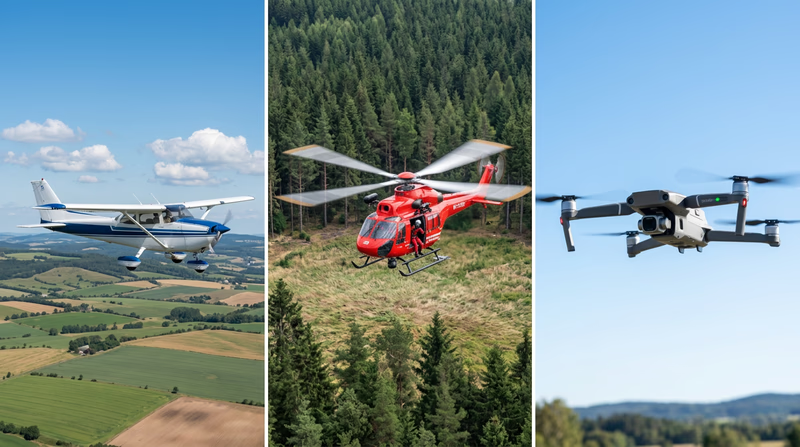
Fixed-wing airplanes are probably what you picture when you hear the word “aircraft.” They have rigid wings attached to a fuselage (the body of the plane), and they generate lift by moving forward through the air. The forward motion comes from propellers or jet engines.
Typical uses: Commercial passenger travel, cargo transport, crop dusting, aerial surveying, private recreation, military combat and reconnaissance.
Fixed-wing airplanes range from tiny single-seat ultralights to massive four-engine cargo planes that can carry tanks and helicopters inside their fuselage.
Helicopters (Rotorcraft)
Helicopters use spinning rotor blades mounted on top of the aircraft to generate lift. Because the rotor can change its angle and speed, helicopters can take off and land vertically, hover in place, and fly in any direction — including backward and sideways.
Typical uses: Emergency medical transport, search and rescue, law enforcement, news reporting, firefighting, offshore oil rig support, military operations.
Helicopters trade speed and efficiency for versatility. They cannot fly as fast or as far as airplanes on the same amount of fuel, but they can go places no airplane can reach.
Unmanned Aircraft Systems (Drones)
Drones — formally called Unmanned Aircraft Systems (UAS) — are aircraft that fly without a pilot on board. They are controlled remotely by an operator on the ground or follow a pre-programmed flight path using GPS.
Typical uses: Aerial photography and videography, agricultural monitoring, infrastructure inspection (bridges, power lines, pipelines), package delivery, search and rescue, scientific research, military surveillance and operations.
Other Kinds of Aircraft
Your counselor may ask about additional types. Here are a few more worth knowing:
- Lighter-than-air craft (balloons and airships): These float because they are filled with a gas that is lighter than the surrounding air, such as helium or heated air. Hot-air balloons are used for recreation, while blimps and airships are used for advertising and surveillance.
- Gliders (sailplanes): These are fixed-wing aircraft with no engine. They are towed to altitude by a powered airplane and then released to soar on rising air currents called thermals. Gliders are used for recreation and pilot training.
- Tiltrotor aircraft: These combine features of helicopters and airplanes. The V-22 Osprey, used by the U.S. military, can take off vertically like a helicopter, then tilt its rotors forward to fly like an airplane at much higher speeds.