Req 1b — History of Flight
The story of flight is one of the greatest adventure stories ever told. It stretches from ancient myths to the edge of space, and almost every chapter involves someone who was told “that’s impossible” and did it anyway.
The Evolution of Flight
The dream of flying is as old as civilization itself. The ancient Greek myth of Daedalus and Icarus imagined wings made of feathers and wax. In China, people flew kites more than 2,000 years ago — the first human-made objects to ride the wind.
Real progress began in the late 1700s and accelerated through the 1800s:
- 1783: The Montgolfier brothers launched the first hot-air balloon flight with passengers in Paris, France. Humans left the ground for the first time.
- 1804: Sir George Cayley built and flew the first successful glider, establishing the basic principles of aerodynamics that aircraft still use today.
- 1891–1896: Otto Lilienthal made over 2,000 glider flights in Germany, carefully recording data about lift and control. His published research directly inspired the Wright brothers.
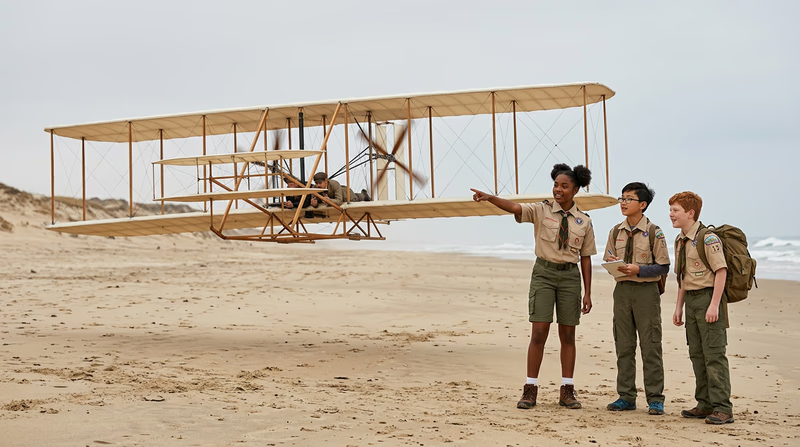
- 1903: Orville and Wilbur Wright achieved the first powered, sustained, and controlled airplane flight at Kitty Hawk, North Carolina.
From that point, aviation advanced at an astonishing pace. Within 66 years of the Wright brothers’ first flight, humans walked on the Moon.
Three Notable Moments in Aviation History
Your counselor will ask you to discuss three notable times in history that were important to aviation. Here are several to choose from — pick the ones that interest you most and be ready to explain why each one mattered.
1. The Wright Brothers’ First Flight (1903)
On December 17, 1903, at Kill Devil Hills near Kitty Hawk, North Carolina, Orville Wright piloted the Wright Flyer for 12 seconds, covering 120 feet. That same day, Wilbur flew 852 feet in 59 seconds. These flights proved that powered, controlled flight was possible.
Why it matters: Everything in modern aviation traces back to this moment. The Wrights did not just build a flying machine — they solved the problem of control. Their system of wing warping (twisting the wings to turn) was the ancestor of the ailerons used on every airplane today.
2. Charles Lindbergh Crosses the Atlantic (1927)
On May 20–21, 1927, Charles Lindbergh flew solo from New York to Paris in the Spirit of St. Louis, covering 3,610 miles in 33.5 hours without stopping. He had no copilot, no radio, and at times he could barely stay awake.
Why it matters: Lindbergh’s flight captured the world’s imagination and proved that long-distance air travel was practical. Investment in aviation exploded afterward, leading to the first commercial airlines.
3. Breaking the Sound Barrier (1947)
On October 14, 1947, U.S. Air Force Captain Chuck Yeager flew the Bell X-1 rocket plane faster than the speed of sound — Mach 1 — over the Mojave Desert. Many engineers believed the “sound barrier” would destroy any aircraft that tried to cross it.
Why it matters: Yeager’s flight opened the door to supersonic aviation and, eventually, to the space program. It proved that the laws of physics could be worked with, not just feared.
Other Notable Moments Worth Knowing
- Amelia Earhart’s solo Atlantic crossing (1932): The first woman to fly solo across the Atlantic Ocean, proving that aviation was not limited by gender.
- The jet age begins (1952): The de Havilland Comet became the first commercial jet airliner, slashing travel times and making air travel affordable for ordinary people.
- Apollo 11 (1969): While technically spaceflight, the Apollo program relied on aviation technology and pilots — including Neil Armstrong, who was a former Navy aviator and test pilot.
- First drone strike / UAS operations (2000s): Military drones changed modern warfare and opened the door to civilian drone applications that are now part of everyday life.