Req 1c — Fixed Wing vs. Rotary Wing
All aircraft that are heavier than air need wings to fly. The big question is: how do those wings move through the air to generate lift? That single question divides aircraft into two major families.
Fixed-Wing Aircraft
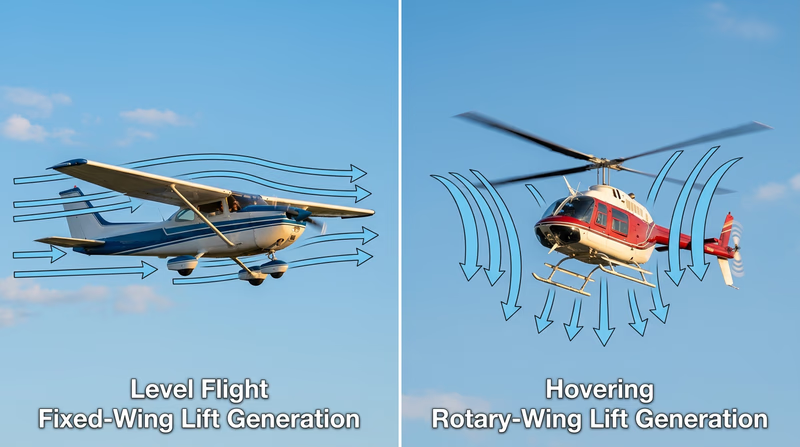
A fixed-wing aircraft has wings that are rigidly attached to the fuselage. The wings do not move on their own — instead, the entire airplane moves forward through the air, and that forward motion causes air to flow over the wings and generate lift.
Think of it this way: a fixed-wing aircraft must keep moving forward to stay in the air. If it slows down too much, the wings stop generating enough lift and the aircraft stalls — meaning it can no longer maintain altitude.
Benefits of fixed-wing aircraft:
- Speed: Fixed-wing airplanes are generally faster than helicopters. Commercial jets cruise at 500–600 mph, while the fastest helicopters top out around 250 mph.
- Range: Airplanes can fly farther on the same amount of fuel because forward flight is more aerodynamically efficient.
- Fuel efficiency: The streamlined shape and forward-flight design mean airplanes burn less fuel per mile than helicopters.
- Payload capacity: Airplanes can carry heavier loads — from passengers to military cargo — over long distances.
- Altitude: Fixed-wing aircraft can fly at higher altitudes, above weather and turbulence.
Examples: Cessna 172, Boeing 737, F-16 fighter jet, gliders
Rotary-Wing Aircraft
A rotary-wing aircraft — most commonly a helicopter — has wings that spin. The rotor blades on top of a helicopter are actually long, narrow wings rotating in a circle. As they spin, they push air downward and generate lift, even when the aircraft is not moving forward.
Because the rotor generates lift independently of forward motion, rotary-wing aircraft can do things that fixed-wing aircraft cannot:
Benefits of rotary-wing aircraft:
- Vertical takeoff and landing (VTOL): Helicopters do not need a runway. They can take off and land in a parking lot, a rooftop, a forest clearing, or a ship deck.
- Hovering: A helicopter can stay in one spot in the air — critical for rescue hoists, aerial crane work, and surveillance.
- Low-speed flight: Helicopters can fly slowly or even backward, making them ideal for search patterns and precision work.
- Access to confined areas: Helicopters can reach places no airplane can, like mountain ledges, offshore platforms, and dense urban areas.
Examples: Bell 206, Black Hawk (UH-60), CH-47 Chinook, Robinson R22
So Which Is Better?
Neither — they are built for different jobs. That is the key insight your counselor is looking for. Aviation is about picking the right tool for the mission.
| Feature | Fixed Wing | Rotary Wing |
|---|---|---|
| Needs a runway? | Yes | No |
| Can hover? | No | Yes |
| Faster? | Yes | No |
| More fuel-efficient? | Yes | No |
| Better for long distances? | Yes | No |
| Better for tight spaces? | No | Yes |
What About Tiltrotors?
Some aircraft try to get the best of both worlds. The V-22 Osprey, used by the U.S. Marine Corps, has rotors that point upward for vertical takeoff and then tilt forward for high-speed cruising flight. It can hover like a helicopter and fly fast like an airplane — but it is more complex and expensive than either.
NASA — How Do Helicopters Fly? NASA's interactive guide explaining how helicopter rotors generate lift and how pilots control them.