Req 1d — How Engines Work
Every powered aircraft needs an engine to generate thrust — the force that pushes (or pulls) the aircraft through the air. There are three main types of aircraft engines, and they each work in a different way. Let’s break them down.
Piston Engines
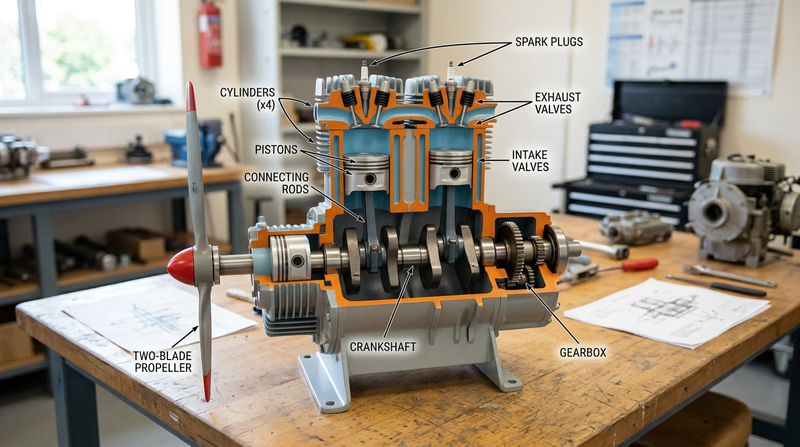
A piston engine (also called a reciprocating engine) works the same way as a car engine. Inside the engine, pistons move up and down inside cylinders, and that motion turns a crankshaft. The crankshaft is connected to a propeller, and the spinning propeller pulls the aircraft forward through the air.
How it works (four-stroke cycle):
- Intake: The piston moves down, pulling a mixture of fuel and air into the cylinder.
- Compression: The piston moves up, squeezing the fuel-air mixture into a small space.
- Power: A spark plug ignites the compressed mixture. The explosion pushes the piston back down with great force.
- Exhaust: The piston moves up again, pushing the burned gases out of the cylinder.
This cycle repeats thousands of times per minute across multiple cylinders, spinning the propeller and generating thrust.
Where you find them: Most small, single-engine aircraft like the Cessna 172 and Piper Cherokee use piston engines. They are reliable, relatively inexpensive, and efficient for low-altitude, low-speed flight.
Turbine Engines (Turboprops)
A turbine engine uses a rapidly spinning turbine — a wheel with many angled blades — to generate power. Instead of pistons moving up and down, a turbine engine uses a continuous flow of air and fuel.
How it works:
- Compressor: Air enters the front of the engine and is squeezed to high pressure by spinning compressor blades.
- Combustion chamber: Fuel is sprayed into the compressed air and ignited. The burning mixture expands rapidly.
- Turbine: The hot, expanding gases rush through the turbine blades, causing them to spin. The spinning turbine drives the compressor at the front (keeping the cycle going) and also drives a propeller through a gearbox.
- Exhaust: The remaining gases exit out the back.
In a turboprop aircraft, the turbine engine drives a propeller — just like a piston engine does. But turbine engines are lighter, more powerful, and more reliable at higher altitudes.
Where you find them: Regional airliners (like the Dash 8), military transport planes (like the C-130 Hercules), and some business aircraft use turboprop engines.
Jet Engines (Turbojets and Turbofans)
A jet engine is actually a type of turbine engine — but instead of using the turbine to drive a propeller, it generates thrust by pushing a high-speed stream of exhaust gases out the back of the engine. Newton’s Third Law of Motion is the key: for every action (hot gas shooting backward), there is an equal and opposite reaction (the engine — and the airplane — being pushed forward).
How it works:
- Fan / Intake: Air enters the front of the engine. In a modern turbofan, a large fan at the front pushes most of the air around the outside of the engine core (bypass air), which produces the majority of the thrust.
- Compressor: The remaining air enters the engine core and is compressed to very high pressure.
- Combustion chamber: Fuel is mixed with the compressed air and ignited.
- Turbine: The hot gases spin the turbine, which drives the compressor and the front fan.
- Exhaust nozzle: The hot gases blast out the back at high speed, producing thrust.
Where you find them: Commercial airliners (Boeing 737, Airbus A320), military fighters (F-22, F-35), and large cargo aircraft. Nearly all modern jets use high-bypass turbofan engines because they are quieter and more fuel-efficient than pure turbojets.
Comparing the Three Engine Types
| Feature | Piston | Turboprop | Jet (Turbofan) |
|---|---|---|---|
| Speed range | Slow (up to ~250 mph) | Medium (250–400 mph) | Fast (400–600+ mph) |
| Best altitude | Low (below 15,000 ft) | Medium (15,000–30,000 ft) | High (30,000–45,000 ft) |
| Fuel efficiency | Best at low speed/altitude | Good at medium speed | Best at high speed/altitude |
| Complexity | Simplest | Moderate | Most complex |
| Typical aircraft | Cessna 172, Piper Cherokee | King Air, C-130 | Boeing 737, F-16 |