Req 1e — Four Forces of Flight
Grab a model airplane — a plastic kit, a balsa wood glider, even a paper airplane will do. Hold it in front of you. There are four invisible forces acting on every aircraft in flight, and understanding them is the key to understanding everything else in aviation.
The Four Forces
Imagine your model airplane in level, straight flight — not climbing, not descending, not turning. At that moment, four forces are perfectly balanced:
1. Lift
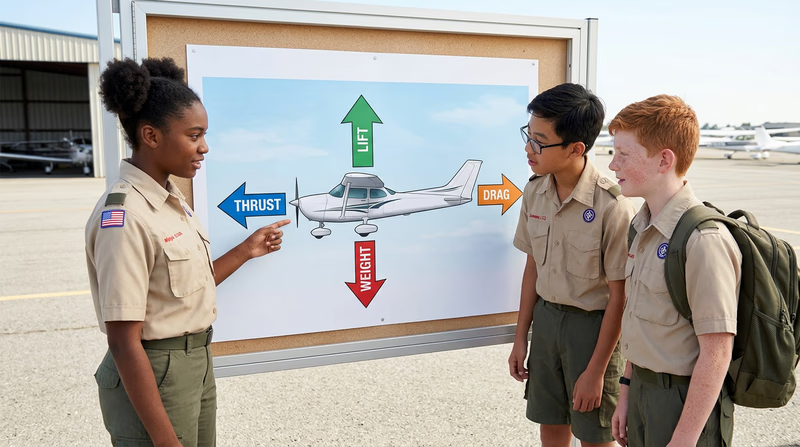
Lift is the upward force generated by the wings. As air flows over and under the wing, the special shape of the wing (called an airfoil) creates a pressure difference that pushes the aircraft upward. Lift acts perpendicular to the direction of flight — straight up when the airplane is flying level.
Lift must be equal to or greater than the aircraft’s weight to keep it in the air.
2. Weight (Gravity)
Weight is the downward force of gravity pulling the aircraft toward the Earth. It includes everything — the airplane itself, the fuel, the passengers, the cargo, and all the equipment on board.
Weight always acts straight down, toward the center of the Earth. An aircraft that is too heavy for its wings to support will not be able to take off.
3. Thrust
Thrust is the forward force that moves the aircraft through the air. It comes from the engine — whether that is a propeller, a jet, or a rocket. Thrust pushes (or pulls) the aircraft in the direction it is pointed.
Without thrust, the aircraft would slow down, lose airflow over the wings, and lose lift.
4. Drag
Drag is the backward force that resists the aircraft’s motion through the air. Think of it as air friction. Every part of the aircraft that is exposed to the airstream creates drag — the fuselage, the wings, the landing gear, even the rivets on the skin.
Drag always acts in the opposite direction of the aircraft’s motion.
How the Forces Work Together
When all four forces are balanced, the aircraft flies in steady, level flight:
- Lift = Weight → The aircraft maintains its altitude (not climbing or sinking)
- Thrust = Drag → The aircraft maintains its speed (not speeding up or slowing down)
When a pilot wants to change what the aircraft is doing, they change the balance:
- To climb: Increase thrust (add power) or increase lift (pull back on the stick to raise the nose). Now lift is greater than weight.
- To descend: Reduce thrust (reduce power) or reduce lift (push forward on the stick to lower the nose). Now weight is greater than lift.
- To speed up: Increase thrust. Now thrust is greater than drag.
- To slow down: Reduce thrust or increase drag (such as extending flaps or landing gear). Now drag is greater than thrust.
A Simple Experiment
Hold a sheet of paper by one edge so it droops down. Now blow steadily across the top surface. The paper rises! You just demonstrated lift — the faster-moving air across the top of the paper creates lower pressure, and the higher pressure below pushes the paper up. This is the same principle that holds an airplane in the sky.
NASA — Four Forces of Flight NASA's interactive guide to the four forces with animations showing how they interact during different phases of flight.