Req 1f — Airfoils & Lift
You know that lift is the force that holds an airplane in the sky. But how does a wing actually create lift? The answer starts with the shape of the wing — a shape called an airfoil.
What Is an Airfoil?
An airfoil is the cross-sectional shape of a wing when you slice through it from front to back. If you could cut a wing in half and look at the cut edge, you would see a teardrop-like shape: rounded and thick at the front (the leading edge), thinner toward the back (the trailing edge), and slightly curved on top.
That curve is critical. The top surface of an airfoil is more curved than the bottom surface. This difference in shape is what makes flight possible.
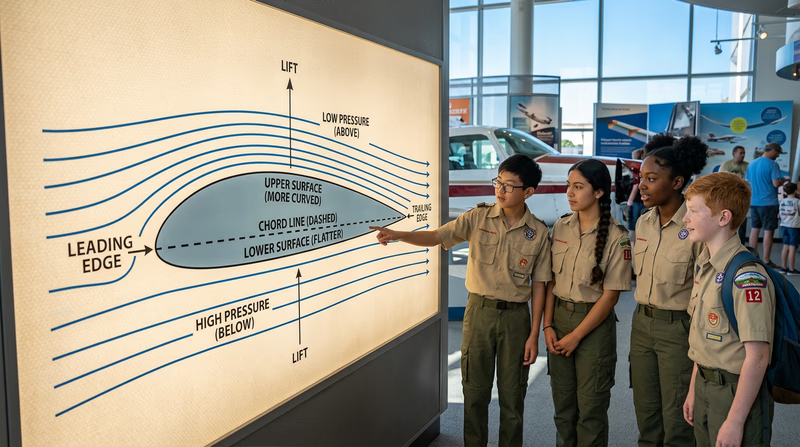
Bernoulli’s Principle
In the 1700s, a Swiss mathematician named Daniel Bernoulli discovered something important about fluids (which includes air): when a fluid speeds up, its pressure drops. When a fluid slows down, its pressure rises.
This is called Bernoulli’s principle, and it is one of the main reasons airplanes can fly.
Here is how it works on a wing:
- Air approaches the wing and splits at the leading edge. Some air goes over the top, and some goes under the bottom.
- The curved upper surface forces the air traveling over the top to travel a longer path. To keep up with the air going underneath, the air on top speeds up.
- According to Bernoulli’s principle, the faster-moving air on top creates lower pressure above the wing.
- The slower-moving air on the bottom creates higher pressure below the wing.
- This pressure difference pushes the wing upward. That upward push is lift.
Angle of Attack
Bernoulli’s principle is the primary explanation, but there is another factor that contributes to lift: the angle of attack.
The angle of attack is the angle between the wing’s chord line (an imaginary straight line from the leading edge to the trailing edge) and the direction the air is coming from. When a pilot tilts the nose of the airplane up slightly, the angle of attack increases. The wing deflects more air downward, and by Newton’s Third Law (every action has an equal and opposite reaction), the wing is pushed upward.
But there is a limit. If the angle of attack gets too steep, the smooth airflow over the top of the wing breaks apart into turbulent swirls. The wing suddenly loses most of its lift. This is called a stall, and it has nothing to do with the engine — it is purely about the wing losing its grip on the air.
Try It Yourself
You can demonstrate Bernoulli’s principle with a simple experiment:
- Hold a strip of paper (about 1 inch wide and 8 inches long) by one short end so it droops down in front of you.
- Blow a steady stream of air across the top surface of the paper.
- Watch the paper rise! The fast-moving air you blew across the top created lower pressure than the still air below. The pressure difference pushed the paper up — exactly how a wing generates lift.