Req 1g — Control Surfaces
You already know the four forces and how a wing generates lift. Now it is time to learn how a pilot actually steers the airplane. Unlike a car, which turns left and right on a flat surface, an airplane moves in three dimensions — it can pitch up and down, roll side to side, and yaw left and right. Each of these movements is controlled by a specific set of control surfaces.
The Three Axes of Flight
Before we look at the control surfaces, you need to understand the three axes an airplane rotates around:
- Lateral axis (wing tip to wing tip): Rotation around this axis is called pitch — the nose goes up or down.
- Longitudinal axis (nose to tail): Rotation around this axis is called roll — one wing goes up while the other goes down.
- Vertical axis (top to bottom): Rotation around this axis is called yaw — the nose swings left or right.
Each axis has a dedicated control surface.
Ailerons — Control Roll
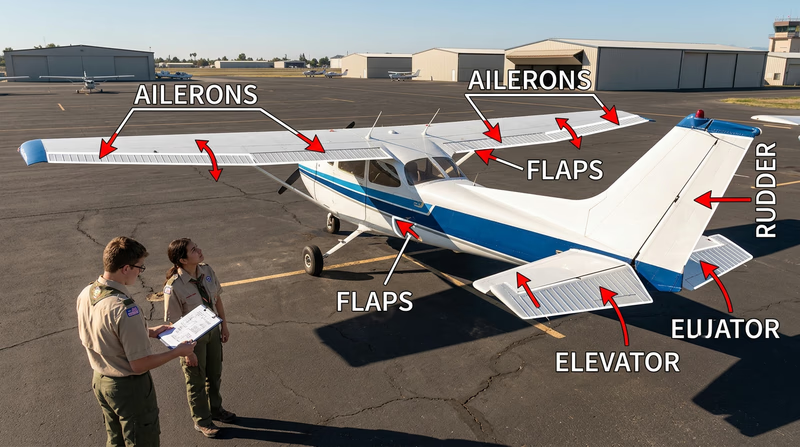
Ailerons are hinged panels on the trailing edge (back edge) of each wing, near the wing tips. They work in opposite directions: when the left aileron goes up, the right aileron goes down.
- The wing with the aileron deflected down generates more lift and rises.
- The wing with the aileron deflected up generates less lift and drops.
- The result: the airplane rolls (banks) in the direction the pilot wants to turn.
The pilot controls the ailerons with the control yoke (or stick) — turning it left rolls the airplane left; turning it right rolls the airplane right.
Elevator — Controls Pitch
The elevator is a hinged panel on the trailing edge of the horizontal stabilizer — the small horizontal “wing” at the tail of the airplane.
- When the pilot pulls back on the yoke, the elevator deflects up, which pushes the tail down and the nose up. The airplane pitches up and climbs.
- When the pilot pushes forward on the yoke, the elevator deflects down, which pushes the tail up and the nose down. The airplane pitches down and descends.
Some aircraft use a stabilator (also called an all-moving tail) instead of a separate elevator. The entire horizontal tail surface pivots as one piece.
Rudder — Controls Yaw
The rudder is a hinged panel on the trailing edge of the vertical stabilizer — the tall fin at the very back of the airplane.
- When the pilot pushes the left rudder pedal, the rudder swings to the left, and the nose yaws left.
- When the pilot pushes the right rudder pedal, the rudder swings to the right, and the nose yaws right.
The rudder is mainly used to coordinate turns (keeping the airplane from slipping sideways) and to keep the airplane straight during takeoff and landing. It is not the primary way to turn — that job belongs to the ailerons.
Secondary Control Surfaces
Beyond the three primary controls, most airplanes have additional surfaces that help with specific situations:
- Flaps: Located on the inboard (inner) trailing edge of the wings. Flaps extend downward to increase both lift and drag. Pilots use them during takeoff and landing to fly at slower speeds safely.
- Trim tabs: Small adjustable surfaces on the elevator (and sometimes the ailerons and rudder) that let the pilot fine-tune the control forces. Once trimmed, the pilot can fly with less physical effort on the yoke.
- Spoilers: Panels on the top surface of the wings that pop up to “spoil” (disrupt) the lift. Used to help descend quickly and to slow down after landing.
Control Surface Summary
How the pilot controls each axis
- Ailerons (on wings): Control roll — turning the yoke left or right banks the airplane.
- Elevator (on horizontal tail): Controls pitch — pulling the yoke back raises the nose; pushing forward lowers it.
- Rudder (on vertical tail): Controls yaw — left pedal swings nose left; right pedal swings nose right.
- Flaps (on inner wings): Increase lift and drag for slower flight during takeoff and landing.
- Trim tabs (on control surfaces): Fine-tune control pressure so the pilot does not have to hold constant force.