Req 1h — Flight Instruments
Step inside the cockpit of a single-engine airplane and you will see a panel full of dials, gauges, and displays. It can look overwhelming at first, but each instrument has a specific job. A pilot scans these instruments constantly to know exactly what the airplane is doing — even when they cannot see the ground or the horizon.
The “Six Pack” — Core Flight Instruments
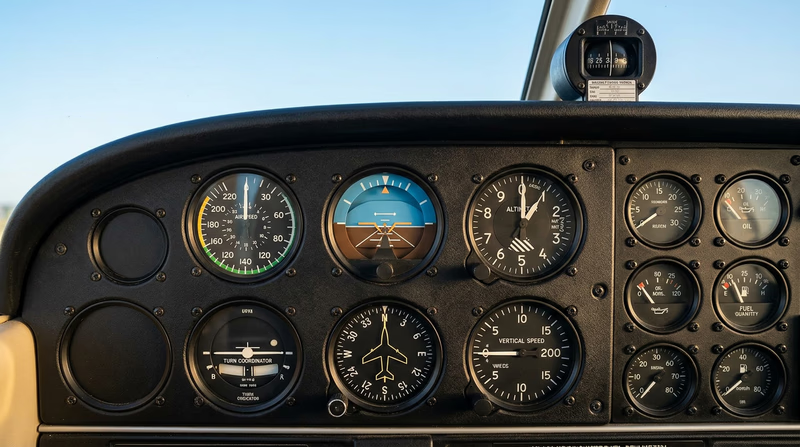
Most single-engine aircraft arrange six primary flight instruments in two rows of three, directly in front of the pilot. Pilots call this layout “the six pack.”
Attitude Indicator (Artificial Horizon)
The attitude indicator shows the airplane’s position relative to the horizon — is the nose pointed up, down, or level? Is the airplane banking left or right? It displays a miniature airplane symbol against a split background: blue on top (sky) and brown on bottom (ground).
This is the most important instrument for flying in clouds or at night when the pilot cannot see the real horizon.
Heading Indicator (Directional Gyro)
The heading indicator shows which compass direction the airplane is pointed — north, south, east, west, or anything in between. It uses a gyroscope to provide a stable, easy-to-read heading without the wobbling and errors that affect a magnetic compass.
Pilots periodically check the heading indicator against the magnetic compass and reset it if necessary, because gyroscopes can drift over time.
Altimeter
The altimeter tells the pilot how high the airplane is above sea level, measured in feet. It works by measuring air pressure — the higher you go, the lower the air pressure. The pilot sets a reference pressure (provided by air traffic control) to ensure the reading is accurate.
Airspeed Indicator
The airspeed indicator shows how fast the airplane is moving through the air, measured in knots (nautical miles per hour). It works by comparing the pressure of the air hitting the airplane head-on (ram air pressure) to the static air pressure around it.
The face of the airspeed indicator has color-coded arcs:
- Green arc: Normal operating range
- Yellow arc: Caution range — fly here only in smooth air
- White arc: Flap operating range
- Red line: Never-exceed speed — structural damage may occur beyond this point
Turn and Bank Indicator (Turn Coordinator)
The turn and bank indicator shows two things at once: the rate at which the airplane is turning, and whether the turn is coordinated (meaning the airplane is not slipping sideways through the air). It has a miniature airplane that tilts to show the turn direction and a ball in a curved tube that slides left or right if the turn is not balanced.
Pilots use the phrase “step on the ball” — if the ball slides left, press the left rudder pedal to center it.
Vertical Speed Indicator (VSI)
The vertical speed indicator shows whether the airplane is climbing, descending, or flying level, and how fast. It measures the rate of climb or descent in feet per minute. If the needle points to zero, the airplane is in level flight. Pointing up means climbing; pointing down means descending.
The Magnetic Compass
The magnetic compass is the simplest and most reliable navigation instrument in the cockpit. It is a magnetized needle (or card) floating in liquid that always points toward magnetic north. Unlike the heading indicator, it does not need electrical power or a gyroscope to work.
However, the compass has quirks. It wobbles during turns, it lags behind when accelerating or decelerating, and it can be affected by metals and electronics in the cockpit. That is why pilots use the heading indicator for moment-to-moment navigation and cross-check with the compass periodically.
Navigation Instruments
Navigation instruments help the pilot figure out where the airplane is and how to get where it is going:
- VOR (VHF Omnidirectional Range): Shows the airplane’s position relative to a ground-based radio beacon. The pilot tunes in a VOR station and the instrument shows whether the airplane is on course, left of course, or right of course.
- GPS (Global Positioning System): Modern aircraft use GPS receivers that show the airplane’s exact position on a moving map. GPS has largely replaced older radio-based navigation.
- ADF (Automatic Direction Finder): Points toward an AM radio beacon (NDB). Older technology, but still found in some aircraft.
Communication Equipment
A pilot’s radios are essential for safety:
- COM radio: Used to talk with air traffic control, other pilots, and airport ground services. Most aircraft have at least one VHF communication radio, tunable to specific frequencies.
- Transponder: Broadcasts the airplane’s identity and altitude to air traffic control radar. This is how controllers see airplanes on their screens.
Engine Performance Indicators
These gauges monitor the health and performance of the engine:
- Tachometer: Shows engine RPM (revolutions per minute) — how fast the engine is running.
- Oil pressure gauge: Indicates oil pressure. Low oil pressure is an emergency — the engine could seize.
- Oil temperature gauge: Shows engine oil temperature. Too hot means something is wrong.
- Fuel gauges: Show how much fuel remains in each tank.
- Exhaust gas temperature (EGT): Helps the pilot adjust the fuel-air mixture for efficient engine operation.
- Manifold pressure gauge: Shows the pressure of the fuel-air mixture entering the engine cylinders (on aircraft with constant-speed propellers).