Req 4 — Airport Operations
Airports are where aviation meets the ground. They are complex operations with strict rules designed to keep everyone safe — from the passengers in the terminal to the mechanics on the ramp to the controllers in the tower. For this requirement, you will choose one of the four visit options below and report on what you learned.
Option A: Visit an Airport
Visiting a general aviation airport (not just a big commercial terminal) is a great way to see the full scope of airport operations. Many small airports welcome visitors and some even have observation areas.
Key things to learn about:
How facilities are used:
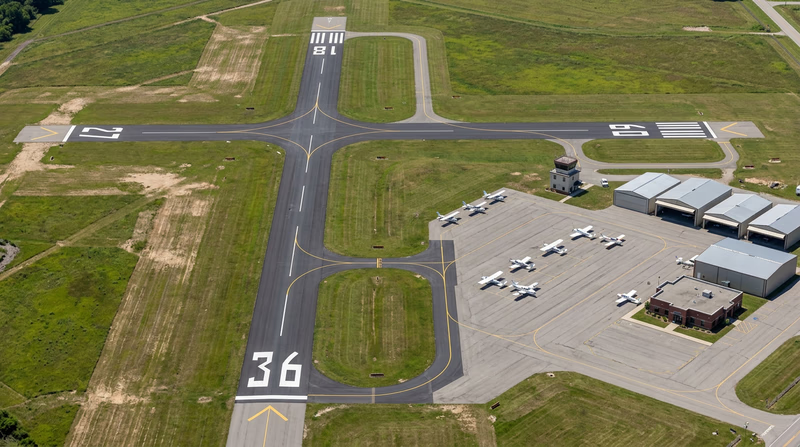
- Runway: The paved strip where aircraft take off and land.
- Taxiway: Paths connecting runways to hangars and ramps. Taxiways have yellow centerline markings; runways have white.
- Ramp (apron): The paved area where aircraft park, load passengers, and refuel.
- FBO (Fixed Base Operator): A business on the airport that provides fuel, parking, maintenance, and pilot services.
- Hangars: Enclosed buildings where aircraft are stored and maintained.
- Control tower: The tower from which air traffic controllers direct aircraft on the ground and in the air near the airport.
- AWOS/ASOS: Automated weather stations that broadcast current conditions to pilots.
How runways are numbered: Runways are numbered based on their magnetic heading, rounded to the nearest 10 degrees, with the last digit dropped. For example:
- A runway pointing due north (360°) is numbered 36.
- A runway pointing due east (090°) is numbered 09.
- A runway pointing due south (180°) is numbered 18.
Every runway has two numbers — one for each direction. Runway 36 and Runway 18 are the same strip of pavement, just approached from opposite ends.
How the “active” runway is determined: Pilots take off and land into the wind whenever possible, because headwind increases the aircraft’s airspeed relative to the ground, which means shorter takeoff rolls and slower landing speeds. The active runway is the one that points most directly into the current wind direction. At towered airports, controllers designate the active runway. At non-towered airports, pilots choose based on the wind.
Option B: Visit an FAA Facility
The FAA operates different types of facilities, each with a specific role in keeping the airspace safe:
- ATCT (Airport Traffic Control Tower): Controllers here manage aircraft on the ground (taxiing) and in the air within about 5 miles of the airport and up to about 3,000 feet. They give takeoff and landing clearances and sequence arriving and departing traffic.
- TRACON (Terminal Radar Approach Control): Controllers manage aircraft within roughly 30–50 miles of a major airport, using radar to guide aircraft toward the runway for landing or out of the airport area after takeoff.
- ARTCC (Air Route Traffic Control Center): These centers manage aircraft flying at high altitudes across large regions of the country. There are 20 ARTCCs in the United States, and together they cover all the airspace.
- FSDO (Flight Standards District Office): FSDOs handle pilot certification, aircraft registration, accident investigation, and regulatory enforcement. This is where pilots go for check rides and where inspectors work.
Option C: Visit a Military Aviation Facility
Military bases with aviation units — Air Force bases, Naval Air Stations, Army airfields, and Coast Guard air stations — offer a unique perspective on how aviation serves national defense and public safety.
How to arrange a visit:
- Many military bases host open houses and air shows that allow public access.
- Some bases offer guided tours for educational groups like Scout units. Contact the base’s Public Affairs Office well in advance.
- Coast Guard air stations often have community engagement programs and may be more accessible than larger military facilities.
Things to learn about:
- What types of aircraft are based there and what missions they fly
- How military aviation supports civilian needs (search and rescue, disaster relief, medical evacuation)
- How military air traffic control coordinates with civilian ATC
- Career paths for military aviators and support personnel
Option D: Visit an Aviation Museum or Air Show
Aviation museums and air shows bring the history and excitement of flight to life in ways that textbooks cannot.
Notable aviation museums worth visiting:
- Smithsonian National Air and Space Museum (Washington, DC) — Home to the Wright Flyer, the Spirit of St. Louis, and the Apollo 11 command module.
- National Museum of the United States Air Force (Dayton, Ohio) — The world’s largest and oldest military aviation museum.
- Museum of Flight (Seattle, Washington) — Includes the original Boeing factory and dozens of historic aircraft.
- Pima Air & Space Museum (Tucson, Arizona) — Over 400 aircraft on display, plus tours of the nearby AMARG “boneyard.”
Many smaller cities have regional aviation museums with hands-on exhibits, cockpit simulators, and volunteer docents who are retired pilots.
At an air show: Watch for different types of aircraft in action — aerobatic teams, warbird flyovers, military demonstrations, and static displays. Pay attention to how aircraft sound, how they maneuver, and how different designs perform different roles.
Smithsonian National Air and Space Museum Explore the world's largest collection of historic air and spacecraft, including the Wright Flyer and Apollo 11. EAA AirVenture Oshkosh The world's largest annual aviation gathering, held every summer in Oshkosh, Wisconsin. Features air shows, exhibits, and thousands of aircraft.