Req 5c — Advanced Certificates
These three certificates represent the upper tiers of pilot certification. Each one opens new doors — from getting paid to fly, to commanding an airliner, to teaching the next generation of pilots.
Commercial Pilot Certificate
The commercial pilot certificate is the first certificate that allows a pilot to fly for money. A private pilot can share expenses with passengers, but a commercial pilot can actually be hired to fly.
Key facts:
- Minimum age: 18 years old
- Flight time required: 250 hours minimum (including time in specific categories like cross-country, night, and instrument flight)
- Prerequisites: Private pilot certificate and instrument rating
- Exams: Written knowledge test and a practical test (check ride) with higher performance standards than the private pilot check ride
- Medical certificate: Requires at least a Second Class medical certificate (more rigorous than the Third Class required for private pilots)
What a commercial pilot can do:
- Fly charter flights
- Tow banners and gliders
- Conduct aerial photography and surveying
- Fly air tours
- Serve as a copilot for a regional airline (with the right type ratings)
- Fly cargo
What a commercial pilot cannot do (yet):
- Serve as pilot-in-command (captain) of a scheduled airline flight — that requires the ATP certificate
Airline Transport Pilot Certificate (ATP)
The airline transport pilot certificate is the highest level of pilot certification. If the commercial certificate is a driver’s license, the ATP is a CDL for the sky. An ATP is required to serve as the captain (pilot-in-command) of a scheduled airline.
Key facts:
- Minimum age: 23 years old (21 for restricted ATP under certain military or collegiate programs)
- Flight time required: 1,500 hours minimum (1,000 for military pilots; 1,250 for graduates of approved aviation degree programs)
- Prerequisites: Commercial pilot certificate with instrument rating
- Exams: ATP written knowledge test and a rigorous practical test
- Medical certificate: First Class medical certificate (the most stringent — includes EKG screening for pilots over 40)
What an ATP pilot can do:
- Serve as captain of any scheduled airline flight
- Fly for major airlines (Delta, United, American, Southwest, etc.)
- Command international flights carrying hundreds of passengers
Certified Flight Instructor (CFI)
A Certified Flight Instructor is a pilot who is authorized to teach others to fly. The CFI certificate is not higher than the commercial or ATP — it is a separate authorization that allows a pilot to provide flight instruction and sign off student pilots for solo flights, check rides, and endorsements.
Key facts:
- Minimum age: 18 years old
- Prerequisites: Commercial pilot certificate (or ATP); instrument rating is required for CFII (Certified Flight Instructor — Instrument)
- Exams: Written knowledge test on the fundamentals of instruction (FOI) and a practical test where the applicant demonstrates the ability to teach
- What makes the CFI unique: The practical test is not just about flying well — it is about explaining what you are doing and teaching the examiner as if they were a student
Why become a CFI?
- Build hours: Most aspiring airline pilots become CFIs to accumulate the flight hours needed for an ATP certificate. Teaching is one of the best ways to log hours while getting paid.
- Give back: Many pilots become instructors because they love sharing their passion for flight. The CFI who taught you is the reason you know how to fly.
- Stay sharp: Teaching forces you to understand aviation concepts deeply. If you can explain a stall recovery to a nervous student, you truly understand it.
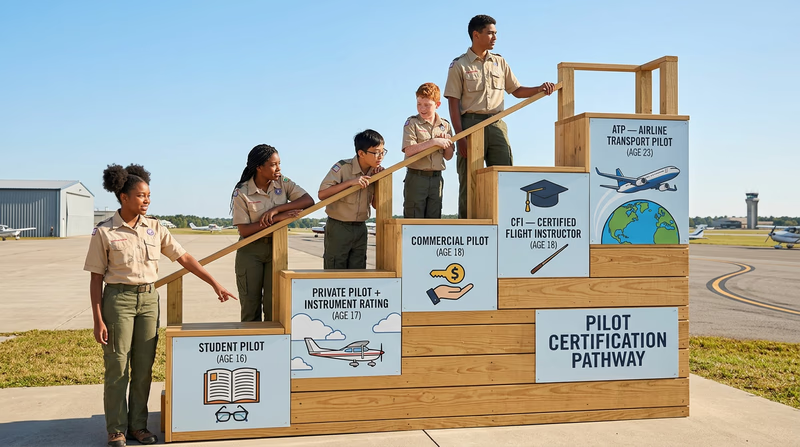
The Certification Ladder
Here is how the certificates typically build on each other:
- Student Pilot → Learn to fly, solo
- Private Pilot + Instrument Rating → Fly for personal use in most conditions
- Commercial Pilot → Fly for pay
- CFI → Teach others and build hours
- ATP → Captain an airliner