Req 5e — Aviation Careers
Aviation is not just about pilots. Thousands of careers keep aircraft flying safely, and many of them do not involve sitting in a cockpit at all. This requirement asks you to explore three of those careers, then take a deep dive into one.
Career Categories in Aviation
Here are several career areas to consider. Pick three that interest you and then research one in depth.
Airline Pilot
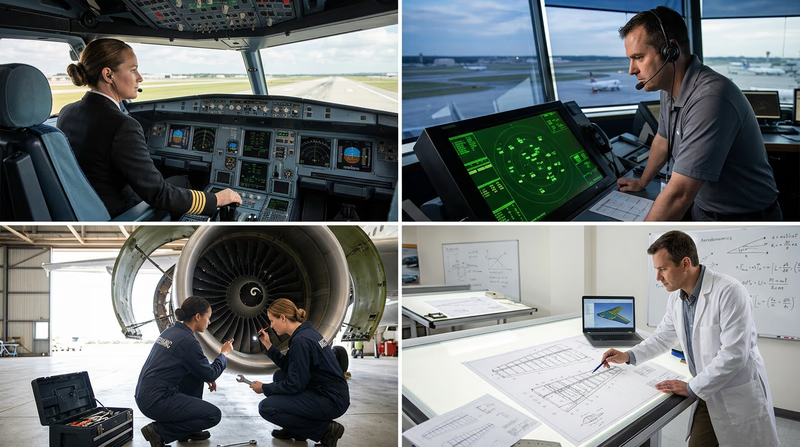
Airline pilots fly commercial aircraft for passenger and cargo airlines. They progress from first officer (copilot) to captain over several years.
- Education: Many airlines prefer a bachelor’s degree (any field), though it is not always required
- Certification: ATP certificate, instrument rating, type rating for specific aircraft
- Experience: 1,500 hours minimum for ATP; most successful applicants have 2,000–5,000+ hours
- Starting salary: $50,000–$90,000 as a first officer at a regional airline; major airline captains can earn $200,000–$400,000+
- Outlook: Strong demand — the aviation industry is experiencing a global pilot shortage
Air Traffic Controller
Air traffic controllers manage the flow of aircraft in the sky and on the ground, keeping everyone safely separated.
- Education: Bachelor’s degree or 3 years of work experience (or a combination), or graduation from an FAA-approved Collegiate Training Initiative (CTI) program
- Training: FAA Academy in Oklahoma City (2–5 months), followed by on-the-job training at a facility (1–3 years)
- Starting salary: $45,000–$60,000 during training; experienced controllers earn $100,000–$180,000+
- Age limit: Must begin training before age 31
- Outlook: Competitive but steady demand, with retirements creating openings
Aircraft Mechanic (A&P Technician)
Airframe and Powerplant (A&P) mechanics inspect, maintain, and repair aircraft. Nothing flies unless a mechanic signs it off as airworthy.
- Education: Graduate from an FAA-approved aviation maintenance technician school (18–24 months) or gain experience through military service
- Certification: FAA A&P certificate (two written exams and a practical test)
- Starting salary: $45,000–$55,000; experienced mechanics at major airlines earn $80,000–$100,000+
- Outlook: Strong demand — there is a shortage of qualified mechanics, and the fleet of aircraft keeps growing
Aerospace Engineer
Aerospace engineers design and develop aircraft, spacecraft, satellites, and missiles. They work on everything from wing design to avionics systems to propulsion.
- Education: Bachelor’s degree in aerospace engineering, mechanical engineering, or a related field (4 years); many positions prefer a master’s degree
- Certification: Engineers can earn a Professional Engineer (PE) license, though it is not always required
- Starting salary: $70,000–$85,000; senior engineers earn $120,000–$160,000+
- Outlook: Steady demand, especially in defense, commercial aviation, and the growing space industry
Drone (UAS) Operator
Professional drone operators fly unmanned aircraft for commercial, government, and military applications.
- Education: Varies — some employers require a degree in aviation, geomatics, or a technical field; others prioritize experience and certification
- Certification: FAA Part 107 remote pilot certificate; specialized training for specific industries (thermography, LiDAR, photogrammetry)
- Starting salary: $40,000–$60,000; specialized operators (power line inspection, surveying, cinematography) can earn $80,000–$120,000+
- Outlook: Rapidly growing field with expanding applications
Aviation Meteorologist
Aviation meteorologists analyze weather patterns and provide forecasts specifically for pilots and air traffic operations.
- Education: Bachelor’s degree in meteorology or atmospheric science
- Certification: Some positions require FAA or National Weather Service certification
- Starting salary: $50,000–$65,000; experienced meteorologists at the FAA or airlines earn $80,000–$100,000+
- Outlook: Stable demand, with increasing use of data science and AI in forecasting
How to Research Your Chosen Career
When you pick one career to research in depth, here is a framework to organize your findings:
Career Research Framework
What to investigate and discuss with your counselor
- Training path: What specific education and training programs lead to this career?
- Certification: What licenses, certificates, or ratings are required?
- Experience: How many years or hours of experience are needed to get started?
- Expenses: What will the education, training, and certification cost? Are scholarships or financial aid available?
- Employment prospects: Is demand growing, stable, or shrinking? Where are the jobs located?
- Starting salary: What can you expect to earn in your first position?
- Advancement: What does the career ladder look like? Where can you be in 5, 10, or 20 years?
- Lifestyle: What are the working hours, travel requirements, and work-life balance like?